
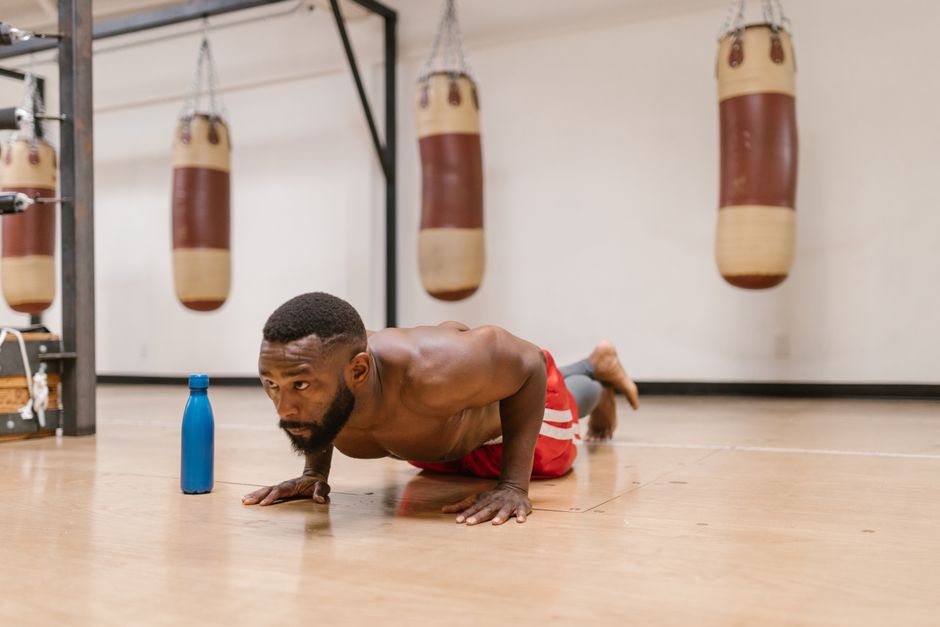
Push ups are one of the most studied exercises in sports science, and for good reason. A push up is a moving plank that loads your chest, shoulders, triceps, and core at the same time. It builds upper body pushing strength, trains your core to resist sagging, and raises your heart rate enough to count as cardiovascular work when done in sets. It also requires no equipment and scales from beginner to advanced by changing your body angle.
What Muscles Do Push Ups Work?
The push up is primarily a chest, shoulder, and triceps exercise. The American Council on Exercise has ranked it among the top exercises for targeting the pectoralis major, and that finding has held up in repeated testing. But the muscle list is longer than most people expect.
The main movers are the pectoralis major (your chest), the anterior deltoid (front of the shoulder), and the triceps (back of the upper arm). These three do the pushing. Everything else is working to keep you from collapsing.
Your core is the quiet partner here. The rectus abdominis, obliques, and transverse abdominis all fire to hold your spine in a straight line. Research using electromyography — the technique that measures electrical activity in muscle — has found that a standard push up produces core activation comparable to a plank. That is not a small detail. It means you are training two things at once.
Other muscles join in as stabilizers:
- Glutes and quadriceps, which keep your hips from dropping
- Serratus anterior, which helps your shoulder blade move correctly
- Upper back muscles, which hold your shoulder blades in position
- Rotator cuff muscles, which stabilize the shoulder joint
Some research also suggests push ups may activate the serratus anterior more effectively than the bench press. That matters because the serratus anterior helps control shoulder blade movement, and poor control there is linked to shoulder problems over time.
What Do Push Ups Do for Your Strength and Body?
Push ups build functional pushing strength. That means the kind of strength you use to push a heavy door, get up off the floor, or catch yourself if you trip. This is different from the strength you build on a machine that isolates one muscle.
Progressive overload is how any strength gain happens. You have to gradually ask more of the muscle than it is used to. With push ups, you can do that in several ways: add reps, slow the tempo, elevate your feet, or move to a harder variation like archers or one-arm progressions. You do not need added weight to keep improving, though some people eventually use a weighted vest.
One thing push ups will not do is build your chest the way heavy bench pressing can. The load is limited by your body weight and your position. If your goal is maximum chest size, push ups alone may not get you there. If your goal is strength you can use, endurance, and a strong core, they are hard to beat for the time invested.
Push ups also improve muscular endurance. That is the ability to keep working without fatiguing. This matters more as you age, because endurance in the upper body is tied to daily function — carrying groceries, pushing a stroller, lifting yourself out of a chair.
Are Push Ups Good Cardio?
Push ups can raise your heart rate, but they are not a substitute for dedicated cardio. Done in fast sets with short rest, they push your heart rate into a moderate range. Done slowly with long rests, they barely move it.
Some research has looked at push up capacity as a marker of overall cardiovascular fitness. A frequently cited study followed male firefighters and found that those who could complete more push ups in a set tended to have lower rates of cardiovascular events over the follow-up period. That does not prove push ups prevent heart disease. It suggests that push up capacity is a rough proxy for general fitness, and general fitness is linked to heart health.
If cardiovascular fitness is your goal, treat push ups as a supplement to walking, running, cycling, or swimming — not a replacement. The heart responds best to sustained rhythmic activity, and push ups are short bursts by nature.





How Do Push Ups Compare to Bench Press and Other Exercises?
The bench press lets you load heavier, which is why it builds more raw strength and muscle size. The push up keeps your shoulder blades free to move, which is closer to how your shoulder works in real life. Both have value, and they are not really in competition.
Here is a rough comparison of what each does well:
| Exercise | Best For | Core Demand | Equipment |
|---|---|---|---|
| Push up | Core stability, shoulder control, endurance | High | None |
| Bench press | Maximal chest and triceps strength | Low | Bench and barbell |
| Dumbbell press | Balanced strength, single-arm work | Low to moderate | Dumbbells |
| Plank | Core endurance | Very high | None |
One comparison worth noting: the bench press pins your shoulder blades against a bench, which limits how much the serratus anterior can work. The push up lets them glide, so the stabilizing muscles around the shoulder get more practice. For shoulder health, that is often a point in the push up’s favor.
Can Push Ups Cause Injury?
Push ups are generally low risk, but poor form can cause problems. The most common issues are wrist pain, shoulder pain, and lower back strain.
Wrist pain usually comes from the angle of the hand. If your wrists hurt, try push up handles or dumbbells, or do them on fists. Shoulder pain often traces back to flared elbows — when your elbows point straight out to the sides instead of back at an angle. Keeping elbows closer to your body, at about 45 degrees from your torso, reduces strain on the shoulder joint.
Lower back strain comes from letting your hips sag. If you feel it in your back, your core has given out before your arms have. Stop the set, or drop to your knees and keep the line straight.
If you have an existing shoulder injury, wrist problem, or back condition, talk to a clinician before starting. No exercise is universally safe, and push ups load the shoulder joint directly.
How Do You Make Push Ups Easier or Harder?
Changing your body angle changes the difficulty. This is the simplest lever you have.
To make them easier, raise your hands. Push ups against a wall are the easiest. A kitchen counter is next. A bench or step is harder but still easier than the floor. Knee push ups also reduce load, though they change the core demand.
To make them harder, raise your feet. Elevating your feet shifts more of your body weight onto your arms and shoulders. Decline push ups, archer push ups, and eventually one-arm progressions are the standard steps up.
Other ways to add difficulty without changing the position:
- Slow the lowering phase to three or four seconds
- Pause at the bottom for a beat
- Add a shoulder tap at the top of each rep
- Increase total reps or reduce rest between sets
For most people, doing push ups three times a week with a day of rest between sessions is a reasonable starting point. That is general training guidance, not a fixed rule. Listen to your body and adjust.
How Many Push Ups Should You Be Able to Do?
There is no single number that defines fitness. Push up capacity varies widely by age, sex, and training background. The American College of Sports Medicine publishes push up norms by age and sex, and those tables are the closest thing to a standard reference.
What matters more than a raw number is whether you are improving. If you could do ten last month and you can do fifteen now, you are getting stronger. If your number has not moved in months, you likely need to change something — more reps, a harder variation, or more rest.
One caution: a high push up count does not guarantee good form. It is common to see people crank out reps with sagging hips or half-range motion. Those reps build less strength and carry more injury risk. Fewer clean reps beat more sloppy ones.
Frequently Asked Questions
What do push ups do for your body?
They build strength in your chest, shoulders, triceps, and core while also improving muscular endurance. Done in fast sets, they can raise your heart rate enough to add a light cardio effect.
Do push ups build muscle?
Yes, they build muscle in the chest, shoulders, triceps, and core, especially for beginners. For maximum muscle size, heavier loading like bench press is generally more effective because it allows greater resistance.
How many push ups a day is good?
There is no single recommended number, and it depends on your current fitness and goals. Training three times a week with rest days between sessions is a common approach that supports recovery.
Can push ups replace the gym?
No, push ups alone cannot replace a full training program because they only train pushing movements. A complete routine also needs pulling, legs, and cardiovascular work.
