
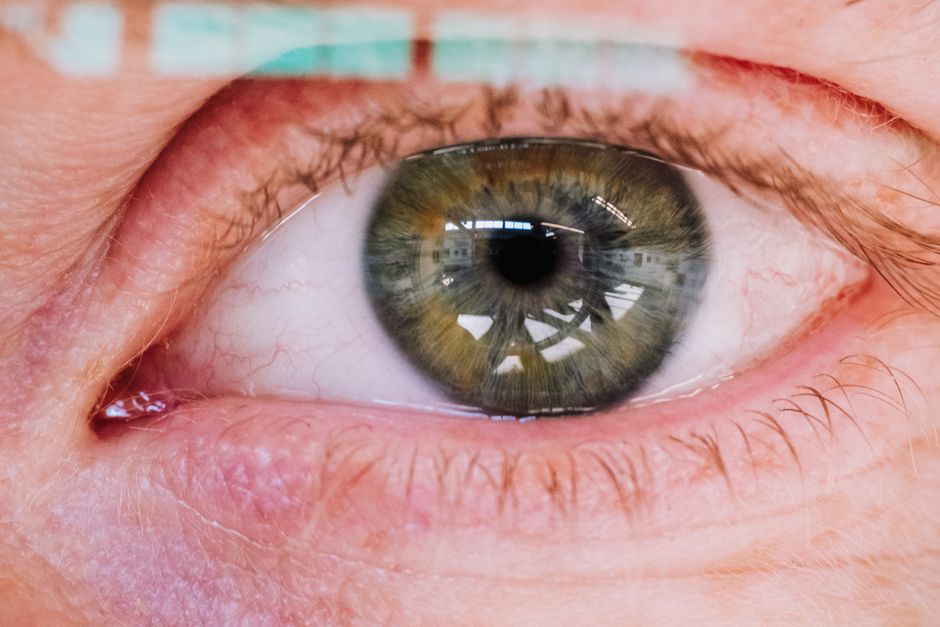
Closing your eyes does not simply make the world go black. Inside your eyelids, your eyes are still active, moving, and responding to light and pressure. What you actually see with your eyes closed depends on several factors, including how much light passes through your eyelids, the natural activity of your retina, and the pressure your eyelids place on your eyeballs. For most people, the experience is not pure darkness but a shifting field of colors, patterns, and shapes known as phosphenes.
What Do Our Eyes Look Like When Their Closed?
From the outside, closed eyes look like relaxed eyelids covering the eyeballs. The upper lid rests against the lower lid, and the eye itself rolls upward slightly in a natural resting position. This is a normal reflex called Bell’s phenomenon. The muscles around the eye relax, though they do not fully go limp. The pupils remain responsive beneath the lids, and the eyes continue to produce tears to keep the surface moist.
Inside, the eyes are far from inactive. The retina keeps sending signals to the brain even without light entering the eye. The brain interprets these signals as visual information, which is why you see colors and shapes rather than pure black. This internal visual activity is completely normal and happens every time you close your eyes.
Why Do You See Colors and Patterns When Your Eyes Are Closed?
The colors and patterns you see with closed eyes are called phosphenes. Phosphenes are visual sensations that occur without light actually entering the eye. They can be triggered by pressure on the eyeball, by the retina’s own spontaneous activity, or by the brain’s visual cortex firing on its own.
When you rub your eyes, you see bright flashes and geometric patterns. This happens because mechanical pressure stimulates the retina. The retina interprets any stimulation as light, so pressure creates the illusion of bright shapes. These pressure phosphenes are harmless and temporary. They fade within seconds after you stop rubbing.
Even without pressure, the retina generates its own background noise. Cells in the retina fire randomly, and the brain tries to make sense of those signals. The result is a slowly shifting field of grainy colors, often described as visual static or white noise. This is similar to the static you see on an old television that is not tuned to a channel.
Does Light Get Through Closed Eyelids?
Yes, light passes through your eyelids, though not much. The eyelids are thin, and they contain blood vessels that filter some wavelengths of light. Red and orange light penetrates most easily. This is why holding a flashlight against your closed eyelid produces a red or orange glow rather than white light.
The amount of light that reaches the retina through closed lids varies from person to person. People with thinner eyelids or lighter skin may perceive more light. People with thicker eyelids or darker skin may perceive less. This is also why closing your eyes does not fully block the sensation of a bright room. You can often tell whether a light is on or off just by closing your eyes and facing the source.
Your pupils also react to light even when your eyes are closed. If a bright light shines on your closed lids, your pupils constrict. This reflex works through the same neural pathways as the pupillary light reflex with open eyes. It is an automatic response that does not require conscious effort.





What Are the Floating Shapes and Shadows You See?
Some of what you see with closed eyes comes from inside the eye itself. The vitreous humor, a clear gel that fills the eyeball, contains tiny fibers and cells. These cast shadows on the retina as they drift. You perceive these shadows as floating specks, threads, or cobweb-like shapes. These are called floaters.
Floaters are more visible against a bright background, including the reddish glow you see through closed eyelids. They are usually harmless and become more noticeable with age as the vitreous gel becomes more liquid. Most people have a few floaters, and they rarely indicate a problem.
A sudden increase in floaters, especially when accompanied by flashes of light, can signal a retinal tear or detachment. This is a medical emergency that requires prompt evaluation. If you notice a shower of new floaters or persistent flashing lights, seek care from an eye doctor immediately.
Why Do Some People See Intricate Patterns When Meditating or Falling Asleep?
As you drift toward sleep, your brain enters a state where visual hallucinations are common. These are called hypnagogic hallucinations. They occur in the transition between wakefulness and sleep. People report seeing geometric patterns, faces, landscapes, or abstract scenes. These images come from the brain’s visual cortex, not from the eyes themselves.
Hypnagogic imagery is normal and occurs in a large portion of the population. The images are usually brief and fragmentary. They can be vivid but are not a sign of mental illness or eye disease. The same brain activity can produce similar imagery during meditation, especially in deep relaxation states where external sensory input is reduced.
The patterns people describe often resemble the geometric forms seen in migraine auras or after taking certain medications. This suggests a shared neurological mechanism. The visual cortex has its own intrinsic rhythms, and when external input drops away, those internal patterns become visible.
Do Blind People See the Same Thing With Their Eyes Closed?
The answer depends on the type of blindness. People who lost their vision later in life often report seeing phosphenes and other visual phenomena with their eyes closed. Their visual cortex remains active even though their eyes do not send it light information. The brain continues to generate internal visual signals.
People who were born blind or lost vision very early in life do not see phosphenes in the same way. Their visual cortex never developed the same neural connections. They may still experience visual sensations during dreams, but these are based on other sensory information such as touch and sound rather than actual visual imagery.
Some people who are legally blind retain partial light perception. They can distinguish bright from dark even through closed eyelids. This means their experience of closed-eye vision falls somewhere between full sight and complete blindness. Each person’s experience is unique and depends on the specific cause and timing of their vision loss.
When Should Closed-Eye Visuals Concern You?
Most closed-eye visuals are normal and harmless. Brief flashes when rubbing your eyes, drifting floaters, and shifting colors are all routine. However, certain patterns warrant medical attention.
Persistent flashes of light that occur without pressure on the eye can indicate retinal traction or detachment. These flashes often appear in the peripheral vision and may look like lightning or camera flashes. They do not disappear when you open your eyes. This symptom requires urgent evaluation.
Visual hallucinations that persist after waking or occur during the day can have other causes. Some medications produce visual side effects. Migraine aura can cause geometric patterns or zigzag lines even without a headache. Certain neurological conditions can also produce persistent visual phenomena. If closed-eye visuals are new, persistent, or accompanied by other symptoms, discuss them with a doctor.
Frequently Asked Questions
Is it normal to see colors when your eyes are closed?
Yes, seeing colors with closed eyes is normal and results from the retina and brain generating visual signals without light input.
Why do I see patterns when I rub my eyes?
Rubbing applies pressure to the eyeball, which stimulates the retina and creates bright geometric patterns called phosphenes.
Can light really pass through closed eyelids?
Yes, some light penetrates the eyelids, especially red and orange wavelengths, which is why closed eyes still perceive brightness.
When should I worry about what I see with my eyes closed?
Seek medical attention if you experience sudden flashes of light without pressure, a shower of new floaters, or persistent visual hallucinations.
