
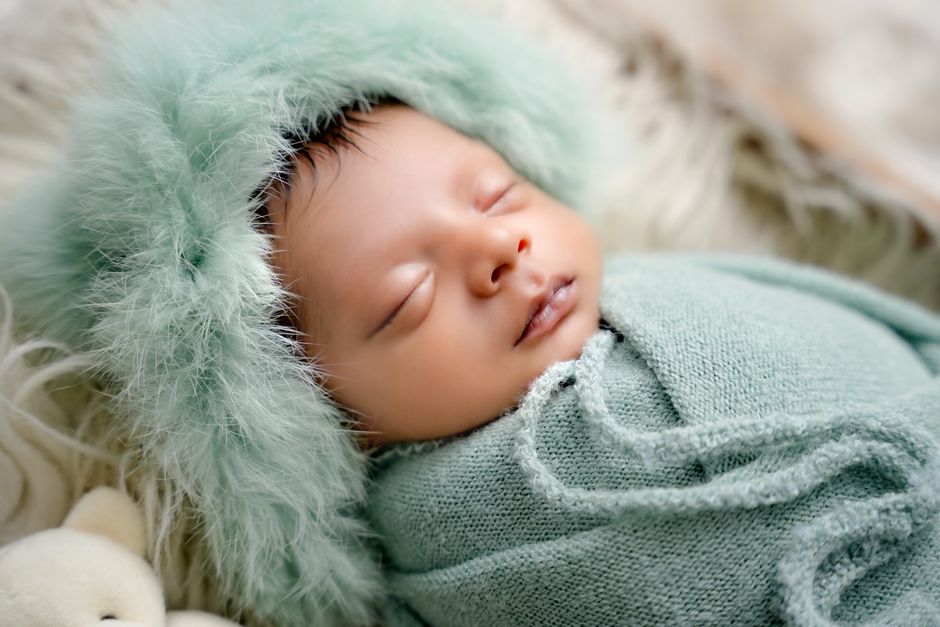
Newborns sleep in a separate, flat sleep space with a firm mattress and a fitted sheet — most often a crib, bassinet, or play yard that meets current safety standards. The American Academy of Pediatrics recommends that infants sleep in the same room as their parents, but on a separate surface, for at least the first six months. That surface should be bare. No pillows, no blankets, no bumpers, no stuffed animals.
That is the short answer. The longer answer involves understanding why those rules exist, how infant sleep actually works, and what to do when your baby refuses to sleep anywhere except your arms.
What Is the Safest Sleep Surface for a Newborn?
A firm, flat surface with a tight-fitting sheet is the safest place for a baby to sleep. This is one of the most consistent findings in pediatric research.
Safety standards for infant sleep products are set by the Consumer Product Safety Commission and tested through ASTM International. Products that meet these standards are labeled as compliant. If a sleep product does not carry that label, it has not been verified to meet current safety requirements.
Firmness matters more than most parents realize. A surface is firm enough if it does not indent when your baby lies on it. Adult mattresses, memory foam, and pillow-top surfaces are too soft. A baby can sink into a soft surface, which can block their airway.
Here is what a safe sleep space includes:
- A flat, firm mattress or pad
- A fitted sheet designed for that specific mattress
- Nothing else — no blankets, pillows, bumper pads, or toys
- A product that meets current CPSC and ASTM safety standards
Here is what it does not include:
- Inclined sleepers or rockers
- Car seats, swings, or bouncers used for routine sleep
- Any product with soft sides or padded surfaces
- Sleep positioners of any kind
Inclined sleepers deserve special mention. Several were recalled after being linked to infant deaths. The Safe Sleep for Babies Act, signed into law in 2022, banned the manufacture and sale of inclined sleepers and crib bumpers in the United States. If you have one, stop using it.
Why Does the AAP Recommend Room-Sharing?
Room-sharing — keeping your baby’s sleep space in your room, close to your bed — is associated with a lower risk of sleep-related infant death. The AAP recommends this for at least the first six months, and ideally up to one year.
The evidence for room-sharing comes largely from observational studies, which cannot prove cause and effect. But the association is consistent across multiple large studies, and the mechanism is plausible: a parent nearby can respond to distress, and the baby’s breathing and arousal patterns may be affected by the parent’s presence.
Room-sharing is not the same as bed-sharing. The AAP recommends against bed-sharing in most circumstances because it is associated with an increased risk of sleep-related death, particularly for infants under 4 months old.
Some parents choose bed-sharing despite the guidance, often because it is the only way anyone gets sleep. If you are in that situation, the most useful thing you can do is talk honestly with your pediatrician about your specific circumstances. They can help you understand the risks and reduce them where possible.
There are situations where bed-sharing is especially dangerous. These include:
- If the adult has consumed alcohol or drugs
- If the adult is a smoker
- If the baby was born prematurely or with low birth weight
- If the sleep surface is soft, such as a waterbed or couch
What About Bassinets, Cribs, and Play Yards?
All three can be safe sleep spaces if they meet current safety standards. The right choice depends on your living situation, budget, and how long you want the product to last.
A bassinet is small and portable, which makes it convenient for room-sharing. Most bassinets have weight limits — often around 15 to 20 pounds — and some have age limits as well. Once your baby can roll over or push up, a bassinet may no longer be safe. Check the specific product’s instructions.
A crib is the standard for infant sleep and typically lasts until your child is ready for a toddler bed. Full-size cribs must meet federal safety standards, including requirements for slat spacing, mattress fit, and structural integrity. Drop-side cribs were banned in 2011 because of safety concerns.
A play yard, sometimes called a pack-and-play, can serve as a sleep space if it has a bassinet attachment or a flat sleep surface designed for sleep. Not all play yards are rated for unsupervised sleep. Check the manufacturer’s instructions carefully.





What Should a Newborn Wear to Sleep?
A onesie or sleep sack is enough for most newborns in a room kept at a comfortable temperature. Overheating is a risk factor for sleep-related death, so it is better to err on the side of too little clothing than too much.
A common guideline is to dress your baby in one more layer than you would wear to be comfortable in the same room. If you are comfortable in a t-shirt, your baby may be comfortable in a onesie plus a light sleep sack.
Signs that your baby may be too warm include:
- Flushed cheeks
- Sweating
- Hot to the touch on the chest or back
- Rapid breathing
Sleep sacks are a safer alternative to blankets because they cannot cover a baby’s face. Weighted sleep sacks and weighted blankets are not recommended for infants. The evidence for their safety and effectiveness is limited, and they carry a risk of restricting movement or breathing.
Why Do Newborns Wake So Often?
Newborn sleep is fundamentally different from adult sleep. Babies spend roughly half their sleep time in active sleep, which is similar to REM sleep in adults. They cycle between sleep states more frequently than adults do, and their sleep cycles are shorter.
This is not a flaw. It is normal infant physiology. Frequent waking is protective — it allows a baby to signal hunger, discomfort, or danger. A newborn’s stomach is small, and they need to feed often, typically every two to three hours in the early weeks.
Newborns also have not yet developed a circadian rhythm. Their bodies do not distinguish between day and night until they are a few months old. This is why they sleep in short stretches around the clock.
By around 3 to 4 months, many babies begin to consolidate sleep into longer stretches at night. But there is wide variation. Some babies sleep through the night by 6 months. Others do not until much later. Both can be normal.
What If My Baby Will Only Sleep in My Arms?
This is one of the most common challenges new parents face. It is also one of the most exhausting.
Contact sleeping — holding your baby while they sleep — is not inherently unsafe if you are awake and alert. The risk comes when a parent falls asleep while holding the baby, especially on a couch or soft chair. That combination is associated with a significantly increased risk of sleep-related death.
If your baby will only sleep in your arms, try these strategies:
- Wait until your baby is deeply asleep before transferring them to a safe surface. Look for limp limbs and slow, regular breathing.
- Warm the sleep surface slightly before putting your baby down. A cold sheet can startle them awake.
- Keep your hand on your baby’s chest for a minute after laying them down.
- Try a swaddle for babies who are not yet rolling over. Swaddling can reduce the startle reflex that wakes them.
Once your baby shows signs of rolling, swaddling should stop. A swaddled baby who rolls onto their stomach may not be able to roll back, which increases risk.
If you are so exhausted that you fear falling asleep while holding your baby, that is a signal to ask for help. A partner, family member, or friend can take a shift. If you do not have that support, talk to your pediatrician. They may have resources or suggestions you have not considered.
Sleep deprivation in new parents is a real health concern. It affects mood, decision-making, and physical health. Asking for help is not a failure. It is a safety measure.
When Should You Talk to Your Pediatrician?
Most newborn sleep patterns are normal, even when they feel impossible. But some signs warrant a call to your pediatrician.
Talk to your doctor if your baby:
- Is extremely difficult to wake for feedings
- Has long pauses in breathing during sleep
- Seems to be in pain or discomfort that disrupts sleep
- Has a dramatic change in sleep patterns that concerns you
You should also talk to your pediatrician if you are struggling with your own sleep deprivation or mental health. Postpartum mood disorders are common and treatable. You do not have to manage alone.
Frequently Asked Questions
Can a newborn sleep in a car seat?
Car seats are designed for travel, not routine sleep. If your baby falls asleep in the car seat during a drive, transfer them to a flat surface as soon as you arrive.
Should I use a pillow or blanket in the crib?
No. Pillows, blankets, and other soft items should not be placed in a newborn’s sleep space because they increase the risk of sleep-related death.
How long should a newborn sleep at a time?
Newborns typically sleep in stretches of two to four hours, waking to feed. There is wide normal variation, and some babies sleep longer or shorter stretches.
Is it safe to let a newborn sleep on their stomach?
No. The AAP recommends placing babies on their back for every sleep until they can roll over on their own.
