
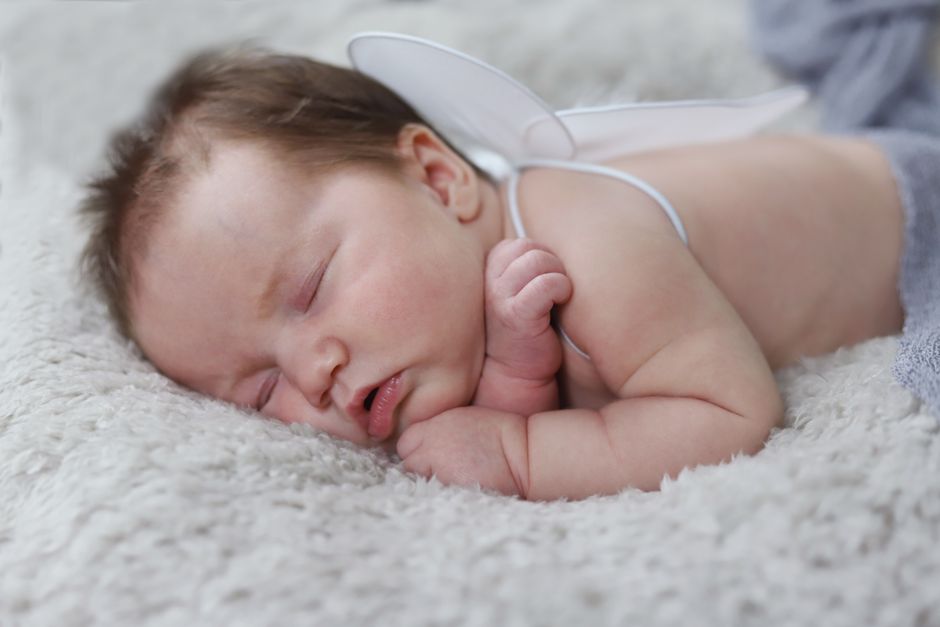
No one knows. Nobody can ask a newborn what they saw while sleeping, and they cannot tell us. That single fact shapes everything researchers can honestly say about newborn dreams. What we do know is that newborns spend roughly half their sleep in a stage called active sleep, which looks a lot like the REM stage where adults report vivid dreaming. Whether a two-week-old brain builds anything like a dream story during that stage is still an open question.
What Do Newborn Dream About?
The most accurate answer is that we do not know, and any confident claim otherwise is speculation. Newborns cannot report dreams, and no method currently exists to read a dream from a baby’s brain.
That said, the question is not unreasonable. Newborns spend a striking amount of time in a sleep stage that resembles the stage where adults dream most. Researchers have studied this stage closely for decades. What they have not been able to do is confirm what, if anything, is happening in a baby’s mind during it.
So the honest position sits between two extremes. It is not true that science has proven newborns dream about milk or faces or warmth. It is also not true that we have proven they do not dream at all. The evidence points to a brain that is active during sleep in ways we do not fully understand.
How Is Newborn Sleep Different From Adult Sleep?
Newborn sleep is organized very differently from adult sleep, and that difference matters for this question. Adults cycle through defined stages, including non-REM stages and REM sleep, with REM making up a smaller share of the night. Newborns have a simpler pattern.
Researchers generally describe newborn sleep in two main states: active sleep and quiet sleep. Active sleep resembles adult REM in several ways. The eyes move under closed lids. Breathing becomes irregular. The baby twitches, grimaces, and makes small sounds. Quiet sleep is calmer, with steadier breathing and less movement.
Newborns spend a large share of their total sleep time in active sleep, far more than adults spend in REM. As babies grow, sleep gradually reorganizes into the more familiar adult-style stages, and the proportion of REM-like sleep drops.
This is where one of the more interesting wrinkles shows up. The link between REM sleep and dreaming is strong in adults, but it is not absolute. People sometimes report dreams when woken from non-REM sleep, and people woken from REM do not always report dreaming. So even the adult rule of thumb is looser than most people assume.
Why Do Babies Sleep So Much in REM-Like Sleep?
Scientists have proposed several explanations, and none is fully settled. The leading ideas focus on brain development rather than dreaming.
One long-standing idea is that active sleep helps build and refine neural connections during a period of rapid brain growth. The newborn brain is forming vast numbers of synapses, the connections between brain cells, and sleep may play a role in shaping which ones are strengthened and which are pruned.
Another idea is that active sleep supports the development of the visual system and other sensory pathways. In animals, early sleep patterns have been linked to how the brain wires itself in response to experience and internal signals.
What is important to understand is that a function for active sleep does not require dreaming. The brain can be doing developmental work during sleep without generating anything like a conscious dream experience. These are separate questions, and the evidence for the developmental role of sleep is much stronger than the evidence for newborn dreaming.





When Do Children Start Reporting Dreams?
Children begin to describe dreams at some point in early childhood, and the reports become more detailed and story-like as they get older. This is one of the few areas where we have real data, because researchers can simply ask children what they dreamed.
Young children’s dream reports tend to be simple and often involve animals, family members, and everyday activities. As children develop, their dreams grow more complex, more narrative, and more likely to include the kinds of social and emotional themes adults report.
The fact that dream reports emerge gradually during childhood is often cited as a clue about newborns. If a child needs years of language and cognitive development before reporting dreams, it is reasonable to wonder whether the capacity for dreaming itself develops over time rather than being present from birth. But that reasoning is suggestive, not conclusive. A baby could in principle have dream-like experiences without the ability to describe them.
Can Brain Imaging Tell Us Whether Newborns Dream?
Brain imaging has advanced our understanding of sleep, but it has not answered the newborn dreaming question. Researchers can measure brain activity during sleep, and they can see that the newborn brain is active in ways that resemble adult REM sleep.
The problem is that brain activity is not the same as a dream. A dream is a subjective experience, something felt from the inside. Imaging can show that certain regions are active, but it cannot show what, if anything, the baby is experiencing. This is a version of a deeper problem in brain science: we can measure the machinery, but we cannot directly measure experience.
Some researchers have tried to identify brain signatures that correlate with dreaming in adults, then look for similar patterns in infants. This work is early and the findings are not settled. No current method can confirm or rule out dreaming in a newborn.
Do Newborns Have Nightmares?
There is no evidence that newborns have nightmares, and it is unlikely in the way most people mean the term. Nightmares are frightening dreams that wake a person and are remembered, at least in part. That requires a level of cognitive and emotional development newborns have not reached.
What parents often see is different. Newborns cry out, startle, twitch, and make faces during active sleep. These behaviors are normal and are part of the active sleep state itself. They do not necessarily mean the baby is frightened or having a bad dream. In many cases the baby is not even fully awake.
If a newborn seems distressed during sleep, the useful response is to check basic needs and comfort rather than to assume a nightmare. Persistent or unusual distress during sleep is worth raising with a pediatrician, but occasional sleep movements and sounds are expected at this age.
What Can Parents Reasonably Take From This?
The main takeaway is that newborn sleep is busy and purposeful even if we cannot say what the baby is experiencing. Active sleep is a major part of a newborn’s day, and it appears to serve important developmental functions.
Parents often want to know whether their baby is dreaming about them, or whether a sleeping newborn is processing the day. Those are warm and natural questions. The honest answer is that we do not know, and anyone who tells you otherwise is going beyond what the evidence supports.
What you can do is support healthy sleep in the ways that are well established. Follow safe sleep guidance, keep the sleep environment simple and safe, and respond to your baby’s needs. The dreaming question, for now, stays open.
Frequently Asked Questions
Do newborns dream at all?
No one knows, because newborns cannot report dreams and no method can read a dream from a baby’s brain. They spend a lot of time in REM-like active sleep, but whether that produces dream experiences is unconfirmed.
What do babies dream about in the womb?
There is no evidence that babies dream in the womb, and fetal sleep patterns are not the same as newborn sleep. Any claim about what a fetus dreams about is speculation, not established science.
At what age do children start having dreams?
Children begin reporting dreams in early childhood, and their reports become more detailed and story-like as they get older. The gradual emergence of dream reports is one clue researchers use, though it does not settle the newborn question.
Are newborn sleep twitches a sign of dreaming?
Sleep twitches and facial movements are normal parts of active sleep and do not confirm dreaming. They are common in newborns and usually do not mean the baby is distressed or fully awake.
