
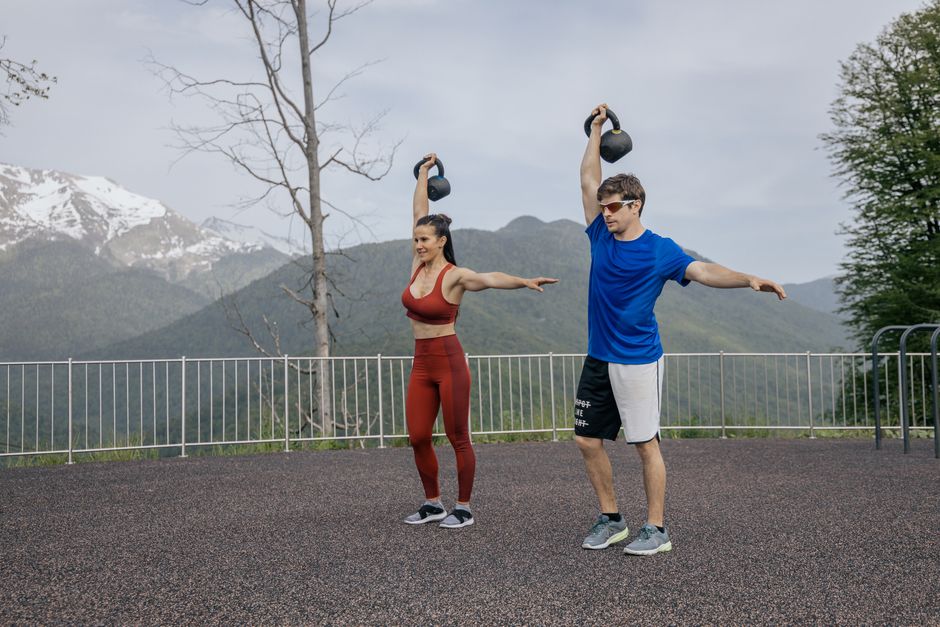
Kettlebell swings are a hip-hinge exercise that builds power and strength in the muscles of your posterior chain — the back of your body. The movement primarily targets your glutes, hamstrings, and core, while also working your lower back, shoulders, and grip. It is not a squat, and it is not an arm exercise; it is a full-body movement driven by explosive hip extension.
What Do Kettlebell Swings Work?
Kettlebell swings work the glutes and hamstrings more than any other muscle group. The power comes from forcefully pushing your hips forward and squeezing your glutes at the top of the swing. Your hamstrings work hard to control the eccentric lowering phase, and your core muscles work continuously to keep your spine stable throughout the movement.
The upper body gets involved too, but not as a primary mover. Your shoulders and upper back work isometrically to hold the kettlebell in front of you. Your forearms and grip work to hold onto the handle. But the swing is fundamentally a lower-body and core exercise.
What Muscles Are Used in a Kettlebell Swing?
The primary muscles are the gluteus maximus and the hamstrings. The gluteus maximus is the largest muscle in the body, and it is responsible for hip extension — straightening the hip joint. The hamstrings, located on the back of your thigh, assist with hip extension and control the rate at which the kettlebell lowers.
Secondary muscles include the core, the adductors (inner thighs), the spinal erectors, the lats, and the trapezius. The core is not the main driver, but it works hard. Your abdominal muscles and lower back muscles brace to prevent your spine from rounding or overextending. The lats and upper back muscles keep the kettlebell close to your body and prevent your shoulders from rolling forward.
What Is the Difference Between a Squat and a Hip Hinge?
This distinction matters because many people turn a kettlebell swing into a squat. A squat bends the knees deeply and lowers the hips down. A hip hinge pushes the hips backward while keeping the shins mostly vertical and the torso at a consistent angle.
In a swing, the movement is a hinge. The knees bend slightly, but the dominant motion is the hips traveling backward. If you find your knees tracking far forward and your thighs going parallel to the floor, you are squatting the weight, not swinging it. That reduces the load on the glutes and hamstrings and shifts it onto the quadriceps.
The payoff of the hinge is that it trains the posterior chain in a way that carries over to real-life movements like lifting something off the floor, jumping, and sprinting. Squats are valuable, but they train a different pattern.





How Do You Perform a Kettlebell Swing Correctly?
Start with the kettlebell on the floor in front of you. Stand with your feet slightly wider than shoulder-width apart. Hinge at the hips, reach down, and grip the handle. Your back should be flat, not rounded.
Hike the kettlebell back between your legs like a football. This is the loading phase. Then drive your hips forward forcefully and squeeze your glutes at the top. The kettlebell should float up to roughly chest height, driven entirely by hip power, not by raising your arms.
Let the kettlebell fall back down and hinge again as it passes between your legs. The arms stay relaxed. The movement is rhythmical, and the power comes from the hips every single rep.
Common mistakes include leading with the arms, rounding the lower back, and letting the kettlebell pull you forward. If you feel it mostly in your lower back instead of your glutes, your hinge mechanics need work. Practicing the movement with a light weight or no weight at all can help you feel the hip drive before adding load.
What Are the Benefits of Kettlebell Swings?
The main benefit is developing explosive hip power. This is the same movement pattern used in jumping, sprinting, and lifting heavy objects. Training it with a kettlebell can improve athletic performance and make everyday tasks feel easier.
Kettlebell swings are also an efficient cardiovascular workout. When performed for intervals, they elevate your heart rate substantially. Some research suggests that kettlebell training can improve aerobic capacity, though it should not replace dedicated cardio if your goal is endurance.
Another benefit is that the swing strengthens the core without requiring spinal flexion. Unlike crunches, which repeatedly bend the spine, the swing trains your core to resist movement. This type of core training, called anti-extension, is highly relevant for protecting your lower back during lifting and daily activities.
The swing is also a time-efficient exercise. A short session of swings can combine strength, power, and conditioning in a way that few single exercises can match.
Are Kettlebell Swings Safe for Your Lower Back?
For most people, kettlebell swings are safe when performed with proper form. The exercise trains the muscles that support the spine, and many people with mild back discomfort find that strengthening the glutes and hamstrings helps them feel better over time.
However, the swing is not appropriate for everyone. If you have an acute back injury, a herniated disc, or significant pain with hip flexion, you should not perform swings without medical clearance. The hinge position places the spine under load, and if your form breaks down, the lower back can take the brunt of the force.
The key is to start light. A weight that is too heavy will cause your form to break down. You should be able to maintain a neutral spine throughout the entire movement. If you cannot keep your back flat, reduce the weight or practice the hinge pattern without any load.
How Heavy Should the Kettlebell Be?
For most beginners, a kettlebell between 8 and 12 kilograms (18 to 26 pounds) is a reasonable starting point for women, and 12 to 16 kilograms (26 to 35 pounds) for men. These are general starting points, not strict rules. Your strength level, body weight, and experience matter more than gender.
The weight should be heavy enough that you feel the load in your glutes and hamstrings, but light enough that you can maintain perfect form for the entire set. If you are swinging with your arms because the weight is too heavy, it is too heavy. If you feel nothing in your glutes, it may be too light.
As you progress, you can increase the weight. Experienced lifters often swing 24 kilograms (53 pounds) or more. But the priority is always technique. A perfect swing with a lighter weight is far more effective than a sloppy swing with a heavy one.
How Often Should You Do Kettlebell Swings?
Swings can be done two to three times per week as part of a strength or conditioning program. Because the movement is explosive and involves the entire body, it does require recovery time. Doing them every day is generally not necessary and may increase the risk of overuse injuries.
A typical set might be 10 to 15 repetitions, with multiple sets depending on your goal. For conditioning, you can do timed intervals, such as 30 seconds of swings followed by 30 seconds of rest. For strength, you would use a heavier weight and perform fewer repetitions with longer rest periods.
Listen to your body. Soreness in the glutes and hamstrings is normal after a challenging session. Sharp pain in the lower back or hips is a sign to stop and reassess your form.
Frequently Asked Questions
Do kettlebell swings build muscle?
Yes, kettlebell swings build muscle in the glutes, hamstrings, and core, especially if you use a challenging weight. They are primarily a power and strength exercise rather than a pure hypertrophy movement.
Are kettlebell swings cardio or strength training?
They are both. The explosive hip drive builds strength and power, while performing them for repeated reps in a circuit raises your heart rate significantly. This makes them a hybrid exercise.
Can kettlebell swings replace squats?
No, they should not replace squats. Squats train the quadriceps and knee-dominant movement patterns, while swings train the posterior chain and hip hinge. They complement each other.
Will kettlebell swings hurt my lower back?
They can hurt your lower back if performed with poor form or too much weight. When done correctly with a neutral spine, they strengthen the muscles that support the back.
