
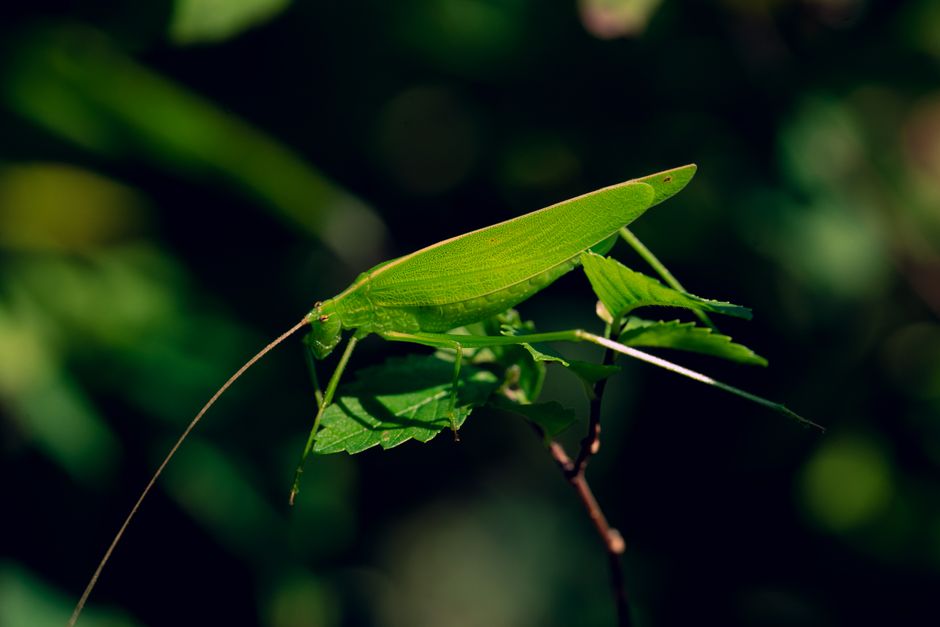
Katydids are the loud insects of late summer and early fall, and their call is one of the most recognizable night sounds in North America. They produce sound by rubbing their wings together, a process called stridulation. The result is a raspy, buzzing, two- or three-syllable rasp that repeats over and over, often described as the insect equivalent of someone saying “katy-did, katy-didn’t.”
The sound is not a voice. It is friction. One wing has a scraper edge, the other has a file-like ridge, and when the insect closes its wings the scraper drags across the file and vibrates a thin membrane that broadcasts the call. Only males typically call, and they do it for one reason: to attract a female. Different species produce different songs, and that difference is often the main way you can tell them apart without ever seeing them.
What Do Katydids Sound Like And How Do They Make It?
A katydid’s call is a repeated, buzzy rasp rather than a clean tone. Most people hear it as a rhythmic “ch-ch-ch” or a two-part “ka-ty, ka-ty” that pulses through the night air. The sound is loud enough to carry across a yard and can be startlingly close when the insect is in a nearby tree.
The mechanics are straightforward once you know what to look for. On the forewings — the leathery upper wings folded over the back — there is a row of tiny teeth on one wing and a hard ridge on the other. When the wings are drawn together, the ridge scrapes across the teeth, and each tooth strike produces a click. Hundreds of clicks per second blend into the continuous buzzing rasp you hear.
A specialized area of the wing called the mirror acts as a resonator. It is a thin, drum-like membrane that amplifies the vibration. A nearby thickened vein, the file, does the scraping. This is not a mouth sound and not a throat sound. It is entirely mechanical, produced by the wings.
The rhythm you hear is not random. Each species has its own pattern — how many pulses per second, how many syllables per chirp, and how long the pauses are. A listener with a trained ear can sometimes identify the species from sound alone.
Why Do Katydids Call at Night?
Katydids are mostly nocturnal, and their calling peaks after dark. The main reason is that night is safer. Birds, lizards, and other daytime predators hunt by sight, and a large green insect sitting exposed on a leaf is easy prey in daylight.
Darkness also helps the sound travel. Cooler, more humid night air carries sound farther than hot, dry daytime air, so a male’s call reaches more potential mates after sunset. The trade-off is real: calling is loud, and loud sounds can attract predators as well as partners. Some bats hunt katydids by listening for their calls, and katydids in turn have evolved ways to stop or change their song when a bat is nearby.
Calling is also temperature-dependent. Katydids are cold-blooded, and their muscle activity slows in cool weather. On a chilly night, calls come slower and further apart. On a warm night, they speed up. Some people use this to estimate temperature, though the relationship is not precise enough to be a reliable thermometer.
Is It a Katydid or a Cricket?
Katydids and crickets are close relatives, both in the order Orthoptera, and their songs can sound similar to an untrained ear. The easiest way to tell them apart is usually by the sound itself and by when you hear it.
- Crickets generally produce a cleaner, more musical chirp — a distinct series of separate notes with clear pauses.
- Katydids tend to produce a raspier, buzzier, more continuous sound, often with a two- or three-syllable pattern.
- Timing overlaps, but katydids are especially associated with late summer and early fall evenings.
- Appearance differs too. Katydids are usually larger, greener, and more leaf-shaped, with long antennae that can exceed their body length. Crickets are typically darker and more compact.
The name “katydid” itself comes from the sound. Early American settlers thought the two-syllable call sounded like someone saying “Katy did” followed by “Katy didn’t,” and the name stuck. That interpretation is a human invention, not a message the insect is sending.





Can You Tell Different Katydid Species Apart by Sound?
Yes, and for many species the song is the most reliable identifying feature. Katydids look remarkably similar to one another — green, leaf-shaped, and well camouflaged — so visual identification is often difficult even for trained observers. The song, by contrast, is distinctive.
Differences show up in several ways:
- Pulse rate — how fast the individual clicks come within a burst.
- Syllable count — whether the call is one note, two notes, or a longer series.
- Frequency — some calls are low and throaty, others higher and sharper.
- Timing — some species call at dusk, others in the middle of the night, others near dawn.
This is why researchers who study katydids often rely on recordings rather than specimens. A single well-made recording can confirm a species that would take hours to identify by sight. For a casual listener, the practical takeaway is simpler: if the call pattern changes noticeably from one part of the yard to another, you are probably hearing more than one species.
How Loud Is a Katydid, and Why Does It Matter?
Katydid calls are loud for their size. Some species can be heard from well over a hundred feet away on a quiet night, and a katydid singing close to a bedroom window can be genuinely disruptive to sleep.
The volume serves a purpose. A male needs his call to stand out against background noise — other insects, wind, water, and human sound. Louder calls travel farther and are more likely to reach a female. But louder calls also carry more risk, since predators can locate the source. This tension between being heard and being eaten is one of the central pressures shaping how katydids sing.
There is a detail worth knowing here. Many katydids have a structure on their front legs near the “knee” that functions as an ear. It is called a tympanum, and it lets the insect hear the calls of others. So a katydid is not just a broadcaster. It is also a listener, and it can pick up the songs of rivals and potential mates from a distance.
When Are Katydids Most Active?
Katydid activity builds through summer and peaks in late summer and early fall in most of the United States. In many regions, the first sustained katydid chorus of the year is a marker that summer is winding down.
Adults emerge, mate, and lay eggs before cold weather arrives. In colder climates, katydids typically overwinter as eggs, which hatch the following spring. In warmer parts of the country, some species may have different life cycles, and a few can be active across more of the year.
Calling usually starts around dusk and can continue for hours. On warm, still nights the chorus is densest. Wind and rain suppress calling, partly because sound is disrupted and partly because the insects are less active in poor conditions.
Do Katydids Bite or Sting?
Katydids do not sting, and they do not have venom. They are not dangerous to people. Some larger species can deliver a nip with their mouthparts if handled roughly, and that nip can be noticeable, but it is not medically significant.
The bigger defense most katydids rely on is camouflage. Their green, leaf-shaped bodies blend into foliage, and some species have wing patterns that mimic the veins of a leaf or even the look of a damaged, brown-edged leaf. When disturbed, many katydids will drop to the ground or stay perfectly still rather than fight.
If you find one on your arm, the sensible move is to let it walk onto a leaf or a stick and move it somewhere else. There is no reason to be alarmed, and no reason to handle it more than necessary.
Why Does the Sound Stop When You Approach?
Katydids are sensitive to vibration and movement. When you walk toward a calling katydid, the ground and foliage carry your footsteps, and the insect often goes silent as a defensive response.
This is why the chorus can seem to switch off the moment you step outside. It is not your imagination. The insects are detecting you and pausing their calls until the disturbance passes. If you stand still and quiet for a minute or two, the singing usually resumes.
That pause is itself informative. A katydid that stops calling is trading mating opportunity for safety. The behavior makes sense when you consider that a calling insect is essentially announcing its location to everything in the area, including animals that would eat it.
Frequently Asked Questions
What does a katydid sound like?
A katydid makes a raspy, buzzing, rhythmic call, often heard as a repeated two- or three-syllable “ka-ty-did” pattern. It sounds buzzier and less musical than a typical cricket chirp.
How do katydids make their sound?
They rub a scraper edge on one forewing against a file-like ridge on the other, a process called stridulation. The vibration is amplified by a thin membrane on the wing called the mirror.
Do only male katydids call?
Yes, in most species only males produce the calling song, and they do it to attract females. Females of some species can produce quieter sounds, but they are not the loud nighttime chorus you hear.
Are katydids harmful to humans?
No. Katydids do not sting and have no venom, though a large one may nip if handled roughly. That nip is not medically significant.
