
Dips are a compound upper-body exercise where you lower and raise your body using parallel bars or a stable surface. They primarily target the chest, shoulders, and triceps, making them one of the most effective bodyweight exercises for building pushing strength. The specific muscles you feel working depend heavily on your body angle and grip width.
What Muscles Do Dips Actually Target?
Dips are a multi-joint exercise. This means they work several muscle groups at the same time, rather than isolating a single muscle like a bicep curl does. The primary movers are the triceps, chest, and front shoulders.
The triceps brachii is the muscle on the back of your upper arm. It straightens your elbow. Research consistently shows that dips produce high levels of triceps activation. If you keep your body upright and your elbows close to your sides, the triceps do most of the work.
The pectoralis major is your chest muscle. It brings your arms together and helps push. When you lean your torso forward during a dip, you shift more of the workload onto the lower chest fibers. This is why many lifters use dips as a primary lower-chest builder.
The anterior deltoid is the front head of your shoulder. It assists in the pressing motion. It works alongside the chest and triceps to move your body upward.
Secondary muscles include the core and upper back. Your abdominals and obliques stabilize your pelvis so your body moves as one unit. The rhomboids and lower traps help keep your shoulder blades stable throughout the movement.
How Does Body Position Change the Focus?
Small changes in posture create big changes in which muscles feel the most tension. This is the most practical part of learning dips.
Upright torso with elbows tucked: This position maximizes triceps involvement. Your body stays vertical, and your elbows track close to your ribs. This variation feels intense in the back of the arms.
Leaning forward with elbows flared: This position shifts emphasis to the lower chest. The more you lean, the more the chest muscle stretches and contracts. Some lifters also feel increased front-shoulder involvement with this angle.
Grip width: A shoulder-width grip is the standard and balances the load across all three muscles. A narrower grip increases triceps activation. A wider grip increases chest and shoulder strain but can be uncomfortable for some people’s shoulders.
There is no perfect form for everyone. The right variation depends on your goals and your shoulder health history.
Are Dips Better Than Bench Press or Push-Ups?
Each exercise has strengths, and none is universally superior. Dips offer a unique combination of load and range of motion that the others do not.
Bench press allows you to load the chest and triceps with very heavy weights. It is easier to progressively add small increments of weight. However, it requires equipment and a spotter for maximal effort sets.
Push-ups are more accessible and easier on the shoulders for many people. They also engage the core strongly. But push-ups limit how much you can load the muscles once bodyweight becomes easy. Adding weight to push-ups is awkward compared to adding a dumbbell to a dip.
Dips sit between these two. They allow you to add weight easily using a belt or a dumbbell held between your legs. They also provide a deeper stretch at the bottom of the movement than most bench press or push-up variations. Some research suggests that a greater range of motion can lead to greater muscle growth, though the evidence comparing these exercises directly is limited.
A practical approach is to rotate between them. Many lifters use dips as a primary exercise and push-ups as an accessory or warm-up.





How Many Dips Should You Do for Strength and Muscle?
The answer depends on your current level and your goal. The principles of progressive overload apply here just as they do to any other exercise.
For muscle growth, the research points to a moderate rep range. Sets of 8 to 15 repetitions are commonly recommended. If you can do more than 15 clean repetitions with your bodyweight, you likely need to add external weight. Use a dip belt or hold a dumbbell between your feet.
For strength, lower reps with heavier load work best. Sets of 3 to 6 repetitions with added weight build maximal strength. This requires a dip belt and access to weight plates.
For endurance, higher reps of 20 or more are effective. This trains the muscles to work for longer periods but does less for raw strength or size.
A general recommendation is 3 to 4 sets per workout, performed 2 to 3 times per week. Rest 2 to 3 minutes between strength-focused sets and 60 to 90 seconds between hypertrophy-focused sets.
What Are the Most Common Mistakes and Injury Risks?
Dips are a demanding exercise. They place significant stress on the shoulder joint, especially at the bottom of the movement. Understanding the risks helps you train safely.
The most common mistake is going too deep too quickly. Lowering until your shoulders feel a sharp pinch or strain is a warning sign. The shoulder joint is most vulnerable when the arm is raised behind the torso. Stop your descent when you feel a comfortable stretch in the chest, not when your shoulders complain.
Another frequent error is flaring the elbows out to 90 degrees from the body. This position increases stress on the front of the shoulder capsule. Keeping elbows at roughly 30 to 45 degrees from your torso is safer for most people.
Using momentum to bounce out of the bottom is also problematic. This reduces muscle tension and increases joint compression. Control the descent over 2 to 3 seconds, then press up smoothly.
People with a history of shoulder impingement or instability should be cautious. Some physical therapists recommend avoiding deep dips for these individuals. If you feel sharp pain during the movement, stop and consult a professional. Dull muscle fatigue is normal. Sharp joint pain is not.
How Do You Progress When Bodyweight Becomes Too Easy?
Once you can perform 15 to 20 strict repetitions, your muscles have adapted. Adding more reps will build endurance, but it will not build much more strength or size. This is the point where weighted dips become valuable.
The simplest method is a dip belt. This is a leather or nylon belt with a chain that hangs between your legs. You attach weight plates to the chain. Start with a weight that allows you to perform 8 to 10 reps with good form.
If you do not have a dip belt, hold a dumbbell between your feet or ankles. This works well for moderate loads. For heavier loads, the dumbbell becomes awkward and the belt is safer.
Increase the weight by small increments, roughly 5 pounds at a time. Add weight only when you can complete your target rep range with controlled form on every rep.
If you train at home without equipment, you can make bodyweight dips harder by slowing the tempo. Take 4 to 5 seconds to lower yourself and pause for 2 seconds at the bottom. This increases time under tension without adding weight.
Can Beginners Do Dips?
Full dips require substantial upper-body strength. Many beginners cannot perform a single strict repetition. This is normal and not a reason to avoid the exercise.
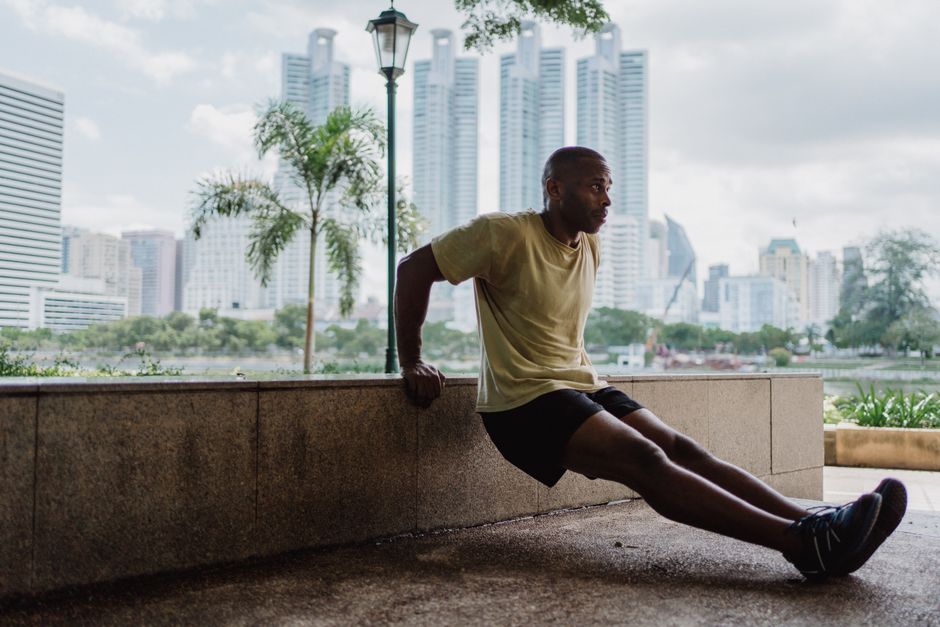
Start with bench dips or foot-assisted dips. Place your hands on a stable bench or chair behind you and your feet on the floor. Lower your body by bending your elbows. The more your legs support your weight, the easier the movement.
As you get stronger, elevate your feet onto another bench to increase the load. Eventually, you can progress to parallel bars.
Another option is using a resistance band looped under your knees or feet. The band provides assistance at the bottom of the movement where you are weakest. As you press up, the band slackens and you lift more of your bodyweight.
Beginners should also build foundational strength with push-ups and overhead pressing. These exercises prepare the chest, shoulders, and triceps for the demands of dips.
Frequently Asked Questions
Are dips better for chest or triceps?
Dips work both, and your body position decides the emphasis. Leaning forward targets the lower chest more, while staying upright with elbows tucked targets the triceps more.
How many dips should I do a day?
For most people, 3 to 4 sets performed 2 to 3 times per week is effective. Doing dips every single day does not allow enough recovery for muscle growth.
Why do my shoulders hurt when doing dips?
Shoulder pain during dips often comes from going too deep or flaring the elbows out too wide. Stop the descent at a comfortable chest stretch and keep your elbows at roughly 45 degrees from your torso.
Can I build chest muscle with just dips?
Yes, dips can build chest muscle, especially the lower chest. For balanced development, combine them with a flat pressing movement and a fly variation to target the upper and middle chest fibers.
