
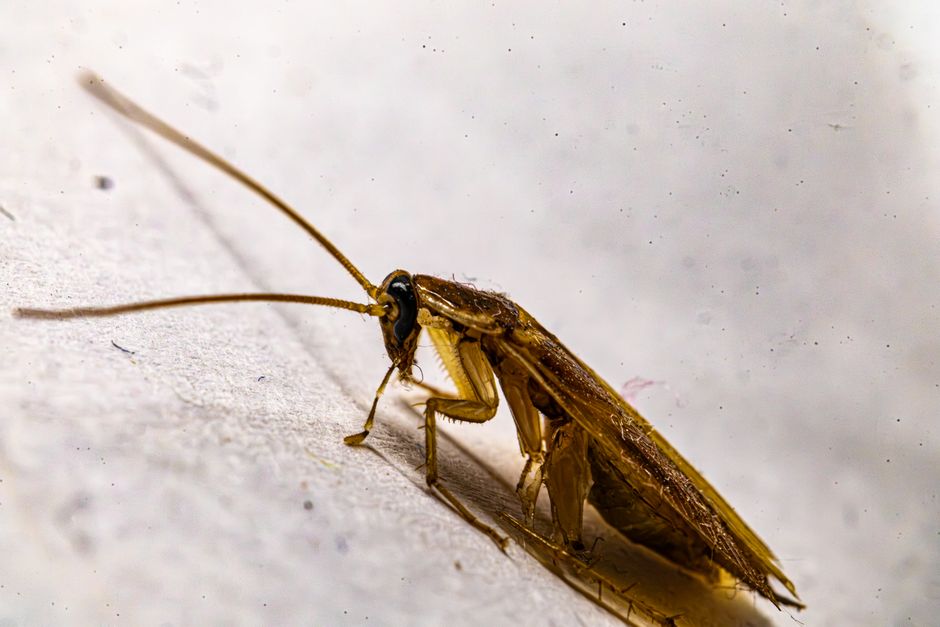
Cockroaches eat, breed, and spread bacteria across the surfaces they walk on. They are nocturnal scavengers that hide in cracks and damp spaces during the day and come out at night to find food and water. Their presence in a home is more than a nuisance — it can trigger allergies and asthma, and it can contaminate food and food-prep surfaces.
What Do Cockroaches Do?
At their core, cockroaches do three things in a home: they find food and water, they reproduce, and they move bacteria and allergens around with them. They are not aggressive toward people. They do not bite to feed, and they do not sting. The harm they cause is indirect — through contamination, allergens, and the way their bodies and waste affect indoor air and surfaces.
Most species that live indoors are nocturnal. They spend daylight hours in dark, warm, moist harborage — behind appliances, inside wall voids, under sinks, in cabinet hinges, and around plumbing. When the lights go off and the house quiets down, they emerge to forage. If you see cockroaches during the day, especially in open areas, it often points to a large population that has outgrown its hiding spaces.
What Do Cockroaches Eat and How Do They Find It?
Cockroaches are opportunistic omnivores. They eat almost anything organic, which is a big part of why they are so hard to get rid of. Common food sources include crumbs, spilled liquids, pet food, garbage, grease buildup, paper, cardboard, and even dead skin cells and hair.
They find food mostly by scent and by random movement. A cockroach that wanders into a food source will often return to it, and other cockroaches can be drawn to the same area. This is why a small spill behind a stove can become a recurring problem rather than a one-time visit.
Water matters as much as food, sometimes more. Many indoor species need a reliable water source. Leaky pipes, condensation on pipes, wet sponges, and standing water in sinks all support them. In some cases, reducing moisture is more effective than cleaning up crumbs.
They are also known to feed on things people would not call food — soap, glue, toothpaste, and the residue on unwashed dishes. This wide range is why “just clean up” is not a complete answer to an infestation.
How Do Cockroaches Reproduce?
Cockroaches reproduce quickly, and that is central to why infestations grow. The female carries her eggs in a protective case called an ootheca. Depending on the species, she may deposit the case in a hidden spot or carry it until the eggs are ready to hatch.
Each case holds multiple eggs, and the young that emerge — called nymphs — look like small versions of the adults. They molt as they grow. A single female can produce many offspring over her life, and generations can overlap in a single home. This is why catching one cockroach rarely means there is only one.
Different species favor different conditions. German cockroaches, one of the most common indoor species, tend to prefer warm, humid areas near food and water, such as kitchens and bathrooms. American cockroaches are larger and often associated with sewers, drains, and damp basements. The exact reproductive rates and lifespans vary by species, so general numbers should be treated with caution.
What Harm Do Cockroaches Cause in a Home?
Cockroaches do not usually cause direct injury, but they are linked to real health and hygiene problems. The main concerns are contamination, allergens, and the difficulty of getting rid of them once they establish a population.
Contamination of food and surfaces
Cockroaches move between garbage, drains, and food-prep areas. As they walk, they can carry bacteria on their bodies and deposit them on surfaces and food. This does not mean every cockroach transmits disease, and it is important not to overstate the risk. But the potential for contamination is real, especially where food is prepared or stored.
Some research has found that cockroaches can carry bacteria associated with foodborne illness, including species such as Salmonella and E. coli, on their bodies. What is less clear is how often this actually leads to human illness in a typical home. The evidence supports caution and good hygiene rather than panic.
Allergies and asthma
This is one of the better-documented health concerns. Cockroach allergens come from their saliva, feces, shed skins, and body parts. These particles become part of household dust, and people can inhale them.
Research has consistently linked cockroach exposure to allergic sensitization and asthma symptoms, particularly in children and in urban environments. Some studies indicate that cockroach allergens are among the more common indoor triggers for asthma in certain populations. If someone in the home has asthma or allergies, an infestation is a more serious issue than simple disgust.
Psychological and quality-of-life effects
Living with an infestation can cause stress and disrupted sleep. This is a real effect, though it is harder to measure than contamination or allergy risk.
Do Cockroaches Bite or Sting?
Cockroaches do not sting, and they are not built to bite humans as a way of feeding. Bites are extremely rare and, when reported, are usually minor skin irritation rather than a true bite. Some people develop small skin reactions after contact with cockroach allergens or body parts, but this is not the same as being bitten.
The bigger practical point is that cockroaches are not a direct physical threat in the way a wasp or a rodent might be. The concern is what they leave behind and what their presence signals about sanitation and moisture in a building.
How Do You Know If You Have Cockroaches?
You may not see a cockroach and still have them. The signs are often indirect. Common indicators include:
- Droppings that look like small dark specks or smears, often near food or water sources
- Egg cases (oothecae) tucked into cracks, behind appliances, or under furniture
- A musty, oily odor in severe infestations
- Shed skins as nymphs molt
- Live cockroaches seen at night when lights are turned on in a kitchen or bathroom
Seeing one cockroach during the day does not prove a large infestation, but it is a reason to look more carefully. A single sighting in a bathroom or kitchen is worth investigating rather than ignoring.
What Actually Helps Reduce Cockroaches?
The evidence for what works is strongest for removing their access to food, water, and harborage, and for using proven pest-control methods when an infestation is established. There is no single trick that reliably eliminates cockroaches.
Practical steps that are widely supported include:
- Fixing leaks and reducing standing water and condensation
- Storing food in sealed containers and cleaning up crumbs and grease
- Taking out garbage regularly and keeping bins closed
- Sealing cracks and gaps around pipes, cabinets, and walls
- Reducing clutter that provides hiding spaces
For an active infestation, baits and other targeted pest-control products are commonly used, and professional help is often needed for larger or persistent problems. Some clinicians and public health sources emphasize that reducing cockroach allergens in the home — through cleaning and pest control — matters for people with asthma. The exact cleaning frequency and methods are not standardized in clinical guidelines, so general good hygiene is the reasonable approach.
One point worth being honest about: home remedies and “natural” repellents are widely marketed, but no strong clinical evidence confirms that most of them eliminate an infestation. They may help with prevention in some cases, but they are not a substitute for proven pest control when cockroaches are already established.
When Should You Take Cockroaches More Seriously?
Cockroaches deserve more attention when someone in the home has asthma or allergies, when food-prep areas are affected, or when the infestation keeps returning despite cleaning. In those situations, the issue is not just discomfort — it is indoor air quality and food safety.
For most healthy adults, an occasional cockroach is a hygiene problem, not a medical emergency. For a child with asthma, or an adult with known cockroach allergy, the same situation carries more weight. That difference is worth taking seriously without overstating the danger for everyone else.
Frequently Asked Questions
What do cockroaches do at night?
They come out of hiding to search for food and water, often returning to the same sources repeatedly. Most indoor species are nocturnal and avoid light and open spaces.
Do cockroaches bite humans?
True bites are extremely rare, and cockroaches are not built to bite people as a way of feeding. Skin reactions are more often linked to allergens than to bites.
Can cockroaches make you sick?
They can carry bacteria on their bodies and contaminate food and surfaces, and their allergens are linked to asthma and allergy symptoms. The risk is real but should not be exaggerated into a certainty of illness.
Why do I see cockroaches during the day?
Daytime sightings often mean the population has grown beyond its usual hiding spaces. It can also happen when food or water is scarce, pushing them to search more openly.
