
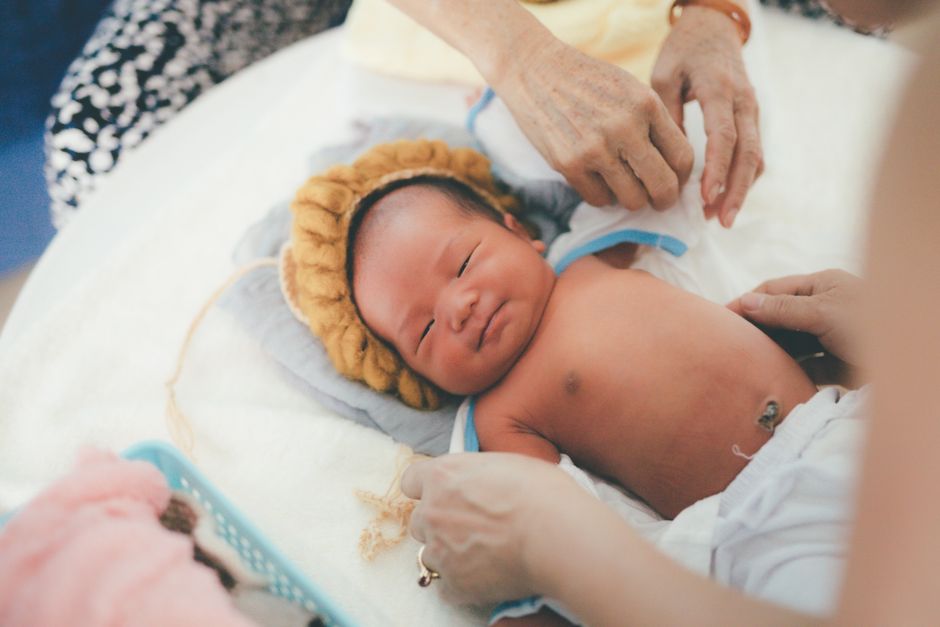
An umbilical granuloma is a small, moist, pink or red lump of tissue that appears on a baby’s belly button after the umbilical cord stump falls off. It forms when the stump heals with a bit of extra tissue left behind, and it is one of the most common newborn navel concerns. It is not an infection, it is not dangerous, and in most cases it is treated simply — often with a topical medicine your doctor applies, or sometimes it resolves on its own.
What Causes Umbilical Granuloma And How Is It Treated?
During pregnancy, the umbilical cord carries oxygen and nutrients from the placenta to your baby. After birth, the cord is clamped and cut, leaving a short stump. Over the next week or two, that stump dries, shrivels, and separates from the belly button.
Underneath the stump is a small wound where the cord’s blood vessels met your baby’s abdominal wall. Normally this heals flat and closes over. In some babies, the healing tissue at that spot produces a small amount of extra granulation tissue — the same kind of soft, moist tissue the body makes to close any wound. When that tissue stays raised instead of flattening, it forms an umbilical granuloma.
The key point is that this is a healing response, not an infection. The tissue is not pus, and there is usually no bacteria involved. That distinction matters because it changes how the problem is treated.
Treatment depends on how the granuloma looks and how long it has been there. Many granulomas shrink and disappear without any treatment. When treatment is needed, the most common approach is a chemical called silver nitrate, which a clinician applies directly to the tissue to dry it out. Other options include a salt (sodium chloride) application or, less often, a topical steroid or a simple procedure to remove the tissue. Most cases resolve with one or a few treatments.
It is worth knowing that an umbilical granuloma is not the only thing that can cause a moist or lumpy belly button in a newborn. An umbilical polyp, an infection, or a deeper problem such as a patent urachus or omphalocele can look similar. That is why a doctor should confirm what it is rather than a parent assuming.
What Does An Umbilical Granuloma Look Like?
An umbilical granuloma is usually easy to spot. It looks like a soft, round, pink or reddish lump sitting right in the belly button. It is typically small — often no bigger than a pencil eraser. The surface is moist and shiny, and it may leave a small amount of clear or slightly blood-tinged fluid on the diaper or clothing.
What it usually is not:
- It is not generally red and swollen around the base in the way an infection is.
- It does not usually cause a fever or make your baby fussy or unwell.
- It does not typically have a bad smell, which is more typical of infection.
- It does not usually squirt out gas or stool, which would suggest a deeper connection between the bowel and the navel.
Some moisture and a little spotting are normal for a healing navel. A granuloma tends to stay moist and persistent rather than drying up and going away on its own schedule.
One detail that is easy to miss: a granuloma is not the same as the normal healing stump. If the stump has already fallen off and a pink lump remains for more than a week or two, that is the pattern that points toward a granuloma rather than ordinary healing.
When Should A Parent Be Concerned?
Most umbilical granulomas are harmless. But a few signs mean the belly button needs to be looked at promptly, because they point to something other than a simple granuloma.
Contact your baby’s doctor if you notice any of the following:
- Redness, warmth, or swelling spreading around the belly button.
- A foul-smelling discharge, or discharge that looks like pus.
- Fever in a newborn — this is always a reason to seek medical care, because newborns cannot fight infection the way older children can.
- Bleeding that does not stop with gentle pressure, or bleeding that keeps returning.
- Any drainage that looks like stool, or a belly button that leaks gas.
- A lump that is growing quickly, or a lump that is larger than a small pea.
- Your baby seems uncomfortable, is feeding poorly, or is unusually sleepy.
The reason these matter is that an umbilical infection in a newborn can spread. A patent urachus — a rare condition where a channel between the bladder and the navel stays open — can cause clear fluid to drain from the belly button. An omphalocele is a birth defect where organs remain outside the abdomen, but that is present at birth and would be identified immediately, not mistaken for a granuloma later. These are uncommon, but they are the reason a persistent or unusual navel finding deserves a professional look.





How Is An Umbilical Granuloma Treated?
Treatment is usually straightforward, and the choice depends on the size of the granuloma and how it is responding.
Silver nitrate. This is the most common treatment. A clinician touches the tissue with a silver nitrate applicator, which chemically cauterizes the surface and causes it to dry and fall away. It is quick, usually done in the office, and often needs to be repeated once or twice. Silver nitrate can temporarily stain the skin a brownish color, which fades. Because it can irritate surrounding skin, it should be applied by a clinician rather than at home.
Salt application. Some clinicians recommend applying table salt to the granuloma for a short period, then rinsing it off. The salt draws moisture out of the tissue and helps it dry. This is a recognized approach, but it should be done under medical guidance because the timing and method matter, and salt can irritate healthy skin.
Topical steroids. In some cases a steroid cream is used to reduce the tissue. This is less common than silver nitrate and is generally reserved for specific situations.
Observation. If the granuloma is small and not causing problems, a doctor may simply watch it. Many shrink over weeks without intervention.
Surgical removal. This is rarely needed. It may be considered if the granuloma is large, does not respond to other treatments, or if there is concern about a deeper problem such as a polyp or a persistent channel.
What parents should not do is try to treat it at home with home remedies, tight banding, or by picking at it. Those approaches can cause bleeding, infection, or scarring, and none of them are supported by good evidence.
How Long Does It Take To Heal?
With treatment, an umbilical granuloma often improves within days to a couple of weeks. Silver nitrate typically causes the tissue to dry and separate quickly, though a second application is sometimes needed. Without treatment, some granulomas resolve on their own over a few weeks to a few months.
The timeline is not exact, and it varies. What matters more than the calendar is the direction: a granuloma that is slowly shrinking is behaving as expected. One that is growing, getting redder, or producing new discharge is not, and that is when to check back with your baby’s doctor.
Can An Umbilical Granuloma Be Prevented?
There is no proven way to prevent an umbilical granuloma. It is not caused by anything a parent did or did not do during pregnancy or after birth. It results from how the individual baby’s tissue heals.
Good cord care may reduce the chance of infection, which is a separate concern. General guidance for newborn cord care includes keeping the stump clean and dry, folding the diaper below the stump so it is not rubbed or covered, and letting the stump fall off on its own rather than pulling it. Some clinicians recommend cleaning with plain water, while others have used alcohol; practices vary, and you should follow what your baby’s doctor advises.
One non-obvious point: the stump falling off is not the end of the story. The belly button continues to heal for a while afterward, and that is exactly when a granuloma can appear. Watching the navel for a week or two after the stump separates is more useful than focusing only on the days before it falls off.
Is An Umbilical Granuloma Serious?
An umbilical granuloma itself is not serious. It is a benign, common finding in newborns, and it does not harm your baby’s development or internal organs. It is not a sign that something went wrong during pregnancy.
The main risk is not the granuloma but what it can be confused with. A parent who assumes a red, draining navel is “just a granuloma” could miss an infection or a rare structural problem. That is why the safe approach is to have any persistent or unusual navel finding checked, and then to follow the treatment your clinician recommends.
For the large majority of babies, this is a minor issue that resolves with simple care and leaves no lasting mark.
Frequently Asked Questions
Is an umbilical granuloma dangerous?
No, an umbilical granuloma is a benign healing response and is not dangerous on its own. The main concern is making sure it is not confused with an infection or a rare structural problem, which is why a doctor should confirm the diagnosis.
How do you treat an umbilical granuloma?
The most common treatment is silver nitrate applied by a clinician, which dries the tissue so it falls away. Salt application, topical steroids, or simply watching it are alternatives depending on the case, and small granulomas sometimes resolve without treatment.
How long does an umbilical granuloma take to go away?
With treatment it often improves within days to a couple of weeks, though a second application may be needed. Without treatment, some granulomas shrink over a few weeks to a few months.
Can I treat an umbilical granuloma at home?
No, home remedies, banding, or picking at the tissue are not supported and can cause bleeding, infection, or scarring. Treatment should be done or guided by a clinician.
