
Tendon pain after hip replacement is more common than many people expect, and it often has nothing to do with the new joint itself. The surgery changes how your hip moves, how your muscles fire, and how much load your tendons carry. Tendons that were doing one job before surgery are suddenly asked to do another. That shift, combined with inflammation from healing and altered walking mechanics, is the usual source of the problem. In most cases the implant is fine. The soft tissue around it is the part that is struggling to adapt.
What Causes Tendonitis After Hip Replacement?
The short answer: tendonitis after hip replacement usually comes from a combination of changed biomechanics, tissue inflammation during recovery, and overload of tendons that were not conditioned for their new role. It is rarely one single cause.
During a total hip replacement, the surgeon removes the damaged joint surfaces and replaces them with a metal, ceramic, or plastic implant. To reach the joint, they must move or detach muscles and tendons. Even with modern surgical approaches that spare more tissue, the soft tissue envelope around the hip is disrupted. It then has to heal while also supporting your full body weight during walking.
There is another factor. Before surgery, many people with hip arthritis walk with a limp or shift their weight abnormally. Their muscles and tendons adapt to that pattern over months or years. After surgery, the joint can suddenly move through a more normal range. The tendons that cross the hip — particularly the gluteal tendons on the outside of the hip and the iliopsoas tendon at the front — may not be ready for that new demand. In a sense, they are being retrained by force rather than by gradual conditioning.
This is why tendon pain can appear weeks to months after surgery, even when the initial recovery seemed to go well.
Which Tendons Are Most Often Affected?
The two most commonly involved areas are the gluteal tendons on the outside of the hip and the iliopsoas tendon at the front. Each has a distinct pain pattern.
Gluteal tendons. These attach the buttock muscles to the outer hip. They are the main stabilizers that keep your pelvis level when you stand on one leg. If they become inflamed or torn, you feel pain on the outer hip, sometimes radiating down the side of the thigh. Lying on that side often hurts. Walking on uneven ground or standing on one leg makes it worse.
Iliopsoas tendon. This tendon runs from the lower spine and pelvis to the front of the thigh bone. It helps bend the hip. After hip replacement, it can rub against the front edge of the implant cup, especially if the cup is positioned slightly forward. This is called iliopsoas impingement. The pain is a deep ache or snapping sensation in the groin or front of the hip, often worse when lifting the knee or rising from a low chair.
Less commonly, the hamstring tendons at the back of the hip or the abductor tendons near the greater trochanter can be involved. The exact tendon matters because the treatment approach differs.
How Does Surgery Change the Way Tendons Work?
Hip replacement changes the length and tension of the muscles around the hip. This is not a flaw in the surgery — it is a mechanical consequence of restoring normal joint alignment.
Consider leg length. Many people with hip arthritis have a shortened leg on the affected side. Surgery often restores length. That is good for walking, but it stretches the gluteal muscles and their tendons. A tendon that is suddenly stretched has to work harder to generate the same force. Over time, that extra load can cause inflammation or small tears.
Offset is another factor. Offset is the distance between the center of the hip joint and the shaft of the thigh bone. Surgeons try to restore it, but it is not always possible to match the other side exactly. A change in offset alters the leverage of the gluteal muscles. If the leverage is worse, the tendon has to pull harder for every step.
There is also the matter of surgical approach. The posterior approach involves splitting the gluteus maximus and detaching the short external rotators. The direct anterior approach spares those muscles but can irritate the iliopsoas tendon. The lateral approach may affect the abductors. Each approach has a different soft tissue profile, and each has a different set of tendons that tend to complain afterward.





Is It Tendonitis or Something Else?
Tendon pain after hip replacement is not always true tendonitis. That distinction matters because the treatment can differ.
True tendonitis means acute inflammation of the tendon. It is more common in the early weeks after surgery. Tendinopathy, by contrast, is a degenerative process without much active inflammation. It develops from chronic overload and is more common months or years after surgery. The two can feel similar, but they respond differently to rest, loading, and anti-inflammatory medication.
Other conditions can mimic tendonitis:
- Trochanteric bursitis. Inflammation of the bursa over the outer hip. It causes similar outer hip pain but is treated differently.
- Nerve irritation. The sciatic nerve or lateral femoral cutaneous nerve can be irritated by surgery or scar tissue, producing burning or numbness rather than the achy pain of tendonitis.
- Implant-related pain. Loosening, infection, or a reaction to metal debris can cause pain that is not tendon-related. These are less common but more serious.
- Referred pain from the spine. A pinched nerve in the lower back can cause hip and thigh pain that feels muscular but is not.
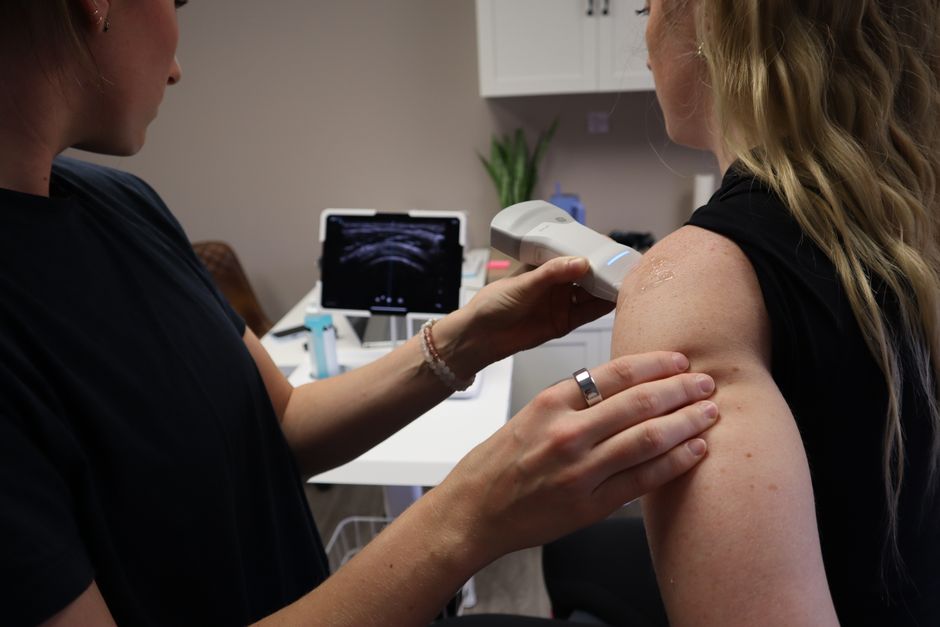
Because these conditions overlap, imaging is often needed. An ultrasound or MRI can show whether a tendon is inflamed, torn, or normal. X-rays show the implant position but not the tendons. A physical exam that reproduces the pain with specific movements is often the most useful first step.
What Makes Tendon Pain More Likely After Surgery?
Some people are more prone to tendon problems after hip replacement than others. The reasons are a mix of anatomy, surgical factors, and individual health.
Pre-existing tendon damage is a major one. If your gluteal tendons were already worn or partially torn before surgery, they are less able to handle the new demands afterward. Many people with advanced hip arthritis also have gluteal tendinopathy, even if it was not the main source of their pain.
Leg length discrepancy plays a role. A small difference is common and usually well tolerated. A larger one can overload the gluteal tendons on the longer side. Surgeons aim to keep the difference small, but perfect symmetry is not always achievable.
Implant positioning matters, especially for the iliopsoas tendon. If the cup is placed too far forward or too large, the tendon can rub against it with every hip flexion. This is a mechanical problem, not an inflammatory one, and it may not improve with rest.
General health factors also contribute. Conditions that affect tendon quality — diabetes, obesity, and certain inflammatory diseases — can make tendon problems more likely. Some medications, including certain antibiotics and steroids, are associated with tendon damage, though this is uncommon at typical doses.
Activity level after surgery is another factor. Returning to high-impact activity too soon, before the soft tissues have adapted, can overload tendons that are still healing. This does not mean you should avoid activity. It means the ramp matters.
How Is Tendon Pain After Hip Replacement Treated?
Most tendon pain after hip replacement improves with conservative care. The evidence for specific treatments varies, so it helps to know what is well supported and what is not.
Activity modification is the first step. Reducing the movements that provoke pain gives the tendon a chance to settle. This does not mean complete rest, which can weaken the tendon further. It means finding a level of activity that does not make things worse.
Physical therapy is the mainstay. A therapist can assess your gait, strength, and flexibility. Strengthening the gluteal muscles and improving hip mechanics can reduce tendon load. This is well established for tendinopathy in general, though the evidence specific to post-hip-replacement tendonitis is more limited.
Anti-inflammatory medications may help in the early inflammatory phase. They are less useful for chronic tendinopathy, where inflammation is not the main problem. This is a common point of confusion.
Corticosteroid injections are sometimes used for gluteal tendon pain. They can reduce pain in the short term, but repeated injections may weaken the tendon. Some clinicians recommend them; the evidence for long-term benefit is mixed.
For iliopsoas impingement caused by the implant, treatment is different. Physical therapy may help, but if the tendon is rubbing against the cup, the mechanical problem remains. In some cases, a procedure to release or lengthen the tendon is considered. This is uncommon and usually reserved for cases that do not improve with other measures.
Surgery to repair a torn gluteal tendon is an option for complete tears that do not respond to conservative care. Results vary, and the evidence for repair after hip replacement is not as strong as for repair in people without implants.
When Should You Seek Medical Attention?
New or worsening hip pain after replacement deserves a medical evaluation. Most tendon pain is not dangerous, but some causes of post-surgical pain are serious.
Seek care promptly if you have:
- Pain that is getting worse instead of better over weeks
- Sudden inability to bear weight on the operated leg
- Fever, chills, or redness around the incision
- Swelling in the leg or calf
- Chest pain or shortness of breath
The last two can signal a blood clot, which is a medical emergency. Tendon pain does not cause these symptoms, but they can occur after surgery for other reasons.
For persistent tendon pain, a physiatrist, orthopedic surgeon, or sports medicine physician can help sort out the cause. An accurate diagnosis is the first step toward effective treatment.
Does Tendon Pain After Hip Replacement Go Away?
Most cases improve with time and appropriate care, but the timeline varies widely. Some people notice improvement within weeks. Others take months. A minority have ongoing symptoms that require more involved treatment.
The outcome depends on the cause. Inflammatory tendonitis from surgical healing often resolves as the tissue recovers. Tendinopathy from chronic overload may take longer and requires gradual loading to rebuild tendon strength. Mechanical impingement from implant positioning may not resolve without addressing the implant.
It helps to have realistic expectations. Tendons heal slowly because they have limited blood supply compared with muscle. Progress is often measured in weeks, not days. Setbacks are common and do not mean the tendon is permanently damaged.
The good news is that the hip replacement itself is rarely the problem. In most cases, the implant is functioning well. The challenge is helping the soft tissue around it adapt to its new job.
Frequently Asked Questions
Can hip replacement cause tendonitis?
Yes. Hip replacement changes the mechanics of the hip, which can overload tendons like the gluteal or iliopsoas tendons. This can lead to tendonitis or tendinopathy after surgery.
How long does tendonitis last after hip replacement?
It varies. Some cases improve within weeks, while others take several months. Chronic tendinopathy may take longer and sometimes requires more involved treatment.
What does gluteal tendonitis feel like after hip replacement?
It typically causes pain on the outer hip that worsens with walking, standing on one leg, or lying on the affected side. The pain may radiate down the side of the thigh.
Is tendonitis after hip replacement serious?
Most cases are not serious and improve with conservative care. However, persistent or worsening pain should be evaluated to rule out other causes like infection, loosening, or nerve irritation.
