
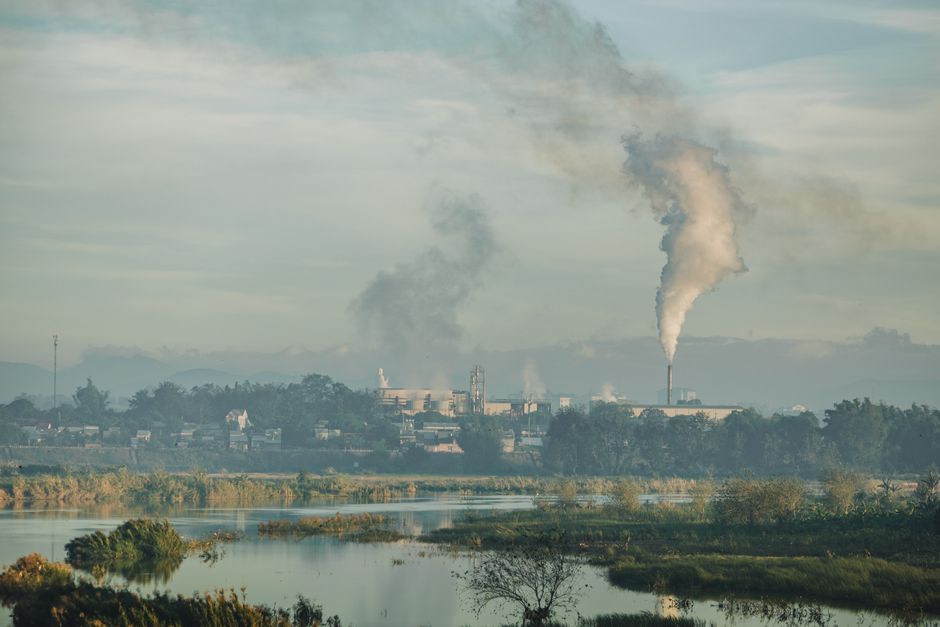
PM 2.5 pollution comes from things that burn. Vehicle engines, power plants, wood stoves, wildfires, and industrial furnaces all release fine particles smaller than 2.5 micrometers in diameter. Some PM 2.5 also forms in the air when gases from these sources react chemically with sunlight and other compounds. The root causes are combustion, certain industrial processes, and the atmospheric chemistry that turns emissions into particles.
That is the short answer. The longer one explains why some cities have far more PM 2.5 than others, why it varies by season, and why reducing it is harder than it looks.
What Causes PM 2.5 Pollution?
PM 2.5 has two origins: primary and secondary. Primary particles are emitted directly as solid or liquid droplets. Secondary particles form in the atmosphere from gases.
Primary sources include combustion engines, residential wood burning, coal-fired power plants, industrial boilers, and wildfires. When fuel burns incompletely, it releases soot and organic compounds that become fine particles.
Secondary formation is less intuitive. Gases like sulfur dioxide (SO2), nitrogen oxides (NOx), ammonia (NH3), and volatile organic compounds (VOCs) drift in the air and react. Sunlight speeds these reactions. The result is sulfate, nitrate, and organic aerosol particles — often far from where the gases were first released.
This distinction matters. A factory can cut its own smokestack emissions and still contribute to PM 2.5 downwind, because the gases it releases keep reacting in the air. Some research suggests secondary formation accounts for a large share of PM 2.5 in many urban areas, though the exact proportion varies widely by region and season.
Which Sources Produce the Most PM 2.5?
The mix depends heavily on where you live. In the United States and Europe, transportation and industry tend to dominate. In parts of Asia and Africa, residential solid fuel burning and dust can be larger contributors.
Broadly, the major source categories are:
- Transportation — diesel and gasoline engines, especially older vehicles and heavy trucks. Diesel exhaust is a well-documented source of fine particles.
- Residential combustion — wood stoves, fireplaces, and in some regions coal or biomass for cooking and heating.
- Power generation and industry — coal plants, refineries, cement kilns, smelters, and manufacturing.
- Agriculture — ammonia from fertilizer and livestock reacts in the air to form secondary particles. Dust from tilling and harvesting adds primary particles.
- Wildfires and prescribed burns — increasingly significant in some regions, and highly variable year to year.
- Dust and construction — road dust, demolition, and unpaved surfaces contribute, though these particles are often larger than 2.5 micrometers.
One clarification worth making: not all air pollution is PM 2.5. Ozone, for example, is a gas, not a particle. It is often reported alongside PM 2.5 on air quality indexes, but it forms and behaves differently.
Why Does PM 2.5 Vary by Season and Location?
Weather and geography shape PM 2.5 as much as emissions do. The same amount of pollution can produce very different air quality depending on conditions.
In winter, cold air often sits close to the ground under a layer of warmer air above — a temperature inversion. This traps pollution near the surface. Residential heating also peaks in cold months, adding smoke and combustion particles. Many cities see their worst PM 2.5 days in winter for this reason.
In summer, sunlight drives secondary formation. Photochemical reactions produce more sulfate and organic aerosol. Wildfire season overlaps with summer in many regions, and smoke can travel hundreds or thousands of miles.
Geography adds another layer. Valleys and basins trap air. Coastal areas may get cleaner air from sea breezes or worse air when winds carry pollution inland. Mountains can block dispersal entirely.
This is why a city’s annual average can look acceptable while its worst days are genuinely unhealthy. Short-term spikes matter for health, and averages can hide them.
How Do Natural Sources Compare to Human Sources?
Nature produces PM 2.5 too. Wildfires, dust storms, volcanic eruptions, and sea spray all release particles. So does vegetation, through compounds that react in the air.
The key difference is scale and timing. Human sources are continuous and concentrated where people live. Natural sources are often episodic — a dust storm or a fire season — but can be intense when they occur.
Wildfires deserve separate mention. They are natural in origin but increasingly influenced by land management, climate conditions, and human ignition. Smoke from large fires can raise PM 2.5 to levels far above typical urban pollution, sometimes across entire regions for weeks.
Some studies indicate that in parts of the western United States, wildfire smoke now accounts for a growing share of unhealthy PM 2.5 days. The trend is real but varies by year and location.
What Role Does Atmospheric Chemistry Play?
Secondary PM 2.5 is chemistry in motion. The main reactions involve a handful of gases, and understanding them explains why pollution control is complicated.
Sulfur dioxide from coal and oil combustion oxidizes in the air to form sulfate particles. These are a major component of haze and can travel long distances.
Nitrogen oxides from vehicles and power plants convert to nitrate particles, especially at night and in cooler conditions.
Ammonia from agriculture reacts with sulfate and nitrate to form ammonium salts — a significant fraction of fine particles in many agricultural regions.
Volatile organic compounds from vehicles, solvents, and vegetation contribute to organic aerosol through complex reactions.
The implication is direct. Cutting SO2 emissions reduces sulfate. Cutting NOx reduces nitrate. But because these gases interact, reducing one can sometimes shift the chemistry and change how much secondary particle mass forms. Air quality models account for this; simple assumptions do not.
Why Is PM 2.5 Harder to Control Than Larger Particles?
Fine particles stay in the air longer and travel farther. Larger particles settle out relatively quickly. PM 2.5 can remain suspended for days and cross state or national borders.
This creates a governance problem. A region can meet its own emission targets and still experience unhealthy PM 2.5 from sources hundreds of miles away. Wildfire smoke is the clearest example, but industrial and agricultural emissions cross boundaries too.
Control technology exists for many sources. Diesel particulate filters, scrubbers on power plants, cleaner fuels, and improved combustion all reduce emissions. The evidence that these measures lower ambient PM 2.5 is well established. What varies is how quickly and completely they are adopted, and whether secondary formation responds as expected.
Some interventions work better than others depending on the local mix. A city dominated by vehicle emissions will benefit most from transportation measures. A region dominated by agriculture will need a different approach. There is no single fix.
What Does This Mean for Air Quality Improvement?
Reducing PM 2.5 requires addressing both primary emissions and the gases that form secondary particles. It also requires coordination across regions, because pollution does not respect boundaries.
Monitoring matters. You cannot manage what you do not measure, and PM 2.5 varies sharply by location and hour. Regulatory networks and lower-cost sensors have improved coverage, though sensor accuracy varies and calibration matters.
For individuals, the practical takeaway is that local air quality reports are worth checking, especially on days with inversions, wildfire smoke, or high heat. The evidence is strong that PM 2.5 exposure is linked to respiratory and cardiovascular health effects. Reducing exposure on bad days is a reasonable step, though the specific health benefit of any single action for any single person is difficult to quantify.
The bigger picture is that PM 2.5 is largely a byproduct of combustion and industrial activity. Where those activities are reduced or cleaned up, air quality tends to improve. The relationship is not always linear, and secondary chemistry adds uncertainty, but the direction is consistent across many regions that have cut emissions.
Frequently Asked Questions
What is the main cause of PM 2.5 pollution?
Combustion is the main cause — vehicle engines, power plants, wood burning, and industry release fine particles directly and release gases that form them in the air. The exact mix varies by region and season.
Is PM 2.5 natural or human-made?
Both. Wildfires, dust storms, and sea spray produce PM 2.5 naturally, but human sources are typically continuous and concentrated where people live, making them the dominant contributor in most urban areas.
Why is PM 2.5 worse in winter?
Cold air often traps pollution near the ground under a temperature inversion, and residential heating adds smoke and combustion particles. Many cities see their highest PM 2.5 levels in winter for these reasons.
Can PM 2.5 travel long distances?
Yes. Fine particles can stay suspended for days and cross state or national borders, which is why a region can have unhealthy air from sources far away. Wildfire smoke is a clear example.
