
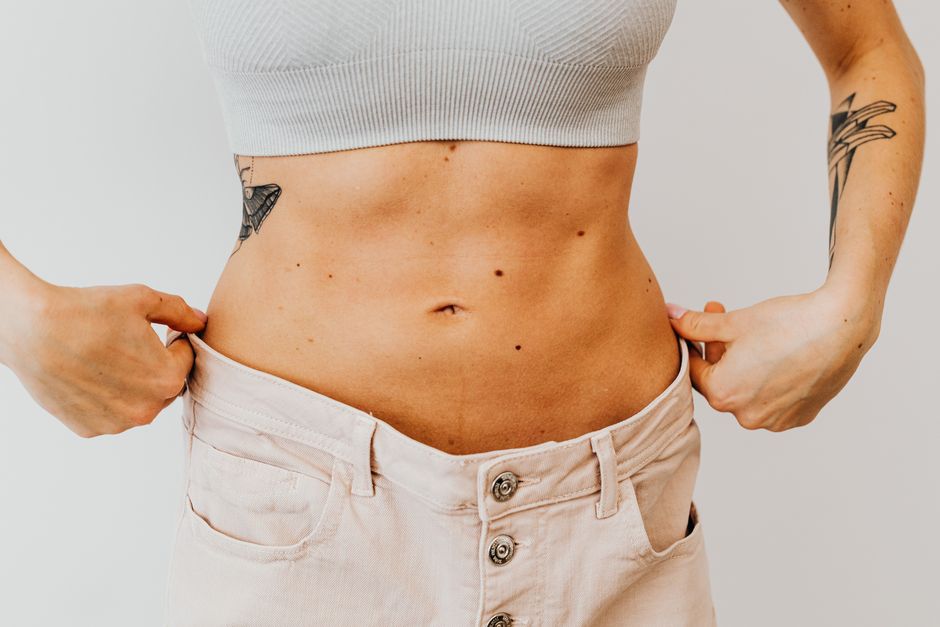
Pregnancy stretches skin faster than the body can rebuild its support structure. The result is loose, crepey, or sagging skin — most often on the belly, but also on the breasts and thighs. Some of this tightens on its own in the months after birth. Some does not fully reverse, and how much depends on factors largely outside your control: genetics, age, how much your belly stretched, and how many pregnancies you’ve had.
There is no cream, wrap, or supplement that has been shown to rebuild stretched skin. That is not a marketing position — it is what the evidence shows. What follows explains what is actually happening in your skin, what genuinely recovers, and what the realistic options are.
What Causes Loose Skin After Pregnancy And Can It Heal?
Loose skin after pregnancy comes from two separate changes that happen at the same time: the skin itself stretches and loses some of its elastic quality, and the connective tissue that holds your abdominal muscles together can separate. These are different problems with different outlooks, and confusing them leads to a lot of wasted money.
The skin change is real and measurable. Your skin is built on two proteins — collagen, which gives it strength, and elastin, which lets it snap back. During pregnancy the belly expands over months. Collagen fibers rearrange to accommodate the growth. Elastin fibers can break, and here is the part that matters: elastin does not regenerate well in adult skin. Once those fibers are damaged, your body does not rebuild them the way it rebuilds collagen.
The second change is a gap in the linea alba, the band of connective tissue running down the middle of your abdomen. When it widens, the belly can still look rounded or “pouchy” long after the uterus has shrunk back. This is called diastasis recti. It is not the same as loose skin, and it does not respond to skin creams either.
Can it heal? Partly. Skin that stretched moderately often tightens noticeably in the first six to twelve months after birth as swelling resolves and collagen remodels. Skin with significant elastin damage — often visible as stretch marks — typically does not return to its pre-pregnancy state on its own. That is the honest answer, and it is not a failure on your part.
Why Does Skin Lose Elasticity During Pregnancy?
Hormones drive much of the change. During pregnancy, levels of relaxin and other hormones rise. Relaxin’s job is to loosen the connective tissue in your pelvis so the baby can pass through. It does not limit itself to the pelvis. Connective tissue throughout the body becomes more pliable, including the tissue that supports your skin.
At the same time, the mechanical stretch is enormous. Skin on the abdomen may expand far beyond what it was designed to hold. When skin is stretched past a certain point, and held there for months, some elastic fibers fail. This is why stretch marks form — they are essentially small areas where the deeper layer of skin (the dermis) has torn.
Collagen production also shifts. The body is prioritizing building a baby and a placenta, and skin remodeling is not the priority it would be in a non-pregnant state. Some research suggests collagen synthesis in the skin is altered during pregnancy, though the exact picture is complex and not fully mapped.
One clarification worth having: loose skin and stretch marks are related but not identical. You can have significant stretch marks with skin that tightens reasonably well, or mild stretch marks with skin that stays loose. The stretch marks are a visible sign of dermal tearing. The looseness is about overall elastic recoil.
What Makes Loose Skin More Likely After Pregnancy?
Some factors you can influence and some you cannot. Being clear about which is which saves a lot of guilt.
Factors largely outside your control:
- Genetics. How your skin ages and how well it recoils is strongly inherited. If your mother or sisters had significant loose skin after pregnancy, you are more likely to as well.
- Age at pregnancy. Skin elasticity declines with age. This is a gradual, well-documented change in collagen and elastin content.
- Number of pregnancies. Each pregnancy stretches the skin again, and repeated stretching accumulates.
- How much your belly stretched. Larger babies, twins, or polyhydramnios (excess amniotic fluid) mean more stretch.
- Pre-pregnancy skin quality and sun exposure history. Sun damage breaks down collagen and elastin over decades.
Factors you may have some influence over:
- Rate of weight gain during pregnancy. Rapid gain stretches skin faster than it can adapt. Gradual gain is generally easier on the skin.
- Smoking. Smoking damages collagen and elastin and impairs skin healing. This is well established.
- Hydration and nutrition. Adequate protein and overall nutrition support collagen synthesis, though no diet has been shown to prevent loose skin.
Notice what is not on either list: whether you exercised during pregnancy, whether you used a belly butter, or how quickly you “bounced back.” None of these have been shown to determine the outcome.
Does Loose Skin Tighten On Its Own After Birth?
Yes, some of it does — and the amount is often underestimated. In the first weeks after birth, much of the “loose” appearance is actually swelling and a still-enlarged uterus. The uterus takes roughly six weeks to return to near its pre-pregnancy size. As that happens, the belly visibly flattens.
Over the following months, collagen remodeling continues. Skin that was stretched but not severely damaged gradually regains some tone. Most of the natural improvement happens in the first year. After that, further spontaneous tightening is limited.
How much tightens varies enormously between people. Some people see their skin return close to its previous state. Others see a lasting change in the texture and firmness of the skin on the belly. Both outcomes are common, and neither reflects anything you did wrong.
Breast changes follow a different pattern. Breasts enlarge and then shrink, and the skin envelope may not return to its previous shape. This is one of the most common and least discussed changes after pregnancy and breastfeeding.
Do Creams, Wraps, or Supplements Help Loose Skin?
No cream, wrap, or oral supplement has been shown in good-quality human studies to restore skin elasticity after pregnancy. This is not a close call. The dermis is where the damage is, and topical products do not penetrate deeply enough to rebuild elastin fibers there.
Some products contain ingredients with plausible mechanisms — retinoids, vitamin C, peptides, hyaluronic acid. Retinoids are the best-studied topical for skin aging in general, and some evidence supports their use for fine lines. But they have not been shown to reverse pregnancy-related loose skin, and they are not recommended during pregnancy or breastfeeding. Vitamin C and peptides have modest evidence for skin appearance in general aging, not for post-pregnancy elasticity.
Belly wraps and binders are widely sold and sometimes recommended by clinicians for comfort and support in the early postpartum weeks. There is no good evidence they change the final appearance of your skin. Some clinicians recommend them for back support or comfort; that is a different purpose than skin tightening.
Collagen supplements are heavily marketed for skin. The evidence is limited and mixed. Some small studies suggest collagen peptides may modestly improve skin hydration and elasticity, but the research is not strong enough to promise a visible change in loose skin after pregnancy. No clinical guidelines currently recommend collagen supplements for this purpose.
Be wary of any product that claims to “rebuild elastin.” No topical product has been shown to do this.
What Actually Helps Loose Skin After Pregnancy?
The honest answer is that the interventions with the strongest evidence are procedural, not topical — and even those are modest and not risk-free.
Time. The first year after birth is when most natural improvement happens. Giving your body that time before pursuing other options is reasonable.
Gradual weight loss if you have weight to lose. If you are carrying extra weight after pregnancy, losing it gradually can improve the appearance of the skin. Rapid weight loss can make loose skin look worse, because the skin has less volume beneath it. Slow, steady loss gives skin some chance to adapt.
Strength training. Building the muscles beneath the skin does not tighten the skin itself. But it can improve the contour of the abdomen and the overall appearance of the midsection. This is a real effect, though it is often overstated in fitness marketing. Strength training also supports posture, which affects how the belly looks.
Addressing diastasis recti separately. If the belly still looks rounded months after birth, a gap in the abdominal muscles may be part of the picture. Physical therapy focused on deep core and pelvic floor function is often recommended. Some clinicians refer to this as pelvic floor physical therapy. Evidence for specific exercise protocols is growing but not definitive. What is clear: if you have a significant gap, no amount of skin cream will change it.
Procedures. For significant loose skin, the interventions with the most evidence are medical procedures — radiofrequency, ultrasound-based tightening, and in more significant cases, abdominoplasty (tummy tuck surgery). These carry real risks, costs, and recovery time. Results vary. A tummy tuck removes excess skin, which is the only intervention that physically removes it. Non-surgical tightening devices produce modest, temporary improvements in some people. None of these should be entered into casually, and a consultation with a board-certified dermatologist or plastic surgeon is the appropriate starting point. This is informational, not a recommendation.
When Should You Talk to a Doctor?
Talk to a clinician if the looseness is accompanied by a bulge in the middle of your abdomen that gets worse when you sit up or strain. That pattern can suggest diastasis recti, which is worth assessing properly.
Also seek evaluation if you have persistent pain, a feeling of heaviness in the pelvis, or symptoms that suggest pelvic floor dysfunction — leaking urine, difficulty holding stool, or a sensation of bulging. These are common after pregnancy and treatable, and they are not something to simply live with.
If the appearance of your skin is affecting your mental health, that is also a reason to talk to someone. Body changes after pregnancy are common and the distress they cause is real. It is not vanity to want support with it.
Frequently Asked Questions
Can loose skin after pregnancy tighten back up?
Some of it usually does, especially in the first six to twelve months after birth as swelling resolves and collagen remodels. Skin with significant elastin damage often does not return fully to its pre-pregnancy state.
Does exercise tighten loose skin on the belly?
Exercise builds the muscles under the skin but does not tighten the skin itself. Strength training can improve the contour and appearance of the midsection, which is a different effect than skin tightening.
Do belly creams or oils prevent loose skin?
No cream or oil has been shown to prevent or reverse pregnancy-related loose skin. The damage is in the deeper layer of skin, and topical products do not reach it in a way that rebuilds elastin.
Is loose skin after pregnancy permanent?
It can be, particularly when stretch marks are significant or multiple pregnancies have occurred. Many people see meaningful improvement in the first year, and procedures can remove excess skin, but full reversal is not guaranteed.
