
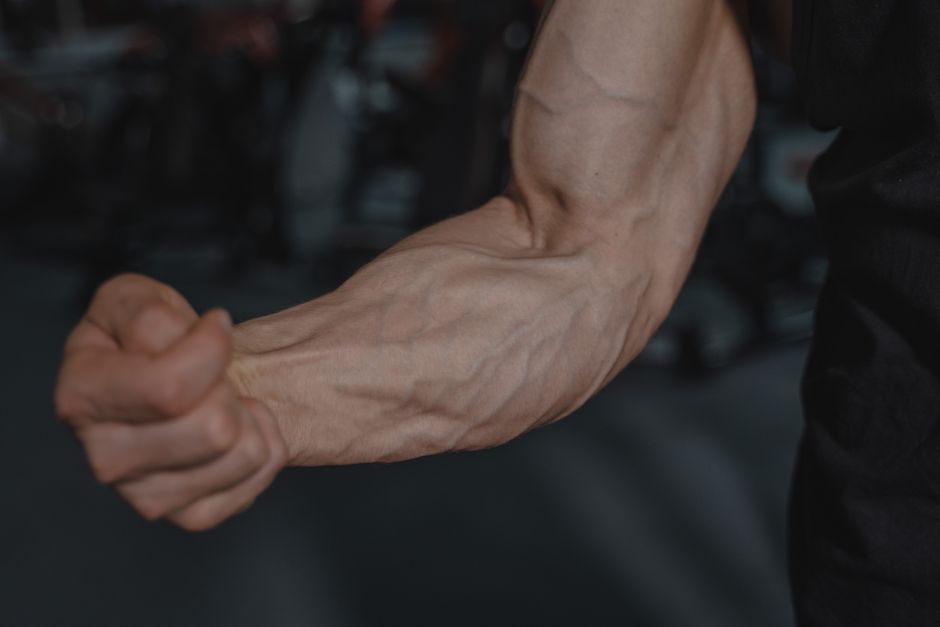
If your forearms ache or burn during curls, rows, or pull-ups, the pain usually comes from one of a few specific structures: the wrist flexor or extensor muscles, their tendons, or the elbow tendons where those muscles attach. The most common cause during lifting is overload of the forearm muscles and their tendons, especially the flexor group that runs from the inner elbow down to the wrist and fingers. When you grip a bar hard and pull, those muscles work far harder than most people realize.
Forearm pain during lifting is rarely random. It tends to follow a pattern tied to grip, wrist position, and how much load the tendons can handle. Understanding which structure is involved changes what you do about it.
What Causes Forearm Muscle Pain When Lifting?
The forearm pain you feel during lifting almost always traces back to muscles and tendons being asked to do more than they are conditioned to handle. The forearm contains two main muscle groups: the flexors on the palm side and the extensors on the back of the hand side. Both cross the wrist, and the flexors also cross the elbow at the medial epicondyle.
When you grip a barbell, dumbbell, or pull-up bar, the flexor muscles contract to close your fingers and stabilize your wrist. Under heavy load or high volume, these muscles and the tendons connecting them to bone can become irritated, strained, or inflamed. That is the mechanism behind most forearm pain in the gym.
Several specific problems fall under this umbrella:
- Muscle strain — small tears in the muscle fibers from sudden overload or a rapid increase in training
- Tendinopathy — tendon irritation or degeneration, often from repeated stress over weeks or months
- Medial epicondylitis (golfer’s elbow) — pain at the inner elbow where the wrist flexors attach
- Lateral epicondylitis (tennis elbow) — pain at the outer elbow where the wrist extensors attach
- Compartment syndrome — a rare but serious condition where pressure inside the forearm builds up
Most lifters are dealing with one of the first four. The fifth is uncommon but needs urgent medical attention if it occurs.
Why Does Gripping Heavy Weights Cause Forearm Pain?
Grip is the hidden workload in almost every pulling exercise. When you deadlift 300 pounds, your forearm flexors are contracting the entire time to hold the bar. That is a sustained isometric contraction, and it can fatigue the muscles and stress the tendons even if your back and legs feel fine.
The flexor muscles originate at the medial epicondyle of the elbow and run down to the wrist and fingers. Every time you squeeze a bar, these muscles pull on that attachment point. Repeated pulling on the same spot without adequate recovery is a common pathway to tendon pain at the elbow.
This is why forearm pain often shows up not during the exercise but the next day, or when you grip something firmly outside the gym. The tissue was overloaded, and the soreness or irritation lingers.
There is a detail many lifters miss: your grip endurance is often the limiting factor in a set, not the muscle you think you are training. If your forearms give out before your back does on rows, your grip is the weak link, and it is absorbing disproportionate stress.
Is It a Muscle Strain or a Tendon Problem?
Muscle strains and tendon problems feel different and behave differently. A muscle strain usually produces a sudden, sharp pain during a specific movement, often with a sense of something pulling or tearing. It tends to hurt most in the first few days and then improves steadily.
Tendon problems develop more gradually. The pain builds over weeks, is often worse in the morning or after rest, and tends to warm up with activity before hurting again afterward. Tendinopathy is a degenerative process, not simple inflammation, which is why rest alone often does not resolve it.
Where the pain sits can help you tell them apart:
- Pain in the meat of the forearm, away from the elbow or wrist — likely muscular
- Pain right at the inner or outer elbow — likely a tendon attachment issue
- Pain along the wrist or into the hand — could involve the wrist tendons or a nerve
This is a rough guide, not a diagnosis. A clinician can distinguish these with a physical exam, and imaging is sometimes used when the picture is unclear.





Can Forearm Pain Be Caused by Something Other Than Muscle?
Yes, and this matters because the treatment is different. Nerve compression in the forearm or wrist can produce pain, tingling, numbness, or weakness that feels like a muscle problem but is not.
Carpal tunnel syndrome compresses the median nerve at the wrist. Cubital tunnel syndrome compresses the ulnar nerve at the inner elbow. Both can cause forearm discomfort, and both can be aggravated by certain lifting positions. If you notice numbness, tingling, or a weak grip that does not match the effort you are putting in, that points toward a nerve issue rather than a muscle one.
Compartment syndrome is rare in recreational lifters but serious. It causes severe pain, swelling, tightness, and sometimes numbness in the forearm, often after intense or unusual exertion. It is a medical emergency. If your forearm becomes swollen, tight, and painful out of proportion to what you did, seek care immediately.
Other possibilities include referred pain from the neck or shoulder, and in rare cases, blood vessel problems. These are uncommon, but they are reasons to get persistent or unusual forearm pain evaluated rather than self-treating indefinitely.
What Makes Forearm Pain Worse During Training?
Certain training habits reliably aggravate forearm pain. Recognizing them helps you decide what to change.
- Rapid increases in load or volume — tendons adapt more slowly than muscles, so a fast jump in weight stresses them
- Excessive gripping work — heavy deadlifts, shrugs, farmer’s carries, and pull-ups done in the same week
- Wrist position — a bent-back wrist during pressing or curling increases strain on the flexors and extensors
- Using straps or a false grip inconsistently — changing grip style suddenly can shift stress to unprepared tissue
- Skipping warm-ups — cold tendons and muscles tolerate load less well
One underappreciated factor is doing too many pulling exercises back to back. If every session hammers your grip, the forearm never gets a real chance to recover, and irritation accumulates.
When Should You See a Doctor for Forearm Pain?
Most mild forearm soreness from lifting settles with relative rest and load management. But some signs mean you should get it checked.
See a clinician if you have:
- Severe pain, swelling, or tightness in the forearm
- Numbness, tingling, or weakness in the hand
- Pain that persists for more than a few weeks despite rest
- Pain that wakes you at night or is worsening over time
- A visible deformity or you heard a pop with sudden pain
These signs can point to a nerve problem, a significant tear, or compartment syndrome. Getting an accurate diagnosis early usually means a faster path back to training.
How Is Forearm Pain From Lifting Usually Managed?
For common muscle and tendon issues, the general approach is to reduce the aggravating load while keeping the tissue active. Complete rest is often not necessary and can make tendons less tolerant of load over time. Instead, clinicians typically recommend modifying training so the forearm is stressed less while it recovers.
Common strategies include:
- Reducing grip-intensive exercises temporarily
- Using straps to offload the forearms on pulling movements
- Lowering weight and increasing repetitions to build tendon tolerance gradually
- Addressing wrist position so the joint stays closer to neutral
- Gradual loading programs for tendons, which some evidence supports for tendinopathy
Some clinicians recommend eccentric exercises for tendon problems, and physical therapy is often used for persistent cases. The evidence for specific protocols varies, so it is worth working with a professional rather than guessing. Pain relief approaches like ice or anti-inflammatory medication may help symptoms in the short term, but they do not address the underlying tendon changes.
For nerve-related pain or suspected compartment syndrome, the approach is different and requires medical evaluation. Do not try to train through those.
Can You Prevent Forearm Pain From Lifting?
You can reduce the risk, though no approach eliminates it entirely. The most reliable steps involve managing how fast you add load and how much grip work you stack into a week.
- Increase weight and volume gradually rather than in jumps
- Build grip strength as its own training goal so it is not always the weak link
- Vary grip positions and use straps when grip is not the point of the exercise
- Warm up the forearms before heavy pulling
- Give the forearms recovery time between grip-heavy sessions
Grip strength training is often overlooked. A forearm that is conditioned to handle load tolerates it better, much like any other muscle. But even a strong forearm has limits, so recovery still matters.
Frequently Asked Questions
Why do my forearms hurt when I lift weights?
Your forearm flexor and extensor muscles and their tendons are being overloaded by gripping and stabilizing the weight. This shows up as muscle strain, tendon irritation, or elbow tendon pain depending on which structure is involved.
Is forearm pain during lifting a sign of something serious?
Usually not, but severe swelling, tightness, numbness, or weakness can signal a nerve problem or compartment syndrome, which need urgent care. Persistent pain lasting weeks should also be evaluated.
Should I stop lifting if my forearms hurt?
Not necessarily. Reducing grip-heavy load and modifying exercises is often enough for mild cases, but sharp pain, swelling, or numbness means you should stop and get it checked.
How long does forearm muscle pain from lifting take to heal?
Minor muscle soreness often improves within a few days, while tendon problems can take weeks to months to settle. Timelines vary widely based on the specific injury and how it is managed.
