
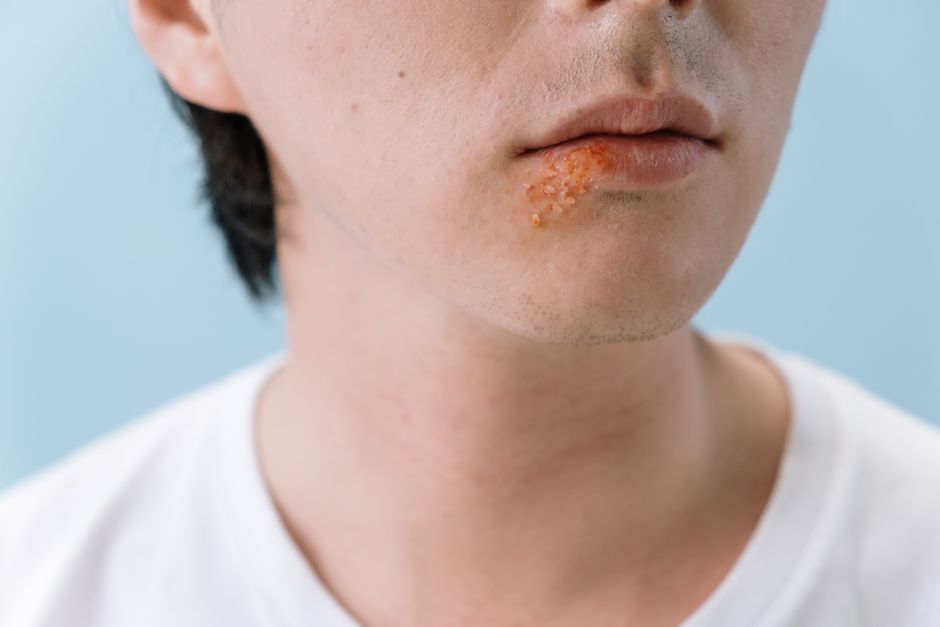
Cold sores are small, fluid-filled blisters that usually appear on or around the lips. They do not typically form inside the mouth on the cheeks, tongue, or gums. If you have a sore inside your mouth, it is likely a canker sore, not a cold sore. Cold sores are caused by the herpes simplex virus, most often HSV-1. Once you are infected, the virus stays in your body for life. It can become active again and cause new sores when certain triggers weaken your immune system.
What causes cold sores?
Cold sores are caused by infection with the herpes simplex virus. Two types exist: HSV-1 and HSV-2. HSV-1 is responsible for the vast majority of cold sores. HSV-2 is more commonly linked to genital herpes but can also cause oral sores.
The virus enters the body through a break in the skin or through mucous membranes. After the first infection, the virus travels to nerve cells near the ear or jaw. There it stays dormant. Most people are exposed to HSV-1 during childhood. By age 50, roughly two-thirds of the world’s population carries the virus. Many infected people never develop symptoms or notice only mild irritation.
Once you carry the virus, you are prone to recurrent outbreaks. The virus reactivates, travels back down the nerve, and causes a blister at or near the original site of infection. Exactly why it reactivates in some people but not others is not fully understood, but several known triggers play a role.
What triggers an outbreak?
Several factors can wake the dormant virus. Common triggers include:
- Stress — emotional or physical stress weakens the immune system, making reactivation more likely.
- Illness — a cold, flu, or fever puts extra demand on the body.
- Sun exposure — ultraviolet light can damage the lip area and trigger a sore.
- Fatigue — lack of sleep lowers immune defenses.
- Hormonal changes — some women get outbreaks around their menstrual period.
- Injury to the lip area — dental work, a cut, or even windburn can provoke an outbreak.
Not everyone has the same triggers. Some people can identify their personal pattern. Others get outbreaks without any clear cause.
Are cold sores the same as canker sores?
No. They are completely different conditions. Canker sores — also called aphthous ulcers — appear inside the mouth: on the cheeks, tongue, soft palate, or gums. They are not caused by a virus. Their cause is not fully known, but genetics, minor injury, stress, and certain foods may contribute.
Cold sores are caused by herpes simplex virus. They appear on the lips or on the skin around the mouth. Occasionally they can appear on the hard palate (roof of the mouth), but this is less common. If you have a sore inside your mouth that is not on the hard palate, it is almost certainly a canker sore. Canker sores are not contagious. Cold sores are highly contagious.





How does the virus spread?
Herpes simplex virus spreads through direct contact. This can be kissing, sharing utensils, razors, towels, or lip balm. The virus is present in the fluid from the blister. It can spread even when no sore is visible — a process called asymptomatic shedding. This means you can pass the virus to someone else without knowing it.
The highest risk of transmission occurs when a blister is present. The virus is very contagious from the first tingle until the sore is completely healed and scabbed over. Touching the sore and then touching another part of your body — such as your eyes or genitals — can spread the virus to those areas.
Once a person is infected with HSV-1, they cannot be reinfected at the same site, but they can develop sores elsewhere. For most people, primary infection happens in childhood and may cause symptoms like fever, swollen glands, and painful mouth sores. After that, recurrent cold sores are milder and more localized.
What causes cold sores in your mouth specifically?
The title question is important to address clearly. Cold sores rarely occur on the inside of the cheeks, lips, or tongue. When herpes simplex affects the inside of the mouth, it is usually during a first-time (primary) infection, called herpetic gingivostomatitis. This happens most often in children and can cause many small sores on the gums, tongue, and inside the cheeks. Recurrent outbreaks of oral herpes almost always appear on the lips or the skin around the mouth.
If an adult gets a single sore inside the mouth on the hard palate (roof of the mouth), it could be a cold sore. But sores on the soft palate or inside the cheek are almost certainly canker sores or another condition. If you develop sores inside your mouth frequently or they last longer than two weeks, see a dentist or doctor for an accurate diagnosis. Do not assume it is a cold sore.
Can you prevent cold sores?
You cannot cure the infection, but you can reduce outbreaks and lower transmission risk. Some strategies have good evidence behind them:
- Avoid known triggers. If you know sun triggers your outbreaks, use lip balm with SPF 30 or higher.
- Manage stress. Regular sleep, exercise, and relaxation techniques may help.
- Use antiviral medication. Prescription creams or pills (acyclovir, valacyclovir, famciclovir) can shorten outbreaks and reduce frequency when taken daily.
- Do not share personal items during an outbreak or when you feel a tingle.
- Wash your hands after touching a sore.
No supplements, vitamins, or lysine have been proven in large clinical trials to prevent cold sores effectively. Some people report benefit, but the evidence is limited. If you choose to try lysine, discuss it with your doctor. Do not expect a guaranteed effect.
When should you see a doctor?
Most cold sores heal on their own within 7 to 10 days. You do not need medical treatment for every outbreak. But see a doctor if:
- You have frequent or severe outbreaks.
- The sores do not heal within two weeks.
- You have a weakened immune system from chemotherapy, organ transplant, or HIV.
- The sore spreads near your eyes or causes eye pain or irritation.
- You develop a fever or feel very ill.
If you are pregnant and get a cold sore near delivery, tell your obstetrician. Newborns can get serious herpes infections, though this is rare when the mother already has HSV-1.
Frequently Asked Questions
Can you get cold sores inside your mouth?
Yes, but it is uncommon. Recurrent cold sores usually appear on the lips or skin around the mouth. Inside the mouth, they can occur on the hard palate (roof of the mouth) during an outbreak. Sores on the cheeks, tongue, or gums are more likely canker sores or another condition.
What does a cold sore look like when it first starts?
It often begins with a tingling, burning, or itching sensation in one spot on or near the lip. Within 12 to 24 hours, a small red bump appears and quickly becomes a fluid-filled blister or cluster of blisters.
Are cold sores contagious before they appear?
Yes. The virus can be shed from the skin even before you notice any symptoms. This is called asymptomatic shedding. During the tingling phase, you are already contagious.
Can stress alone cause a cold sore outbreak?
Yes, stress is a well-documented trigger for many people. Emotional or physical stress weakens your immune system’s ability to keep the virus dormant, making reactivation more likely.
