
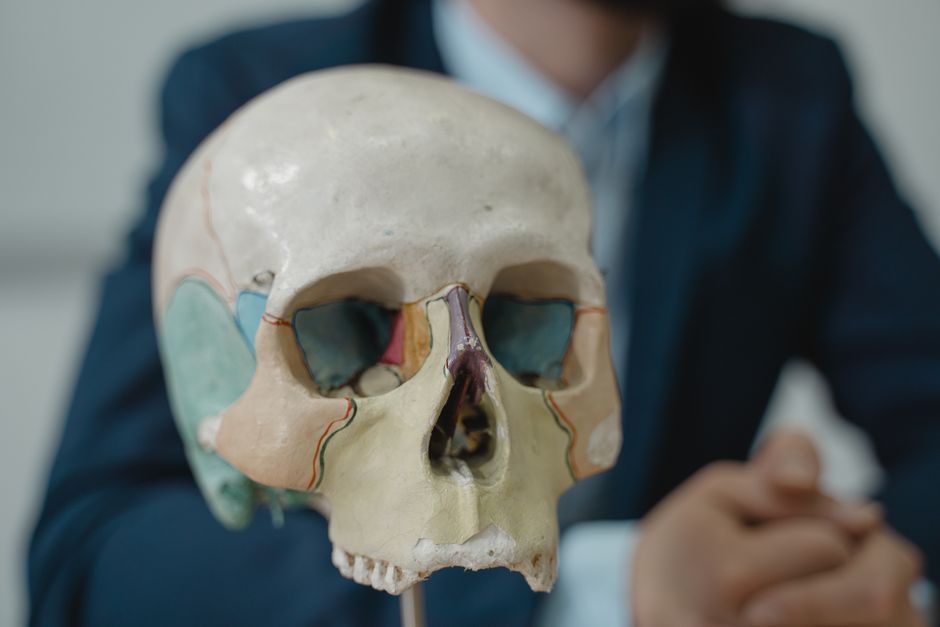
An abnormal skull shape in adults is rarely a new problem. Most often, it is the result of a condition that began in infancy or childhood, such as premature closure of the skull plates, and was not corrected or became more noticeable as the face and skull matured. In some cases, an adult skull shape changes due to trauma, surgery, or a progressive bone disease. The most common root causes fall into three categories: congenital conditions present since birth, acquired changes from injury or medical treatment, and metabolic or bone disorders that alter the skull’s structure over time.
What Causes An Abnormal Skull Shape In Adults? Root Causes
The shape of the adult skull is determined by genetics, growth during childhood, and any events that affect the bones of the head. The skull is not a single bone. It is made of several bones that fuse together along joints called sutures. In infants, these sutures are open to allow the brain to grow. If one or more sutures close too early, a condition called craniosynostosis, the skull grows in an abnormal shape. This is usually diagnosed and treated in infancy. Adults with untreated craniosynostosis have a skull shape that has been stable for years. The shape does not worsen in adulthood because brain growth is complete, but the cosmetic and structural changes remain.
Other causes include Paget’s disease of bone, which can thicken and enlarge the skull over time. Acromegaly, a condition of excess growth hormone, can also enlarge the skull and facial bones. Trauma that heals poorly can leave visible asymmetry. Surgical procedures that remove part of the skull for brain surgery can change its contour. Some adults simply notice a shape they have always had, but it becomes more prominent as facial fat decreases with age.
How Can You Tell If a Skull Shape Is Normal or Abnormal?
There is a wide range of normal skull shapes. Some heads are rounder, some are longer front to back, and some are flatter on one side. A truly abnormal shape usually involves a visible asymmetry or a prominent ridge along the top or back of the head.
Doctors assess skull shape by physical examination first. They look at the head from above, from the side, and from the front. They feel along the suture lines for ridges or depressions. If a shape change is new or painful, imaging is the next step. A CT scan is the most accurate way to evaluate the bones of the skull. Plain X-rays can show some abnormalities but are less detailed.
It is important to distinguish between a shape that has always been that way and a shape that is changing. A stable shape that has been present since childhood is almost never a medical emergency. A shape that is changing in adulthood, especially if accompanied by pain, headache, or neurological symptoms, requires prompt medical evaluation.
What Are the Congenital Conditions That Cause Skull Deformity?
Craniosynostosis is the most common congenital cause. It occurs in about 1 in 2,000 to 2,500 births. The specific shape depends on which suture closed early.
- Sagittal synostosis (closure of the top suture) produces a long, narrow head called scaphocephaly.
- Coronal synostosis (closure of the suture running from ear to ear over the top) produces a flattened forehead and a high, prominent eye socket on the affected side.
- Metopic synostosis (closure of the forehead suture) produces a triangular forehead with a ridge down the center.
- Lambdoid synostosis (closure of the back suture) produces a flat back of the head on one side.
Positional plagiocephaly is different. This is a flat spot caused by pressure on the back or side of the head in infancy, not by early suture closure. It is common and usually improves with repositioning or helmet therapy. Adults who had positional plagiocephaly as infants may have a mild flat spot that persists, but it is generally not progressive and does not affect brain function.
Genetic syndromes can also cause skull shape abnormalities. Conditions like Apert syndrome, Crouzon syndrome, and Pfeiffer syndrome involve craniosynostosis along with other facial and limb differences. These are usually diagnosed in infancy because they are obvious at birth.





Can Trauma or Surgery Change Adult Skull Shape?
Yes. Head trauma is a common cause of acquired skull deformity in adults. A depressed skull fracture can leave a visible indentation if it heals without surgical elevation. Severe fractures can change the contour of the forehead, temple, or cheekbone.
Neurosurgery is another cause. A craniectomy removes a section of the skull to relieve pressure on the brain. This is done for conditions like traumatic brain swelling or after a stroke. The bone flap may be replaced later, or a synthetic plate may be used. The cosmetic result depends on how well the bone heals and whether any infection or bone resorption occurs.
Some adults notice asymmetry after sinus surgery or dental implant procedures that involve the upper jaw. These changes are usually minor. Significant skull shape changes from surgery are almost always the result of major neurosurgical or craniofacial procedures.
What Bone Diseases Can Change Skull Shape in Adults?
Paget’s disease of bone is the most notable condition that can enlarge or deform the skull in adults. It is a disorder of bone remodeling where the normal process of breaking down and rebuilding bone goes out of balance. The affected bone becomes enlarged, thickened, and structurally weak. When Paget’s affects the skull, it can cause the head to enlarge, sometimes noticeably. This can compress nerves and cause hearing loss or headaches. Paget’s disease is more common in people over 55 and is diagnosed by blood tests showing elevated alkaline phosphatase and by imaging.
Acromegaly is another condition that changes skull and facial bone shape in adults. It is caused by a benign pituitary tumor that produces excess growth hormone. Because the skull sutures are closed in adulthood, the bones cannot grow longer, but they can thicken. The forehead becomes more prominent, the jaw enlarges, and the facial features coarsen. These changes develop slowly over years. Acromegaly is diagnosed by measuring growth hormone and insulin-like growth factor-1 levels in the blood.
Fibrous dysplasia is a condition where normal bone is replaced by fibrous tissue. It can affect one bone or multiple bones. When it affects the skull, it causes a painless, gradual swelling of the affected area. It usually begins in childhood or adolescence and stabilizes in adulthood, though it can sometimes continue to grow slowly.
When Should an Adult See a Doctor About Skull Shape?
A stable skull shape that has been present for years does not require medical attention. You should see a doctor if you notice a change in skull shape that is new, if you have pain in the skull or face, or if you have headaches, vision changes, hearing loss, or any neurological symptoms.
Sudden changes in skull contour are rare but can occur with certain tumors or infections. A growing lump on the skull could be a benign bone tumor like an osteoma, a cyst, or in rare cases a malignant process. Imaging is needed to determine what the lump is.
If you are concerned about the appearance of your skull shape, a plastic surgeon or a craniofacial specialist can discuss surgical options. Craniofacial surgery in adults is more complex than in children because the bones are fully fused and harder to reshape. Recovery is longer, and the risks are higher. Some adults choose surgery for cosmetic reasons. Others need it to relieve pressure on the brain or to correct functional problems.
What Is the Treatment for Abnormal Skull Shape in Adults?
Treatment depends entirely on the cause. For congenital craniosynostosis that was not treated in childhood, surgery in adulthood is possible but requires careful planning. The procedure involves cutting the fused sutures and reshaping the bone. This is a major operation that requires a specialized surgical team.
For Paget’s disease, treatment focuses on controlling bone turnover with medications called bisphosphonates. These drugs can slow the progression of the disease and reduce pain. They cannot reverse skull deformity that has already occurred.
For acromegaly, treatment targets the pituitary tumor. Surgery to remove the tumor is the first-line approach. Medications and radiation therapy are options if surgery is not successful. Treating the underlying hormone excess stops further bone thickening but does not reverse changes already present.
For trauma-related deformities, reconstructive surgery can restore contour using the patient’s own bone, synthetic implants, or bone cement. The timing of surgery depends on when the injury occurred and whether any prior surgeries have healed completely.
No clinical guidelines exist for cosmetic reshaping of a normal but unusual skull shape in an otherwise healthy adult. This is an elective procedure. If you are considering it, seek a surgeon who specializes in craniofacial reconstruction and ask about realistic outcomes and risks.
Frequently Asked Questions
Can an adult skull shape change on its own?
In a healthy adult, the skull shape does not change on its own because the sutures are closed and bone growth is complete. If you notice a change, it warrants medical evaluation for conditions like Paget’s disease, acromegaly, or a growing mass.
Is an asymmetrical skull shape dangerous in adults?
An asymmetrical shape that has been present since childhood is usually not dangerous. A new asymmetry or one accompanied by pain, headaches, or neurological symptoms requires prompt evaluation with imaging.
Can adult skull shape be corrected with surgery?
Yes, craniofacial surgery can reshape the adult skull, but it is a major procedure with higher risks than in children. It is performed by specialized craniofacial surgeons for functional problems or significant cosmetic concerns.
Does a misshapen head affect brain function in adults?
No, an abnormal skull shape does not compress the brain in adults because brain growth is complete and the skull has accommodated its final size. Conditions that cause progressive skull thickening, like Paget’s disease, can affect brain function, but the shape alone does not.
