
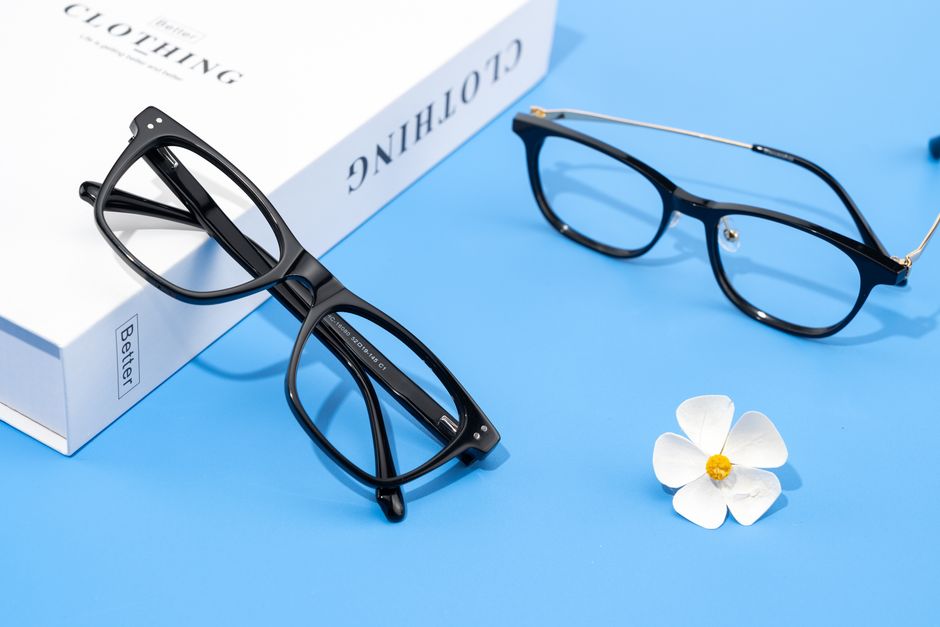
Presbyopic glasses are reading glasses or progressive lenses designed to correct presbyopia, the age-related loss of near vision that typically begins after age 40. These glasses work by adding a plus-power lens that refocuses close-up objects onto the retina, compensating for the eye’s stiffening lens that can no longer change shape easily. The extra magnifying power in the lower portion of the lens restores clear near vision for tasks like reading, texting, or working on a computer.
What Causes Presbyopia in the First Place?
Presbyopia is not a disease. It is a natural part of aging. The lens inside your eye is flexible when you are young. Tiny muscles squeeze it to change shape, letting you focus from far away to close up in an instant. That ability is called accommodation.
Over time, the lens loses its flexibility. The proteins inside it change structure and the lens becomes harder. By around age 40, most people notice they need to hold books or phones farther away to see them clearly. By age 60, the lens has lost nearly all of its ability to change shape. This is why nearly everyone needs some form of reading correction by their 60s, even people who never wore glasses before.
This is a normal, universal process. It happens to everyone regardless of how good their vision was earlier in life. It is not caused by reading in dim light, staring at screens, or any other habit. Those things can cause eye strain, but they do not cause presbyopia.
What Are Presbyopic Glasses And How Do They Work
Presbyopic glasses work by replacing the focusing power the aging lens has lost. When you look at something close, your eye needs extra plus power to bend light rays so they land precisely on the retina. A young lens provides that power automatically. An older lens cannot.
The glasses add that power externally. A simple pair of reading glasses has the same power across the entire lens. You put them on, and everything within a certain distance becomes clear. Take them off, and distance vision is unchanged. This works well for people who only need correction for reading and are fine seeing distance without glasses.
For people who already wear glasses for distance, single-vision reading glasses mean constantly switching between two pairs. That is where multifocal designs come in. Bifocals have distance correction in the top portion and reading power in the bottom segment. Progressives, also called no-line bifocals, blend the two powers gradually across the lens so there is no visible line and no sudden jump in power.
The reading power is measured in diopters, usually starting at +1.00 and increasing in 0.25 steps up to +3.00 or higher. The number is not arbitrary. It is determined by your age, your working distance, and any existing prescription. A 45-year-old typically needs around +1.00 to +1.25. A 60-year-old typically needs around +2.25 to +2.50.
Do You Need Presbyopic Glasses or Something Else?
Not every near-vision problem is presbyopia. If you are under 40 and struggling to see close up, the cause may be something else entirely. Accommodative dysfunction, convergence insufficiency, or an undiagnosed refractive error can all mimic presbyopia symptoms. A comprehensive eye exam is the only reliable way to tell the difference.
Even after 40, sudden changes in vision are not normal. If reading vision worsens rapidly over weeks or months, or if you experience pain, headaches, or distortion, see an eye care professional. Presbyopia develops gradually. Fast changes warrant investigation, not just a stronger pair of reading glasses.
There is also a difference between presbyopia and age-related eye diseases. Macular degeneration, cataracts, and glaucoma all become more common with age. They affect vision in different ways and require different treatment. Presbyopic glasses will not help with any of them. That is why regular eye exams matter more as you get older, not less.




Reading Glasses vs. Progressive Lenses: Which Should You Choose?
Reading glasses are the simplest option. They are inexpensive, easy to use, and work perfectly for people who only need help with close tasks. You put them on to read, take them off to walk around. The downside is that you cannot wear them for distance. Looking through them at something across the room will make it blurry.
Progressive lenses are the most common choice for people who already wear glasses. They provide clear vision at all distances in one pair. The top is for distance, the middle for intermediate like a computer screen, and the bottom for reading. There is no line, so they look like regular glasses.
Progressives take time to adjust to. The peripheral areas of the lens have some distortion, and you have to learn to move your eyes rather than your head to find the right zone. Most people adapt within a week or two, but some never fully adjust and prefer bifocals instead.
Bifocals are a middle ground. They have a visible line separating distance and near zones. There is no intermediate zone, so computer work at arm’s length can be awkward. But there is no peripheral distortion either, which makes them easier for many people to adapt to.
Are Over-the-Counter Reading Glasses Safe?
Drugstore reading glasses are safe for occasional use. They are essentially magnifiers. If you use them to read a menu or a book, they will not harm your eyes. The concern is not safety. It is accuracy.
Over-the-counter readers have the same power in both eyes. Most people have slightly different prescriptions in each eye, even if they do not realize it. Drugstore glasses also do not correct astigmatism, which is very common. If you have astigmatism, cheap readers will work but will not give you the sharpest possible vision.
Using the wrong power can cause eye strain and headaches. It will not damage your eyes permanently, but it is uncomfortable. If you find yourself holding reading glasses away from your face, squinting, or getting headaches, the power is probably wrong.
If you only need reading correction and have no other vision issues, over-the-counter readers are a reasonable starting point. If you need correction for distance as well, or if you have astigmatism, prescription glasses are the better choice. An eye exam will tell you which category you fall into.
Can You Delay or Reverse Presbyopia?
No. There is no evidence that any exercise, diet, or supplement can reverse presbyopia or slow its progression. The lens hardens as a natural consequence of aging. You cannot exercise it back to flexibility any more than you can exercise your skin back to its 20-year-old elasticity.
Some online sources claim eye exercises or specific nutrients can prevent presbyopia. These claims are not supported by clinical evidence. Some research has explored treatments like eye drops that temporarily constrict the pupil to improve depth of focus, but these are not widely available and are not a cure.
Surgical options exist, including monovision LASIK and lens replacement surgery. These are real procedures with real risks. They are not appropriate for everyone, and they are not “cures” in the traditional sense. They trade one type of vision for another. For example, monovision corrects one eye for distance and the other for near, which works well for some people but causes depth perception issues in others.
For the vast majority of people, glasses remain the simplest, safest, and most effective solution. They are adjustable, replaceable, and carry no surgical risk.
When Should You Get Your Eyes Checked?
If you are over 40 and have not had an eye exam in the last two years, schedule one. This is not about getting a prescription. It is about ruling out eye diseases that become more common with age. Glaucoma, for example, often has no symptoms until significant vision loss has occurred.
If you already wear reading glasses and find yourself holding things farther away, or if your arms are no longer long enough to compensate, the prescription may need updating. Presbyopia progresses steadily through your 40s and 50s. Expect your reading prescription to change every couple of years during this period.
If you experience sudden vision loss, flashes of light, or a curtain-like shadow across your vision, do not wait for an appointment. Seek emergency care. These can be signs of retinal detachment or other serious conditions that require immediate treatment.
Frequently Asked Questions
At what age do most people need presbyopic glasses?
Most people start needing reading correction between ages 40 and 45. The need progresses until around age 60, when the lens has lost nearly all flexibility.
Can wearing reading glasses make your eyes worse?
No. Wearing reading glasses does not damage your eyes or speed up presbyopia. Your eyes change because of aging, not because of the glasses.
What is the difference between reading glasses and progressive lenses?
Reading glasses have one power across the entire lens and are only for close work. Progressive lenses have multiple powers blended together so you can see clearly at distance, intermediate, and near distances in one pair.
How do I know what strength reading glasses I need?
An eye exam is the most accurate way to determine your prescription. As a rough guide, most people in their 40s need +1.00 to +1.25, and most in their 60s need +2.25 to +2.50.
