
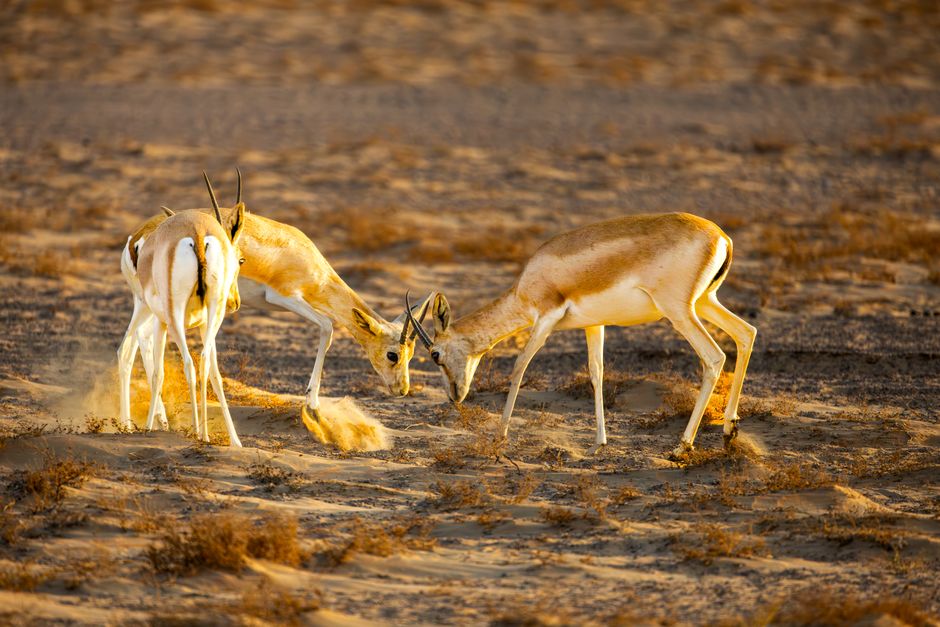
Gazelles are small to medium-sized antelopes found across Africa and Asia. Their predators include lions, leopards, cheetahs, hyenas, African wild dogs, crocodiles, and sometimes eagles that target fawns. Gazelles survive through extraordinary speed, incredible agility, and highly tuned senses that let them detect danger early and escape before a predator gets close.
What Animals Hunt Gazelles?
Gazelles live in open grasslands and savannas where predators are plentiful. Each predator hunts differently, which shapes how gazelles must respond.
Cheetahs are the fastest land animals and rely on short bursts of extreme speed. They chase gazelles in open ground and usually target young, old, or sick individuals. Lions hunt in groups and use ambush tactics, often waiting near water sources or tall grass. Leopards stalk quietly and pounce from close range, sometimes dragging prey into trees.
Spotted hyenas and African wild dogs hunt in packs. They tire their prey over longer distances rather than relying on a single burst of speed. Crocodiles pose a threat at rivers and waterholes. Even large birds of prey, such as martial eagles, can take newborn fawns that are left hidden in the grass.
The type of predator matters. A gazelle cannot outrun a cheetah in a straight line, but it can outmaneuver it. Against a pack of wild dogs, endurance matters more than raw speed.
How Fast Can a Gazelle Run?
Thomson’s gazelles, one of the most studied species, can reach speeds of about 50 miles per hour (80 kilometers per hour). They can maintain a fast pace for several minutes, though not at full top speed.
Speed alone is not enough. Cheetahs are faster, reaching up to 70 miles per hour in short sprints. What gives gazelles an edge is their ability to change direction suddenly at high speed. This zigzag movement makes it difficult for a cheetah to keep its balance and maintain the chase.
Gazelles also have a remarkable ability to leap high into the air, a behavior called stotting or pronking. When a gazelle spots a predator, it may jump straight up with all four legs stiff. Researchers believe this signals to the predator that the gazelle is healthy and too difficult to catch. It may also help the gazelle get a better view of the surrounding area.
How Do Gazelles Detect Predators?
Gazelles depend on their senses to survive. Their eyes sit on the sides of their head, giving them a nearly 360-degree field of vision. They can spot movement from far away while still grazing.
Their hearing is also sharp. Gazelles can pick up the sound of approaching footsteps or the alarm calls of other animals. Many gazelles live in mixed herds with zebras, wildebeests, and ostriches. These animals have different strengths. Zebras have excellent eyesight. Ostriches have keen vision too. When any member of the group detects danger, the whole group reacts.
Gazelles also use scent. They can smell predators that are downwind and avoid moving into areas where a predator may be hiding.
Social living is a key survival strategy. A lone gazelle must constantly watch for danger. A herd has many eyes and ears. When one gazelle bolts, others follow. This collective vigilance reduces the chance that any single animal is caught by surprise.





What Makes Gazelles So Agile?
Gazelles have a body built for sudden movement. Their legs are long and slender, with powerful thigh muscles that allow explosive acceleration. Their spine is flexible, which lets them twist and turn mid-stride without losing balance.
Their hooves are small and pointed, designed for gripping dry, hard ground. This gives them traction when they need to change direction quickly.
This agility is not just about avoiding a single chase. Gazelles often run in a zigzag pattern that forces predators to commit to a direction. A cheetah running at full speed cannot turn as sharply as a gazelle. If the cheetah guesses wrong, the gazelle gains precious distance.
Some gazelle species, like the Grant’s gazelle, are larger and slower but have greater endurance. Others, like the Thomson’s gazelle, are smaller and faster but tire more quickly. Each species has evolved a strategy that works for its specific environment.
How Do Gazelles Protect Their Young?
Fawns are the most vulnerable members of the herd. They cannot outrun predators for the first few weeks of life. Instead, they rely on hiding.
Mother gazelles hide their newborns in tall grass and visit them only a few times a day to nurse. The fawn stays completely still, relying on its spotted coat to blend into the surroundings. This behavior reduces the chance that a predator will find the fawn by scent or sight.
When a predator approaches a fawn, the mother will sometimes try to distract it. She may run in a conspicuous way or make noise to draw attention away from the hiding spot.
This hiding strategy is effective, but it comes with risks. Fawns that are separated from their mothers for too long may miss feedings. Predators like jackals and eagles are skilled at finding hidden fawns by scent.
Do Gazelles Fight Back?
Gazelles are not entirely defenseless. Both males and females have horns, though the males’ horns are usually longer and thicker. These horns are used mainly for fighting other males during mating season, but they can also be used to defend against predators.
In most cases, a gazelle will not stand and fight. Flight is their primary defense. Fighting a lion or a hyena would almost certainly end in death. However, there are recorded instances of gazelles using their horns to fend off smaller predators like jackals or to protect their young in desperate situations.
This is the exception, not the rule. The gazelle’s survival strategy is built around avoiding contact entirely.
How Do Gazelles Survive in Groups?
Living in a herd offers several advantages beyond shared vigilance. When a predator attacks, the herd scatters in different directions. This confuses the predator and makes it harder to single out one target.
Predators typically target the easiest prey. In a herd, the old, sick, or very young are most at risk. Healthy adult gazelles have a strong chance of escaping. This means that predators usually take the weakest individuals, which actually helps keep the gazelle population strong over time.
Herds also provide social learning. Young gazelles watch older members of the group and learn which areas are safe and which are dangerous. They learn migration routes and where water can be found during dry seasons.
Some gazelle species migrate in large numbers, following seasonal rains to find fresh grass. This movement reduces the time they spend in any one area, which lowers the chance that predators will learn their patterns.
What Is the Biggest Threat to Gazelles?
Natural predators have always been part of the gazelle’s world. The bigger threat today is habitat loss. As human populations grow, grasslands are converted to farmland, roads, and cities. Gazelles lose the open space they need to spot predators and run.
Hunting by humans also affects gazelle populations in some regions. While many gazelle species are still common, some are classified as threatened or endangered. The dama gazelle, for example, has declined sharply across its range in North Africa.
Climate change adds another layer of pressure. Droughts reduce the grass that gazelles depend on and force them into smaller areas where predators may be more concentrated.
Conservation efforts focus on protecting grassland habitats and creating wildlife corridors that allow gazelles to move freely between feeding and breeding areas.
Frequently Asked Questions
What is a gazelle’s main predator?
Cheetahs are the most specialized gazelle predators, but lions, leopards, hyenas, and African wild dogs also hunt them regularly.
Can a gazelle outrun a cheetah?
No, a cheetah is faster in a straight sprint, but a gazelle can escape by making sharp, sudden turns that the cheetah cannot match at full speed.
Why do gazelles jump up and down?
This behavior, called stotting, likely signals to predators that the gazelle is healthy and too difficult to catch, and it may also help the gazelle see over tall grass.
How long can a gazelle run?
Gazelles can sustain a fast pace for several minutes, though not at absolute top speed. This endurance helps them escape pack hunters like wild dogs that rely on exhausting their prey.
