
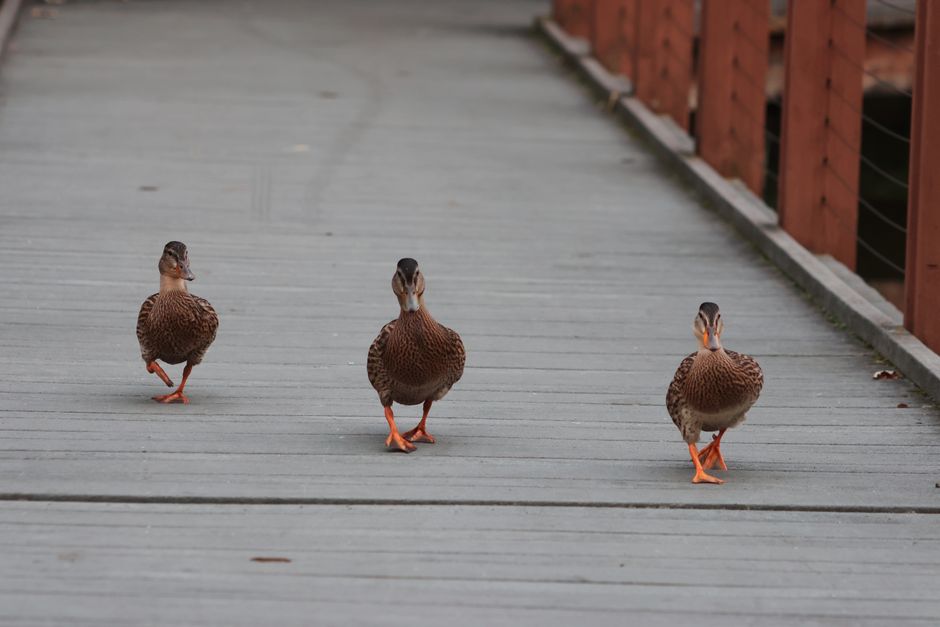
A duck’s foot is called a webbed foot. The webbing is the stretch of skin that connects the duck’s toes. It turns three separate toes into one broad, flexible paddle. That paddle is the main reason ducks move so well in water and so awkwardly on land.
The word “webbed” describes the skin itself. The individual toes underneath still have their own names, and the whole structure has a specific anatomical label. Here is what each part is called and what it actually does.
What Are Ducks Feet Called?
The formal term is a pal mate foot, or simply a webbed foot. In anatomy, “palmate” means shaped like an open hand or palm. The three forward toes are joined by skin, and the fourth toe points backward with no webbing at all.
That backward toe is easy to miss. It is small, sits higher on the leg, and does not touch the ground the way the front toes do. Its job is to help the duck grip and balance rather than to push water.
So a duck’s foot is not one solid flipper. It is a set of separate bones and joints wrapped in skin that folds and spreads. When the duck pushes backward, the toes spread and the webbing opens wide. When it pulls the foot forward, the toes fold together and the webbing collapses. That folding is what reduces drag on the recovery stroke.
How Does the Webbing Actually Help a Duck Swim?
The webbing works like a paddle that changes shape with each stroke. On the power stroke, the foot pushes back against the water and the toes fan out to catch as much water as possible. On the return stroke, the foot closes up and slices forward with little resistance.
This is the same principle behind a rower’s oar, but the duck’s version folds itself. The result is efficient forward thrust without a heavy, rigid flipper.
Ducks also have a built-in reflex that helps here. The tendons in the leg are arranged so that when the leg bends, the toes automatically curl and the webbing closes. When the leg extends, the toes spread. The foot does much of its work without the duck consciously controlling each toe.
One detail worth knowing: the webbing is not just flat skin. It contains blood vessels and nerve endings, and it can sense water pressure and temperature. That feedback helps the duck adjust its stroke as it moves through currents.
Why Do Ducks Waddle on Land?
Ducks waddle because their legs are set wide apart and toward the back of the body. That placement is excellent for swimming and poor for walking. The wide stance shifts the duck’s weight from side to side with each step, which is the rocking motion we call a waddle.
The webbed feet are not really the cause. The waddle comes from hip and leg anatomy, not from the shape of the foot. A duck with its feet tucked up still rocks when it moves.
Waddling is not a flaw, though. For a bird that spends much of its time on water, a stable, low, side-to-side gait is less likely to tip it over than a narrow stride would be. Ducks are built for one environment and manage the other.





What Are the Toes on a Duck’s Foot Called?
The three forward toes are numbered from the inside out. In most ducks, the innermost toe is the shortest and the middle toe is the longest. The outer toe sits between them in length. The backward toe is called the hallux, the same term used for the big toe in humans, though in ducks it points backward and is much smaller.
Each toe ends in a claw. The claws help with gripping muddy banks, climbing onto logs, and scratching for food. The webbing does not extend to the tips of the toes, so the claws stay free and functional.
Do All Ducks Have Webbed Feet?
Nearly all ducks do, but the amount of webbing varies by species and lifestyle. Dabbling ducks, the ones that tip forward to feed in shallow water, tend to have full, broad webbing. Diving ducks also have strong webbing suited to powerful underwater strokes.
Some birds that look like ducks are not ducks at all. Coots, which are often mistaken for ducks, have lobed toes rather than full webbing. Each toe has its own flap of skin instead of a continuous web. Grebes have a similar lobed arrangement. If you see a waterbird with separate flaps on each toe, it is probably not a true duck.
Geese and swans are close relatives and also have webbed feet. Their webbing tends to be large and strong, matched to their heavier bodies.
What Is the Skin Between a Duck’s Toes Made Of?
The webbing is made of skin, but it is not the same as the skin on a duck’s back. It is thin, flexible, and packed with elastic fibers that let it stretch and fold thousands of times without tearing. It is also well supplied with blood vessels, which matters for temperature control.
Ducks stand on ice and swim in cold water without their feet freezing. Part of the explanation is a heat-exchange system in the legs. Warm blood flowing down toward the foot passes close to cold blood flowing back up, so the returning blood is warmed before it reaches the body core. The foot itself can run cooler than the rest of the bird. This is a well-established feature of bird leg anatomy, not a special trick unique to ducks.
The webbing also has a dense network of nerve endings. Ducks can feel the movement of water and the texture of what they are standing on, which helps them find food and avoid hazards.
Why Don’t Duck Feet Get Cold or Waterlogged?
Duck feet stay functional in cold water because of that heat-exchange system and because the tissues of the foot tolerate lower temperatures than the body core. The foot does not need to stay warm the way the duck’s organs do.
As for waterlogging, the skin of a duck’s foot is covered in a thin, oily layer that repels water. Ducks maintain this coating by preening, spreading oil from a gland near the base of the tail over their feathers and feet. The oil is not a waterproof seal in the way a raincoat is. It reduces how much water the skin absorbs and helps the foot shed water quickly.
This is also why ducks spend so much time preening. The coating wears off and needs to be renewed.
Can Ducks Feel Through Their Webbed Feet?
Yes. The webbing and toes are richly supplied with nerve endings, and ducks use that sensitivity to find food. When a duck dabbles in mud or shallow water, it can feel the movement of small invertebrates and the texture of seeds without seeing them.
Some ducks, particularly those that feed by touch in murky water, have especially sensitive bills and feet. The feet help the bird orient to the bottom and to the movement of water around it.
The sensitivity is not the same as human touch. It is tuned to the pressures and vibrations a duck encounters in water and mud, not to fine detail the way fingertips are.
What Is the Difference Between Webbed and Lobed Feet?
Webbed feet have skin connecting the toes along their length. Lobed feet have separate flaps of skin on each toe, with no connection between toes. Both help a bird swim, but they work differently.
Webbed feet create one continuous paddle surface when the toes spread. Lobed feet create several smaller paddles that can move somewhat independently. Lobed feet are found in coots and grebes, not in true ducks.
The distinction matters if you are trying to identify a bird. A waterbird with separate flaps on each toe is not a duck, even if it swims and looks duck-like from a distance.
Do Duck Feet Have Bones Like Other Animals?
Yes. A duck’s foot has the same basic bone structure as other birds, with toe bones, joints, and a small backward-pointing toe. The webbing is soft tissue stretched between the toes, not bone.
The bones are light but strong, and the joints allow the toes to spread and fold with each stroke. The foot is a balance of flexibility for swimming and rigidity for pushing off.
One thing that surprises people: the webbing has no bones in it at all. It is pure skin, connective tissue, and blood vessels. That is why it can fold so tightly when the foot closes.
Frequently Asked Questions
What are ducks feet called?
A duck’s foot is called a webbed foot, or more formally a palmate foot. The skin connecting the three forward toes is the webbing.
Why do ducks have webbed feet?
Webbing turns the toes into a broad paddle that pushes water efficiently and folds to reduce drag on the return stroke. It helps ducks swim, steer, and move through water with less effort.
Do all ducks have webbed feet?
Nearly all true ducks have webbed feet, though the amount of webbing varies by species. Birds like coots and grebes have lobed toes instead of full webbing and are not ducks.
Why do ducks waddle?
Ducks waddle because their legs are set wide apart and toward the back of the body, which shifts their weight side to side with each step. The waddle comes from leg and hip anatomy, not from the webbed feet.
