

Sciatic nerve pain relief stretches are targeted movements that ease pressure on the sciatic nerve by loosening the muscles compressing it or by mobilizing the nerve through its surrounding tissue. The right stretch depends on what’s causing your sciatica — disc herniation, piriformis syndrome, and spinal stenosis each respond to different movements. Done consistently, the correct stretches can reduce pain within a few days and help lower the risk of recurring flares.
What Causes Sciatic Nerve Pain — and Why It Matters for Stretching
The sciatic nerve runs from your lower back, through your glutes, and down the back of each leg. When something presses on it or irritates it, that’s sciatica. Three conditions account for most cases:
- Disc herniation: A spinal disc bulges out and presses directly on a nerve root. This is the most common cause, particularly in adults between 30 and 50.
- Piriformis syndrome: The piriformis muscle — a small muscle deep in the buttock — tightens or spasms around the sciatic nerve, usually from prolonged sitting or overuse.
- Spinal stenosis: The spinal canal narrows, compressing nerve roots as they exit the spine. More common in adults over 50.
Here’s the part most articles skip entirely: the cause changes which stretches help and which ones make things worse.
For disc herniation, extension-based movements — arching the back — push disc material away from the nerve root. Research on directional preference published in Spine (2011, Donelson et al.) found that roughly 70% of lumbar disc patients had a directional preference that reduced their pain when matched to the correct exercise direction.
For spinal stenosis, the spine is already compressed from behind, so flexion-based stretches like knees-to-chest open the spinal canal and relieve pressure. Piriformis syndrome needs neither — it responds to hip rotator stretches targeting the glute, not the spine.
Doing the wrong stretch category won’t just fail to help. It can push you backward.
How Do Sciatic Nerve Stretches Relieve Pain?
Two different mechanisms are at work here, and most people don’t realize they’re not the same thing.
Muscle stretching targets the soft tissue compressing the nerve — tight piriformis, stiff hamstrings, and locked hip flexors. You hold a position, the muscle lengthens, and the mechanical pressure on the nerve eases. Passive. Slow. Works well for piriformis syndrome and general tension.
Nerve mobilization (nerve flossing) is different. The goal isn’t to lengthen a muscle — it’s to move the nerve back and forth through its surrounding tissue to reduce adhesion and stiffness along the nerve pathway. A 2012 study in Manual Therapy found that neural mobilization reduced pain intensity in patients with lumbar radiculopathy more effectively than exercise alone.
But nerve flossing during an active disc herniation can worsen symptoms, because moving the nerve through an already irritated exit point increases friction. The technique that works brilliantly for one cause can backfire badly on another.
As of 2026, most physical therapists recommend starting with muscle stretches during the first week of a flare, and introducing nerve mobilization only once the sharp, electric leg pain has settled to a dull ache.
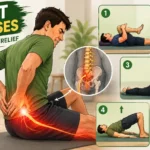
7 Sciatic Nerve Pain Relief Stretches (With Step-by-Step Instructions)
These are organized by cause and mechanism. Use the reference table at the end of this section to find where to start based on your situation.
1. Piriformis Stretch (Figure-4) Best for: piriformis syndrome
Lie on your back with both knees bent, feet flat on the floor. Cross your right ankle over your left thigh, just above the knee. Either stay here or gently pull your left thigh toward your chest until you feel a stretch deep in your right glute — not the lower back. Hold 20–30 seconds. Switch sides. Do 3 rounds per side.
Senior / chair modification: Sit upright in a chair. Cross your right ankle over your left knee. Lean forward slightly from the hips — not the lower back — until you feel the stretch. Same hold time applies.
2. Knee-to-Chest Stretch Best for: spinal stenosis, general lower back tension
Lie on your back. Bend one knee and draw it toward your chest using both hands behind the thigh. Keep the opposite leg relaxed on the floor. Hold 20–30 seconds. Repeat on both sides for 2–3 rounds.
Modification: Do this in bed on a firm mattress — same movement, easier surface for getting in and out.
3. Half Cobra (McKenzie Press-Up) Best for: disc herniation
Lie face down. Place your hands under your shoulders, elbows bent. Slowly press your upper body up while keeping your hips in contact with the floor. Go only as far as the pain-free range allows — even 2 inches off the floor counts at first. Hold 10 seconds, then lower back down. Work up to 10 repetitions.
If this sends pain shooting further down the leg, stop. That’s a sign this direction isn’t right for your presentation.
Modification: Do this from a firm couch cushion or the edge of your bed.
4. Supine Hamstring Stretch Best for: leg pain, nerve tension along the back of the thigh
Lie on your back. Loop a towel, resistance band, or belt around the sole of one foot. Straighten the knee and slowly raise the leg until you feel a gentle pull along the back of the thigh. Hold 20–30 seconds. Keep the opposite leg flat on the floor. Do 3 rounds per side.
Modification: Sit at the edge of a chair, straighten one leg with the heel resting on the floor, and hinge forward slowly from the hips.
5. Child’s Pose Best for: spinal stenosis, general spinal decompression
Kneel on all fours. Sit your hips back toward your heels and walk your arms forward along the floor. Let your forehead rest. Hold 30–60 seconds. This is a resting position — you shouldn’t be fighting to hold the shape.
Modification: Place a folded pillow between your thighs and calves if kneeling on a hard floor is uncomfortable.
6. Seated Spinal Twist Best for: general mobility, muscle tension on one side
Sit on the floor with both legs extended. Bend your right knee and cross it over the left leg, foot flat on the floor. Place your left elbow on the outside of your right knee and rotate your torso gently to the right. Hold 20–30 seconds. Repeat on both sides.
Chair modification: Sit sideways on a chair. Rotate toward the chair back and hold it with both hands to control the depth.
7. Sciatic Nerve Floss Best for: nerve adhesion, recurring stiffness — not for acute flares
Sit on the edge of a chair with your spine relaxed and slightly slouched. Both feet hang loose. Simultaneously, straighten your right knee and tilt your head back. Then lower the foot while dropping your chin to your chest. That’s one rep. Do 10–15 slow, controlled reps per side.
Stop if this produces sharp shooting pain down the leg. Nerve flossing is not a stretch to push through.
-
 5 Best Exercises for Sciatic Nerve Pain Relief At Home.
 -
Best Thing For Sciatic Nerve Pain: At Home What Really Work?
-
Nerve Calm Reviews 2026: Good For Pain Relief & Neuropathy?
-
Sciatic Nerve Pain. What It Really Feels, Why It Travels, & What Can Help?
-
Nerve Calm Reviews: Critical Update Of Neuropathy Supplement




Stretch-by-Cause Quick Reference
| Stretch | Best cause | Safe during flare? | Senior-friendly? |
|---|---|---|---|
| Piriformis Figure-4 | Piriformis syndrome | Mild flares only | Yes — chair version |
| Knee-to-Chest | Stenosis, general | Yes | Yes — in bed |
| Half Cobra | Disc herniation | Yes | Yes — on couch/bed |
| Hamstring Stretch | Leg pain, nerve tension | Yes | Yes — seated version |
| Child’s Pose | Stenosis, general decompression | Mild only | Yes — with pillow |
| Spinal Twist | General mobility | Mild only | Yes — chair version |
| Nerve Floss | Adhesion, recurring stiffness | No | Yes — seated |
Stretches for Severe Sciatica Pain — What to Do Differently
During an acute flare — sharp electric pain, difficulty sitting, pain below the knee — the standard advice doesn’t apply cleanly.
The safest approach in the first 48–72 hours is position management, not aggressive stretching. Find a position that dials down the pain (often lying on your back with knees slightly elevated over a pillow) and use it as your base.
A 2015 Cochrane review found that advice to stay gently active produced better outcomes than bed rest for acute low back pain with nerve involvement. That doesn’t mean stretch hard — it means don’t lie completely still.
These stretches are generally safe to begin even during a moderate flare: knee-to-chest, half cobra (disc cases), and the supine hamstring stretch with a strap. Hold off on nerve flossing and deep piriformis work until the shooting leg pain has clearly eased. Trying to floss an acutely inflamed nerve is one of the more reliable ways to turn a bad day into a worse one.
How Often Should You Do Sciatica Stretches?
Two short daily sessions outperform one long one. Most physical therapists recommend 10–15 minutes twice per day rather than a single 30-minute block. Consistency matters far more than duration.
Morning is particularly useful for disc-related pain, which tends to be worse after hours of lying still — spinal discs rehydrate overnight and can be more pressurized first thing. Post-sitting sessions (after desk work, a long drive, or any extended sitting) work well for piriformis-driven symptoms, since that muscle tightens under sustained compression.
Doing three well-matched stretches every day will produce better results than running through all seven haphazardly twice a week. Start with the stretches that match your cause, build the habit, then layer in the others as pain improves.
Frequently Asked Questions
What is the best stretch for sciatic nerve pain?
There is no single best stretch — it depends on the cause. For disc herniation, the half cobra press-up is generally most effective. For piriformis syndrome, the figure-4 stretch targets the right muscle. For spinal stenosis, the knee-to-chest and child’s pose most directly relieve canal pressure. Matching the stretch to the underlying cause produces results. Random stretching often doesn’t.
Can stretching make sciatica worse?
Yes. Nerve flossing during an active disc herniation can intensify shooting leg pain by increasing friction along an already irritated nerve root. Extension-based stretches like the half cobra can worsen spinal stenosis symptoms. If any stretch causes sharp pain to move further down the leg rather than centralize toward the back, stop that movement and reassess which category best fits your cause.
What are the best sciatic nerve pain relief stretches for seniors?
Chair and bed versions of the standard stretches work well for seniors with limited floor mobility. The seated piriformis stretch, knee-to-chest in bed, seated hamstring stretch with a strap, and the seated nerve floss are all accessible without floor work. No stretch in this guide requires full floor mobility — all seven have a standing or seated alternative.
How long does it take for sciatica stretches to work?
Most people with mild-to-moderate sciatica notice some reduction in leg pain within 1–2 weeks of consistent daily stretching. Around 80–90% of sciatica cases resolve without surgery within 4–6 weeks, according to research summarized in Clinical Evidence. Stretching is not a rapid fix, but consistent daily practice matched to the correct cause meaningfully shortens that recovery window.
Should I stretch if my sciatica is severe?
During the worst of an acute flare, aggressive stretching is not recommended. Focus first on a comfortable resting position — knees slightly elevated, pain minimized. Gentle, limited-range movements like a partial knee-to-chest or a low-range half cobra are generally safe to start. Introduce fuller stretching once sharp electric leg pain settles to a dull ache, usually within 2–4 days.
The right sciatic nerve pain relief stretches — matched to your cause, timed correctly, and done consistently — remain one of the most effective non-surgical approaches available. The catch, as with most things in this space, is doing them in the right order, at the right time, for the right reason.
