
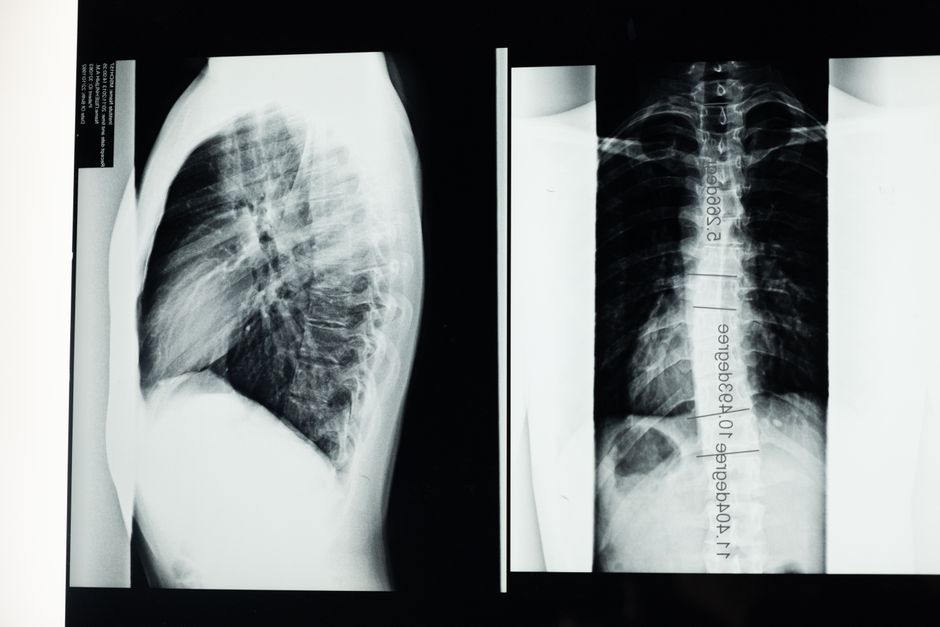
Scoliosis runs in families, and researchers have known this for decades. The evidence for a genetic contribution is strongest for adolescent idiopathic scoliosis, the most common form, where twin and family studies consistently show that relatives of affected people develop it more often than the general population. But genetics is not destiny here. Most people with a family history never develop scoliosis, and no single gene has been shown to cause the common forms of the condition.
What follows is what the research actually supports, where the evidence thins out, and why the difference matters if scoliosis appears in your family.
What Does “Genetic” Actually Mean for Scoliosis?
Scoliosis is not one disease. It is a description of a spinal curve, and it has many different causes. Some of those causes are clearly genetic. Most are not.
Doctors group scoliosis by cause. Idiopathic means no identifiable cause, and it accounts for the large majority of cases. Congenital scoliosis comes from vertebrae that formed abnormally before birth. Neuromuscular scoliosis develops alongside conditions that affect muscle control, such as cerebral palsy or muscular dystrophy. There are also cases caused by injury, infection, or tumors, though these are uncommon.
This matters because the word “genetic” means something different in each group. Some rare syndromes with scoliosis as a feature are linked to specific gene changes. Idiopathic scoliosis, by contrast, shows a pattern of inheritance that is real but complex. It does not follow the simple dominant or recessive rules you may remember from biology class.
Researchers describe it as polygenic, meaning many genes each contribute a small amount of risk. Environmental and developmental factors likely interact with those genes. The result is a susceptibility pattern, not a switch that is on or off.
Is Scoliosis Genetic? The Evidence for Inheritance
The inheritance evidence for adolescent idiopathic scoliosis is substantial and comes from several directions.
Family studies show that first-degree relatives of people with idiopathic scoliosis have a higher risk of developing it than the general population. Twin studies add weight. Research comparing identical and fraternal twins has generally found higher concordance in identical twins, who share all their genes, than in fraternal twins. That pattern points toward a genetic component.
Curve patterns also tend to run in families. Relatives often develop curves in similar locations and with similar shapes, which is hard to explain by chance alone.
What the evidence does not show is a single inherited cause. Despite years of research, including several large genetic studies, no gene has been found that explains most idiopathic scoliosis. Some candidate genes and chromosomal regions have been associated with the condition, but the effects are small, and findings have not always held up when other researchers tried to repeat them.
One clarification worth keeping in mind: a family pattern is not proof of genetics by itself. Families share environments, diets, and habits too. The twin data is what makes the genetic case stronger, because identical twins share a womb and an upbringing as well as their genes, yet they do not always both develop scoliosis. That tells you genes are part of the story, not the whole story.
If a Parent Has Scoliosis, What Is the Child’s Risk?
The honest answer is that the risk is higher than average but still low in absolute terms, and no single number applies to every family.
Estimates from family studies vary widely, which reflects how differently researchers define scoliosis, which curve sizes they count, and which populations they study. A curve of 10 degrees is counted as scoliosis, but many small curves never progress or need treatment. Risk figures for “any curve” and risk figures for “a curve needing treatment” are very different things.
What can be said with confidence is this. Having a parent or sibling with adolescent idiopathic scoliosis raises a child’s chance of developing it. Most such children still do not develop a curve that requires treatment. The increased risk is a reason for awareness and monitoring, not alarm.
Some clinicians recommend that children with a close family history be checked during growth spurts, when curves most often appear or worsen. This is reasonable clinical practice, though it has not been proven in trials that screening relatives changes outcomes. It is also consistent with general guidance that children be checked for spinal curvature during routine well-child visits.
Why Genetics Alone Does Not Predict Who Develops Scoliosis
Adolescent idiopathic scoliosis appears during the growth spurt, most often between ages 10 and the end of skeletal growth. The timing tells you something important. Growth itself is part of the mechanism.
Current understanding is that scoliosis in these cases involves a mismatch between how fast the spine grows and how well the muscles and other tissues around it keep it balanced. Genetic factors likely shape spinal geometry, connective tissue, and the nervous system’s control of posture. Growth then acts on those predispositions.
This explains a puzzle in twin data. Identical twins share the same genes, yet they do not always both develop scoliosis, and when they do, curve severity can differ. Something beyond DNA is involved. Researchers have studied hormones, growth patterns, and mechanical forces for clues, but no complete explanation exists yet.
It also means a genetic test cannot tell a child whether they will develop a serious curve. No such test is currently in routine clinical use for predicting scoliosis. Some research has looked at genetic risk scores, but these are not established clinical tools.
Can Genetic Testing Predict Whether a Curve Will Worsen?
No genetic test is currently established for predicting whether a scoliosis curve will progress.
This is an active area of research, and some tests have been developed commercially. The evidence supporting them is limited, and major clinical guidance has not adopted genetic testing as a standard tool for deciding treatment. Doctors still rely on physical examination and repeated X-rays to track curves over time.
That gap matters. Families sometimes encounter marketing for genetic tests that claim to predict scoliosis progression. No study has confirmed that such tests reliably guide treatment decisions. If a clinician recommends one, it is fair to ask what the result would change about the plan.
What Actually Predicts Whether Scoliosis Gets Worse
Curve size and remaining growth are the factors that matter most, and both are well established.
A larger curve at diagnosis is more likely to progress than a small one. A child who has not yet reached skeletal maturity has more growth ahead, which gives a curve more opportunity to worsen. Doctors estimate remaining growth using signs such as the timing of puberty and, in some cases, bone maturity on X-ray.
Curve location plays a role too. Curves in the mid-back tend to behave differently from curves in the lower back, and the shape of the curve affects how it is managed.
These factors are measured directly, not inferred from family history. A strong family history might raise a clinician’s attention, but it does not replace measuring the curve itself.
When to Seek an Evaluation
Scoliosis often causes no pain and is noticed by someone else, frequently during a school screening, a sports physical, or while a parent is helping a child dress.
Signs that warrant a medical visit include:
- One shoulder sitting higher than the other
- One shoulder blade more prominent than the other
- Uneven waistline or one hip higher than the other
- Ribs that look more prominent on one side when bending forward
- Clothes that hang unevenly
Back pain with a curve is not typical of adolescent idiopathic scoliosis and deserves prompt medical attention. So does a curve that appears in a young child, or one that develops rapidly.
For families with a history of scoliosis, knowing the signs is practical. It does not require special testing, and it does not mean watching anxiously. It means mentioning the family history at routine checkups so a clinician can decide whether an exam is warranted.
The Bottom Line on Inheritance
The evidence supports a genetic contribution to adolescent idiopathic scoliosis. It does not support the idea that scoliosis is simply passed down like eye color.
Most people with a family history will not develop a curve needing treatment. Most people with scoliosis have no close relative with it. Both statements are true, and together they describe a condition shaped by many genes and by growth, not by a single inherited flaw.
If scoliosis runs in your family, the useful response is awareness. Know the signs. Mention the history at checkups. Let a clinician measure what needs measuring. Genetics tells part of the story, but the curve itself tells the rest.
Frequently Asked Questions
Is scoliosis hereditary?
Scoliosis has a hereditary component, strongest in adolescent idiopathic scoliosis, where relatives of affected people develop it more often than the general population. It does not follow a simple inheritance pattern, and most people with a family history never develop a curve needing treatment.
Can scoliosis skip a generation?
Yes, it can appear in a child when no parent had it, because the condition involves many genes that can combine in different ways. A skipped generation does not rule out a genetic contribution.
If I have scoliosis, will my child get it?
Your child’s risk is higher than average but still low in absolute terms, and most children of affected parents do not develop a curve needing treatment. Exact risk figures vary widely between studies.
Is there a genetic test for scoliosis?
No genetic test is currently established for diagnosing scoliosis or predicting whether a curve will worsen. Diagnosis and monitoring rely on physical examination and X-rays.
