
Red light therapy is not inherently bad for tattoos, but the timing matters a great deal. On healed, fully settled tattoos, red light therapy does not appear to damage ink or cause fading in any established way. On a fresh tattoo, it can interfere with healing and is generally best avoided until the skin has fully recovered. The real risks sit in the gap between those two situations, and most marketing content skips right over it.
Is Red Light Therapy Bad For Tattoos The Facts?
No good evidence shows that red light therapy breaks down tattoo ink in healed skin. The concern people raise most often is that light energy might degrade pigment. Red light sits in the wavelength range of roughly 630 to 700 nanometers, which is longer than the wavelengths used in laser tattoo removal.
That distinction matters. Tattoo removal lasers use very short, intense pulses of light tuned to specific wavelengths that pigment particles absorb. The energy is delivered in nanoseconds and is strong enough to shatter ink into fragments small enough for the immune system to clear. Red light therapy devices deliver continuous, low-intensity light over minutes. The power and the delivery are not comparable.
There is one honest caveat. No large human trials have specifically studied red light therapy on tattooed skin over long periods. The reassurance rests on the physics of how the light works and the absence of reported harm, not on dedicated studies of tattooed populations. That is a meaningful difference, and it is worth stating plainly.
Why Fresh Tattoos Are a Different Story
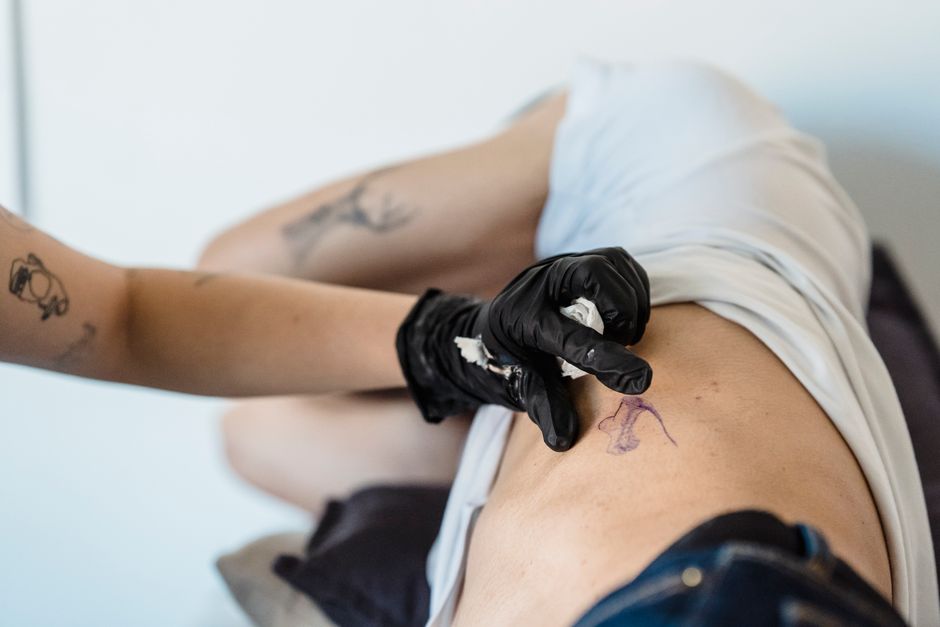
A new tattoo is an open wound. The skin has been punctured thousands of times, the ink sits in the dermis, and the body is actively repairing tissue and forming a protective barrier. This is the period when light therapy carries real practical concerns.
Red light therapy is sometimes marketed for wound healing. The evidence for that use is mixed and generally modest, not the slam dunk advertising suggests. Even if it helped in some contexts, a fresh tattoo is not a clean surgical wound. It is skin loaded with foreign pigment that the immune system is already responding to.
Adding heat and light to newly tattooed skin raises questions that no strong evidence answers well. Devices generate some warmth, and heat can increase blood flow and swelling in tissue that is already inflamed. The safer position, and the one most tattoo artists take, is to leave the area alone during initial healing.
Tattoo healing timelines vary by person and by placement. The surface typically closes within a couple of weeks, but the deeper layers keep remodeling for longer. A reasonable rule is to wait until the tattoo has fully settled and any scabbing or flaking has resolved before considering light therapy on that area.
Does Red Light Therapy Fade Tattoo Ink?
There is no established mechanism by which low-intensity red light fades tattoo ink. To understand why, it helps to know where the ink actually lives.
Tattoo pigment is deposited in the dermis, the layer beneath the surface skin. Immune cells called macrophages engulf some of the pigment and hold it in place. That is part of why tattoos are permanent. For ink to fade, pigment particles need to be broken apart or carried away.
Red light therapy does not deliver the kind of energy needed to fragment those particles. It works on cells in a different way, influencing things like blood flow and cellular activity at low intensity. Some studies suggest it may support collagen production and skin appearance. That is not the same as breaking down pigment.
What you might notice is a temporary change in how a tattoo looks. Light therapy can increase blood flow to the skin, which may make the area look slightly flushed. That effect fades. It is not ink loss.
Can Red Light Therapy Help a Tattoo Heal?
The evidence does not support using red light therapy as a tattoo healing treatment. Some research suggests low-level light therapy may aid certain types of wound healing, but results vary and the quality of studies is uneven. Nothing specifically confirms benefit for tattooed skin.
This is a case where biological reasoning can mislead. It seems logical that a therapy linked to tissue repair might speed tattoo healing. But a plausible mechanism is not the same as proven clinical benefit. The skin is already doing a competent job of healing on its own.
There is also a practical risk. Using a device on healing skin means handling the area, possibly introducing bacteria, and applying heat to tissue that may be irritated. The downside is concrete. The upside is unproven. That is not a good trade during the weeks when a tattoo is most vulnerable.
What About Using Red Light Therapy on Healed Tattoos?
On fully healed tattoos, the practical concerns are minimal. The skin barrier is intact, the ink is stable, and the immune response to the pigment has settled. This is the situation most people are actually asking about, and here the answer is reassuring without being absolute.
A few sensible points apply:
- Start with shorter sessions and watch how the skin responds.
- Avoid devices that produce noticeable heat on tattooed areas.
- Keep the treated skin out of the equation if it is irritated, sunburned, or broken.
- Remember that sun exposure is a far more established cause of tattoo fading than any light device.
That last point deserves attention. Ultraviolet light from the sun is well documented as a cause of tattoo ink fading and blurring over time. If someone is worried about preserving a tattoo, sun protection matters more than anything a red light device might do.
Who Should Be More Cautious
Some people should treat red light therapy on tattooed skin with more care. Anyone with a known photosensitivity condition, or who takes medications that increase light sensitivity, should talk to a clinician before using any light device. This is not specific to tattoos, but tattooed skin is still skin.
People with keloid scarring tendencies or a history of poor tattoo healing should be cautious during the healing phase in particular. And anyone with an active skin infection, a rash, or an open wound in the area should not use the device at all.
Pregnancy is another situation where the honest answer is that the evidence is limited. No clinical guidelines currently establish red light therapy safety for use during pregnancy, so it is reasonable to defer to a clinician rather than assume it is fine.
The Bottom Line on Timing
The single most useful fact is this: the risk depends almost entirely on whether the tattoo is healed. Fresh tattoos need to be left alone to heal. Healed tattoos are not a meaningful concern for red light therapy based on what is currently known.
Be wary of anyone selling a red light device as a way to heal or protect tattoos. No study has confirmed that. The honest position is that red light therapy is probably neutral for healed tattoos and best avoided on new ones, and that the strongest evidence about tattoo fading points to the sun, not to light devices.
Frequently Asked Questions
Can I use red light therapy on a new tattoo?
It is best to avoid red light therapy until the tattoo has fully healed and any scabbing or flaking has resolved. The skin is an open wound during that time, and adding heat or handling the area offers no proven benefit.
Does red light therapy fade tattoos?
No established evidence shows that low-intensity red light fades tattoo ink in healed skin. The energy and delivery are not comparable to tattoo removal lasers, which use short, intense pulses to break up pigment.
How long should I wait before using red light therapy on a tattoo?
Wait until the tattoo has fully settled and the surface skin has completely healed, which varies by person and placement. There is no official guideline, so judge by whether all scabbing and flaking have cleared.
Is red light therapy safe on tattooed skin?
On fully healed tattoos, the practical concerns are minimal, though no large human trials have specifically studied this. People with photosensitivity conditions or who take light-sensitizing medications should check with a clinician first.
