
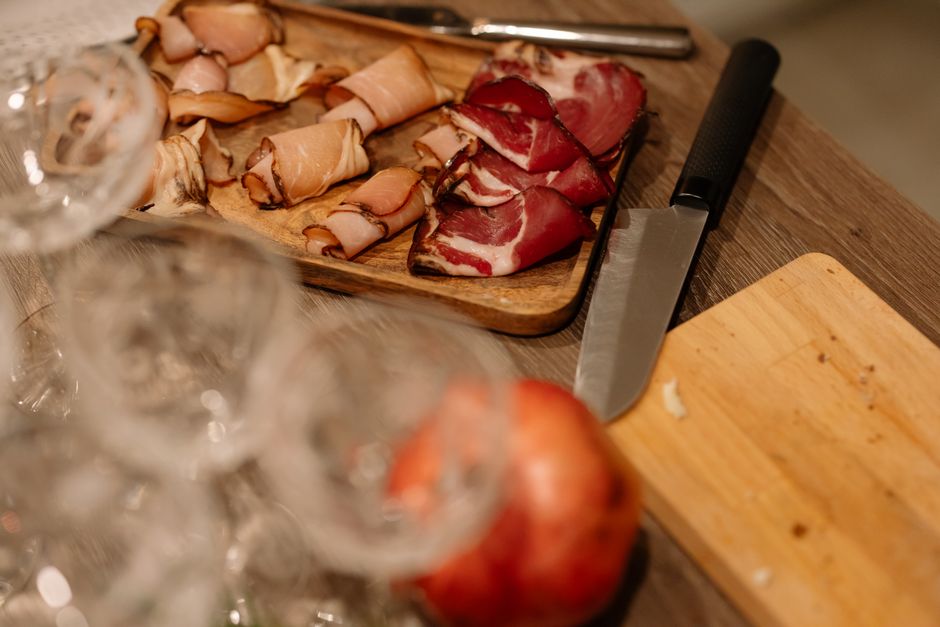
If you are comparing prosciutto and bacon based on nutrition alone, prosciutto is generally the healthier choice. It has less saturated fat, less sodium per serving, and fewer calories than bacon. But “healthier” is a relative term here. Both are processed meats, and both come with health trade-offs that matter more than a simple winner or loser.
What Is the Main Nutritional Difference Between Prosciutto and Bacon?
The biggest difference comes down to fat content and how each meat is prepared. Bacon is cut from pork belly, which is one of the fattiest parts of the pig. Prosciutto comes from the hind leg, which is leaner.
Here is a direct comparison based on a 1-ounce serving of each:
| Nutrient | Prosciutto (1 oz) | Bacon (1 oz, cooked) |
|---|---|---|
| Calories | 80-90 | 140-160 |
| Total Fat | 5-6 g | 12-14 g |
| Saturated Fat | 1.5-2 g | 4-5 g |
| Protein | 8-10 g | 8-10 g |
| Sodium | 700-900 mg | 500-700 mg |
| Sugar | 0 g | 0-1 g (if cured with sugar) |
The table shows bacon has nearly double the calories and fat of prosciutto. But prosciutto has more sodium per ounce. That is partly because prosciutto is dry-cured with salt and aged for months, while bacon is wet-cured or smoked with a shorter process.
If you are watching saturated fat for heart health, prosciutto is the better option. If you are strictly limiting sodium, bacon wins this one small point — but only if you eat the same weight of each.
Does the Way Each Meat Is Processed Matter for Health?
Yes, the processing method changes the nutritional profile and introduces different health concerns. Both prosciutto and bacon are classified as processed meats. The World Health Organization’s International Agency for Research on Cancer (IARC) has classified processed meat as a Group 1 carcinogen. That means there is strong evidence that eating processed meat increases the risk of colorectal cancer.
Bacon is typically cured with nitrites or nitrates, then smoked. Smoking adds compounds called polycyclic aromatic hydrocarbons and heterocyclic amines. Both are linked to cancer risk when consumed in high amounts over time.
Prosciutto is cured with salt only and air-dried. It does not go through smoking. Some traditional prosciutto producers do not add synthetic nitrites, though natural nitrates from salt can still form nitrites during aging. The difference is that prosciutto avoids the additional carcinogens from smoking.
Research published in the journal Nutrients found that dry-cured hams like prosciutto have lower levels of certain harmful compounds compared to smoked meats. That does not make prosciutto risk-free. It just means the processing introduces fewer chemical byproducts.
Is Prosciutto Healthier Than Bacon Nutrition Facts for Heart Health?
For heart health, prosciutto has a clear advantage in fat composition. Bacon’s higher saturated fat content raises LDL cholesterol more than prosciutto does. The American Heart Association recommends limiting saturated fat to 5-6% of total daily calories. A single serving of bacon can cover a large portion of that limit.
But sodium is the bigger concern for many people. The American Heart Association recommends no more than 2,300 mg of sodium per day, with an ideal limit of 1,500 mg for most adults. A 1-ounce serving of prosciutto provides nearly half of that ideal limit. Bacon provides about one-third.
If you eat prosciutto in a sandwich with cheese and bread, the sodium adds up fast. If you eat two slices of bacon with eggs, the total sodium is lower than a single prosciutto serving. The context of your whole meal matters more than the meat alone.
Some studies suggest that the type of fat in prosciutto is less inflammatory than the fat in bacon. Prosciutto fat contains more oleic acid, which is the same monounsaturated fat found in olive oil. Bacon fat contains more saturated fat. This difference is real but small in the amounts most people eat.





What About Calories and Weight Management?
If you are tracking calories, prosciutto is the clear winner. A 1-ounce serving of prosciutto has about half the calories of bacon. That makes it easier to include in a calorie-controlled diet without sacrificing protein.
Protein content is nearly identical between the two. Both provide about 8-10 grams of protein per ounce. That means prosciutto delivers the same protein with fewer calories and less fat. For someone trying to maintain muscle while losing weight, prosciutto is the more efficient choice.
But portion control is easier with bacon for some people. Bacon comes in countable slices. Prosciutto is often sliced paper-thin and people eat more than they realize. A serving of prosciutto is about 3-4 thin slices. Most people eat double that in one sitting.
If you eat prosciutto with crackers, cheese, and wine as a charcuterie board, the calories from the total plate far exceed what you would get from a bacon breakfast. The meat itself is not the problem. The company it keeps matters.
What Are the Hidden Health Risks of Both Meats?
The biggest hidden risk is the nitrite content. Both meats contain nitrites, either added directly or formed naturally during curing. When nitrites are cooked at high heat, they can form nitrosamines, which are carcinogenic compounds.
Bacon is almost always cooked at high heat — pan-fried, baked, or microwaved until crisp. That high-heat cooking creates more nitrosamines. Prosciutto is typically eaten raw and cold. It is never cooked, so nitrosamine formation is minimal.
Some people report that prosciutto causes less bloating and digestive discomfort than bacon. This is widely claimed though strong evidence is limited. The high fat content of bacon can slow digestion and cause discomfort for some people. Prosciutto’s lower fat content may be easier on the stomach.
Another risk is the sugar content in some bacon brands. Many commercial bacons are cured with sugar, honey, or maple syrup. This adds empty calories and can spike blood sugar. Prosciutto contains no added sugar. Traditional prosciutto is cured with salt only.
- Bacon-specific risks: Higher saturated fat, smoking compounds, added sugar in many brands, high-heat cooking creates nitrosamines
- Prosciutto-specific risks: Higher sodium per serving, easier to overeat, no cooking means no kill step for pathogens
- Shared risks: Both are processed meats with cancer risk, both contain nitrites, both are high in sodium overall
How Should You Choose Between Them for Your Diet?
Choose prosciutto if you are focused on lowering saturated fat, cutting calories, or avoiding smoked compounds. It works well as a protein addition to salads, wrapped around vegetables, or eaten in small amounts with fruit.
Choose bacon if you need lower sodium per serving or want a crispy texture for cooking. Bacon also adds more flavor to dishes because of its higher fat content. A small amount of bacon can make vegetables or beans taste richer than a larger amount of prosciutto would.
Neither should be a daily food. The World Cancer Research Fund recommends eating little to no processed meat. If you eat it, keep servings small and infrequent. A reasonable limit is one serving per week, not per day.
For most people, prosciutto is the better option nutritionally. But the difference is not large enough to matter if you eat either only occasionally. What matters more is the overall pattern of your diet — how many vegetables, whole grains, and unprocessed foods you eat alongside these meats.
Frequently Asked Questions
Is prosciutto lower in calories than bacon?
Yes, prosciutto has about half the calories of bacon per ounce. A 1-ounce serving of prosciutto has around 80-90 calories while bacon has 140-160 calories.
Does prosciutto have less sodium than bacon?
No, prosciutto has more sodium per serving than bacon. Prosciutto contains 700-900 mg of sodium per ounce while bacon has 500-700 mg.
Can you eat prosciutto on a low-fat diet?
Yes, prosciutto is lower in total fat and saturated fat than bacon. It can fit into a low-fat diet when eaten in small portions.
Which meat has more protein, prosciutto or bacon?
Both meats have nearly identical protein content. A 1-ounce serving of either provides about 8-10 grams of protein.
