
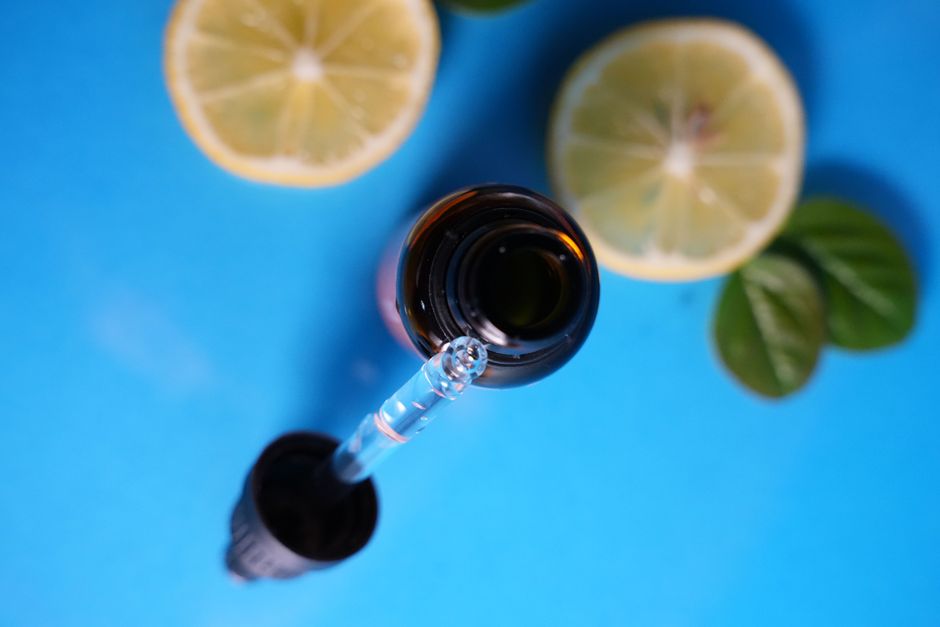
That orange-brown tint at the bottom of your vitamin C serum bottle is not a sign it has gone bad. It is a sign the vitamin C has oxidized — and oxidized vitamin C is a different molecule with different behavior in your skin. The short answer: a serum that has turned color has lost a meaningful amount of its active form, and what remains is largely a weaker compound that cannot do the same job. It is not dangerous to use. It is also not doing what you bought it for.
What Actually Happens When Vitamin C Serum Oxidizes?
Vitamin C in skincare almost always means L-ascorbic acid, the same molecule found in citrus and in your body. It is a reducing agent, which means it readily gives away electrons. That property is exactly why it works on skin — and exactly why it degrades.
When L-ascorbic acid meets oxygen, light, or heat, it loses electrons and converts into dehydroascorbic acid. That is the first oxidation product. It looks pale yellow. Keep going and dehydroascorbic acid breaks down further into diketogulonic acid, which has no vitamin C activity at all. This is the compound responsible for the deep orange and brown color you see in old serums.
The color change is a visible marker of a chemical process, not a cosmetic flaw. A serum that starts clear and turns amber has already lost a substantial portion of its active ingredient. How fast this happens depends on the formulation, the packaging, and how you store it.
Is Oxidized Vitamin C Serum Still Effective?
No — once a vitamin C serum has visibly oxidized, its ability to deliver the skin benefits associated with L-ascorbic acid drops significantly. The remaining compounds are not interchangeable with the original molecule.
This is where a lot of confusion lives. Dehydroascorbic acid is not worthless in a lab dish. Cells can convert it back to ascorbic acid through specific transport mechanisms. But in a topical serum sitting on your bathroom shelf, the conversion chemistry and the skin penetration are both compromised. The molecule that made it through the skin barrier in useful amounts was L-ascorbic acid, and that molecule is largely gone.
What you are left with is a product that may still feel pleasant, may still contain other ingredients, and may still carry some antioxidant activity. What it is not doing is delivering the concentration of active vitamin C that the research on skin effects was based on.
What Does Vitamin C Actually Do for Skin?
L-ascorbic acid has three well-documented roles in skin. It is a cofactor for enzymes that build collagen. It is an antioxidant that neutralizes free radicals from UV exposure and pollution. And at higher concentrations it can interfere with melanin production, which is why it is used for uneven skin tone.
The collagen connection is the most studied. Vitamin C is required for the enzymes prolyl hydroxylase and lysyl hydroxylase to function. Without it, collagen molecules cannot form their stable triple-helix structure. This is why severe vitamin C deficiency causes scurvy, with its characteristic poor wound healing and bleeding gums. That is established physiology, not marketing.
What is less established is how much topical vitamin C meaningfully increases collagen in already well-nourished skin. Some studies suggest benefit. The evidence is not as strong as the supplement industry implies, and results vary by formulation, concentration, and how long the product was tested. This matters when you are deciding whether to replace an oxidized bottle.
How Can You Tell If Your Serum Has Oxidized?
Color is the most reliable signal available to you at home. A fresh L-ascorbic acid serum is typically clear to very pale yellow. As it oxidizes, it moves through yellow, amber, orange, and eventually brown.
- Clear or barely yellow: likely still active
- Golden or light amber: some oxidation has occurred
- Orange or brown: significant oxidation, most active vitamin C is gone
- Dark brown or syrupy: fully degraded, replace it
Smell can also help. A fresh serum has little odor. As it breaks down, some formulations develop a slightly sour or metallic scent. This is a weaker signal than color.
One non-obvious point: a serum that was amber when you opened it is not necessarily old. Some formulations use vitamin C derivatives that are naturally colored, or include other ingredients that tint the product. Check whether the color has changed since you first used it, not just whether it is colored.
Which Vitamin C Forms Resist Oxidation Better?
Pure L-ascorbic acid is the most studied form and also the most fragile. That trade-off is the core problem in vitamin C skincare. Several derivatives exist that are more stable, and they behave differently in the skin.
Common derivatives include ascorbyl glucoside, sodium ascorbyl phosphate, magnesium ascorbyl phosphate, and tetrahexyldecyl ascorbate. These are generally more stable in a bottle. The catch is that most of them must be converted to L-ascorbic acid in the skin before they can do anything, and how efficiently that conversion happens varies. Some derivatives have decent evidence behind them. Others have far less.
If you want the form with the most research behind it, that is L-ascorbic acid. If you want something that will not turn brown in two months, a derivative may serve you better even if the evidence base is thinner.
How Do You Keep Vitamin C Serum From Oxidizing?
You cannot stop oxidation. You can slow it. The same factors that degrade the molecule in a lab are the ones working on your bottle.
Light and heat are the biggest enemies. Store the bottle somewhere cool and dark — a cabinet, not a sunny bathroom counter. A refrigerator is a reasonable option if you do not mind the cold application. Oxygen exposure matters too, which is why pump bottles and airless containers outperform droppers that you open and close repeatedly.
Packaging is often a better predictor of shelf life than the ingredient list. An opaque airless pump will typically outlast a clear dropper bottle of the same formula. If a brand puts L-ascorbic acid in a clear glass dropper, that is a formulation choice you are paying for in lost potency.
Buying smaller sizes more often can beat buying one large bottle that sits for months. Vitamin C serums are not a product where bulk buying serves you well.
Should You Use an Oxidized Serum Anyway?
There is no strong evidence that using an oxidized vitamin C serum is harmful. The main concern is that you are getting little benefit while spending money and applying a product that may irritate sensitive skin.
Some people report irritation from older serums, though this is not well documented in controlled studies. If your skin reacts, stop using it. If it does not, the honest position is that you are mostly applying a degraded product with limited activity.
If the serum is only slightly yellow and you have been using it for a few weeks, it is probably still working. If it is orange or brown, replacing it makes more sense than finishing the bottle out of guilt.
What Should You Look for When Buying a New One?
Concentration matters, and the research on skin effects has mostly used concentrations in the range of 10% to 20% L-ascorbic acid. Below that, evidence of benefit is thinner. Above that, irritation risk rises without clear added benefit.
Formulation matters as much as concentration. L-ascorbic acid is unstable at the pH of normal skin, so effective serums are formulated at low pH, typically below 3.5. That low pH is part of why some people find vitamin C serums sting. A formula that claims to be gentle and non-acidic may be more stable and less irritating, but it is also relying on a different mechanism or a derivative.
Look for opaque or airless packaging. Look for a bottle size you will finish in a few months. And check the color when it arrives — a serum that shows up already amber has likely been sitting in a warehouse.
The Bottom Line on Oxidized Vitamin C Serum
Oxidation is not a defect. It is the predictable fate of an unstable molecule. The color change is your best at-home signal that the active ingredient has degraded, and once it has, the serum is no longer delivering what the research was based on.
It is not dangerous. It is just not doing the job. Store your next bottle cool and dark, choose packaging that limits air and light, and replace it when it turns. That is the honest version of vitamin C skincare.
Frequently Asked Questions
Is oxidized vitamin C serum safe to use?
There is no strong evidence that oxidized vitamin C serum is harmful to skin. It is simply much less effective, since most of the active L-ascorbic acid has broken down.
Can I still use vitamin C serum if it turned orange?
You can, but an orange serum has lost a large portion of its active vitamin C and is unlikely to deliver the benefits you bought it for. Replacing it is the more practical choice.
Does vitamin C serum expire?
Yes. L-ascorbic acid degrades over time, and most serums lose meaningful potency within a few months of opening, faster if stored in light or heat. The color change is the clearest sign.
How do I stop my vitamin C serum from oxidizing?
Store it in a cool, dark place and choose opaque or airless packaging that limits light and air exposure. You can slow oxidation, but you cannot stop it entirely.
