
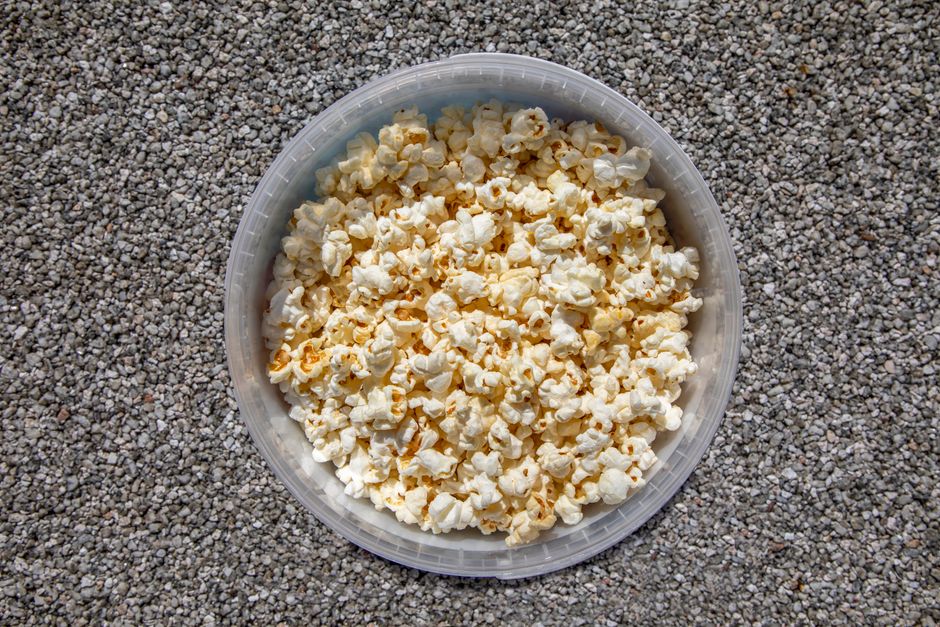
Movie theater popcorn is not a health food. A large bucket with butter topping can deliver well over 1,000 calories and a full day’s worth of saturated fat, largely because of the oil it is popped in and the topping poured on top. Plain air-popped popcorn, by contrast, is a whole grain snack that is low in calories and high in fiber. The difference between those two versions is enormous — and it comes down almost entirely to how the popcorn is prepared.
Is Movie Popcorn Healthy? Calories, Fat, and More
The popcorn itself is not the problem. Corn is a whole grain. When it is air-popped, it contains very little fat and a meaningful amount of fiber. The problems start with the oil and the topping.
Movie theaters typically pop corn in coconut oil, which is high in saturated fat. Then they add a butter-flavored topping that is often not butter at all — it is usually a blend of soybean oil, artificial flavoring, and coloring. Both steps add large amounts of fat and calories.
That is why movie popcorn can be so calorie-dense. A modest serving of popcorn prepared at home might contain around 30 calories per cup. Theater popcorn prepared with oil and topping can contain several times that amount per cup. The exact numbers depend on the theater, the batch, and how much topping is added — which is why published calorie counts for movie popcorn vary so widely.
Here is a non-obvious point that surprises many people: the “butter” flavoring used in most theaters is not butter. Real butter contains milk solids that burn easily under heat lamps, so theaters use a flavored oil blend instead. That blend is where a lot of the extra fat and calories come from.
What Are the Nutrition Facts for Movie Popcorn?
Exact nutrition figures for movie popcorn are hard to pin down because preparation varies so much between theaters and even between batches at the same theater. The table below compares general ranges for air-popped popcorn versus typical theater popcorn with oil and topping. These are approximate figures, not precise measurements.
| Type | Calories (per cup, approx.) | Fat | Saturated Fat | Fiber |
|---|---|---|---|---|
| Air-popped, plain | ~30 | Very low | Negligible | ~1 gram |
| Theater popcorn, oil-popped, no topping | ~60–90 | Moderate to high | Moderate | ~1 gram |
| Theater popcorn with butter topping | ~90–150+ | High | High | ~1 gram |
These ranges are estimates based on common preparation methods. A large bucket holds many cups of popcorn, so the total for a full bucket can easily exceed 1,000 calories. That is not because popcorn is inherently fattening — it is because a large volume of oil and topping adds up fast.
One more factor: portion size. A “medium” theater popcorn today is much larger than a medium from decades ago. Serving sizes at theaters have grown substantially, which means the calorie total per bag or bucket has grown too.
Why Does Theater Popcorn Have So Many Calories?
Three things drive the calorie count up: the popping oil, the topping, and the portion size.
- Popping oil: Many theaters use coconut oil, which is high in saturated fat. It makes popcorn taste richer and pop more evenly, but it adds significant fat and calories.
- Butter topping: The flavored oil poured on top adds more fat and calories. Some people ask for “extra butter,” which can double the topping amount.
- Portion size: A large bucket contains many cups of popcorn. Even at moderate calories per cup, the total climbs quickly.
Air-popped popcorn avoids the first two issues entirely. It uses hot air instead of oil, and it does not need topping to taste good. That is why the calorie gap between air-popped and theater popcorn is so large.
Is Popcorn a Healthy Snack in General?
Yes, with conditions. Popcorn is a whole grain, and whole grains are associated with better heart health and lower risk of several chronic diseases in large population studies. Popcorn also contains fiber, which can help with fullness and digestion.
But “popcorn” covers a wide range. Plain air-popped popcorn is a genuinely good snack. Microwave popcorn can be a mixed bag — some varieties are loaded with oil, salt, and artificial flavoring, while others are lighter. Pre-packaged popcorn in stores varies just as much.
The healthiest approach is simple: pop it yourself, use little or no oil, and go easy on the salt and butter. A sprinkle of herbs or a small amount of grated cheese can add flavor without the calorie load of theater-style topping.
One caveat worth knowing: popcorn hulls can be a choking hazard for young children, and people with certain digestive conditions may find popcorn hard to tolerate. For most adults, though, plain popcorn is a reasonable snack.
How Can You Make Movie Popcorn Healthier?
If you want the movie theater experience without the calorie hit, you have options.
- Skip the topping. Ask for no butter topping, or ask for it on the side so you control how much goes on.
- Choose a smaller size. A small or kids’ size can cut the total calories substantially compared with a large bucket.
- Share it. Splitting a bag with someone else reduces your portion without changing the taste.
- Bring your own. Many theaters allow outside snacks, though policies vary. Air-popped popcorn from home is far lower in calories.
- Make it at home. An air popper or a plain brown paper bag in the microwave can produce popcorn with no added oil.
None of these steps makes movie popcorn a “health food.” They simply reduce the damage. The core issue — oil and topping — remains unless you skip them.
Does Popcorn Have Any Real Health Benefits?
Popcorn does have some nutritional value. It contains fiber, and it is a whole grain, which puts it in a different category from snacks like chips or candy. Some research suggests that people who eat more whole grains tend to have lower rates of heart disease and type 2 diabetes, though that research looks at whole grains broadly, not popcorn specifically.
Popcorn also contains small amounts of certain antioxidants and polyphenols. These compounds are found in many plant foods, and their presence in popcorn does not make popcorn a “superfood.” The amounts are modest, and no clinical trial has shown that eating popcorn prevents any disease.
What popcorn does offer is volume. It is light and airy, so a cup of plain popcorn takes up space in the stomach for relatively few calories. That can help with feelings of fullness. But that advantage disappears once oil and topping are added.
Is Movie Popcorn Bad for You?
Movie popcorn is not toxic or dangerous. It is simply a high-calorie, high-fat food when prepared the standard way. Eating it occasionally is unlikely to cause harm for most people. The concern is more about routine consumption — if movie popcorn is a regular part of your diet, the calories, saturated fat, and sodium can add up.
Sodium is another factor. Theater popcorn is often heavily salted, and a large bucket can contain a substantial amount of sodium. For people watching their blood pressure or managing heart or kidney conditions, that matters.
The bottom line is not that you should never eat movie popcorn. It is that movie popcorn is a treat, not a health food — and the way it is prepared makes most of the difference.
Frequently Asked Questions
Is movie popcorn healthy?
Movie popcorn is not a healthy food when prepared with oil and butter topping, because it is high in calories, fat, and sodium. Plain air-popped popcorn is a healthier option, but that is not what most theaters serve.
How many calories are in a large movie theater popcorn?
A large bucket with butter topping can exceed 1,000 calories, though the exact number depends on the theater and how much topping is added. Without topping, the total is lower but still substantial because of the popping oil.
Is movie popcorn worse than chips?
It depends on the type and portion. Plain air-popped popcorn is generally lower in calories and fat than most chips, but theater popcorn with oil and topping can be comparable to or higher than chips in calories and saturated fat.
Is popcorn a carb or a protein?
Popcorn is mostly carbohydrate, with a small amount of protein and fiber. It is a whole grain, so its carbohydrates come with some fiber, unlike refined snack foods.
