
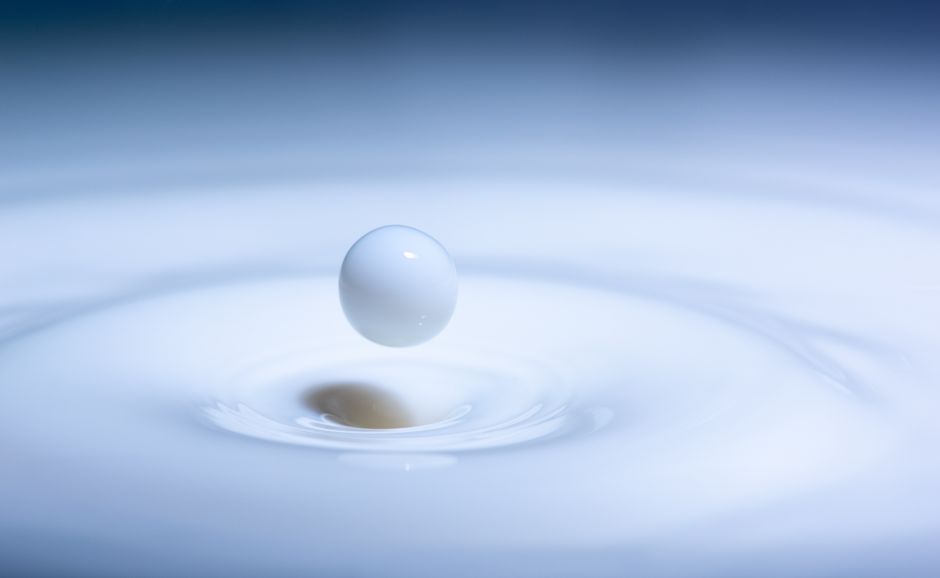
Pour a glass of milk and you are looking at one of the most chemically complicated liquids in your kitchen. The short answer: no, milk is not a pure substance. It is a mixture — mostly water, with fats, proteins, sugars, minerals, and vitamins suspended and dissolved inside it. In chemistry terms, a pure substance has a fixed composition and uniform properties throughout, like distilled water or table salt. Milk has neither.
That distinction matters more than a classroom definition. It explains why milk separates, why it spoils, why some people cannot digest it, and why “pure” on a milk carton means something different from “pure” in a chemistry textbook.
What Makes Something a Pure Substance in Chemistry?
A pure substance is matter with a fixed chemical composition. Every sample is identical, and it cannot be separated into different components by physical means.
Gold is a pure substance — an element. Distilled water is a pure substance — a compound, always two hydrogen atoms bonded to one oxygen atom. Salt is a pure substance, sodium chloride in a fixed ratio. If you filter, freeze, or evaporate any of these, you still have the same substance.
Milk fails every one of those tests. Its composition varies by animal, breed, diet, season, and stage of lactation. It separates into layers if left standing. It can be broken apart into distinct fractions by physical methods like centrifugation. Those are the hallmarks of a mixture, not a pure substance.
The two types of mixtures
Chemists split mixtures into two groups, and milk manages to be both at once.
- Homogeneous mixtures look uniform throughout. Salt water is the classic example.
- Heterogeneous mixtures have visibly different parts. Sand in water is one.
Fresh milk looks homogeneous to the eye, but under a microscope it is not. Fat droplets float in a water-based fluid. That makes milk a colloid — a mixture where tiny particles stay dispersed rather than settling out. It is also an emulsion, because those particles are fat droplets suspended in water.
What Is Milk Actually Made Of?
Milk is roughly 87 percent water. The remaining 13 percent is where all the nutrition and all the complexity lives.
The main components are water, fat, protein, lactose (a sugar), and minerals — chiefly calcium and phosphorus. Vitamins A, D, and B12 are present in varying amounts. Cow’s milk composition is well documented in USDA nutritional data.
| Component | Approximate share of cow’s milk | What it does |
|---|---|---|
| Water | About 87% | Solvent; carries everything else |
| Fat | About 3–4% (whole milk) | Energy; carries fat-soluble vitamins |
| Protein | About 3.3% | Casein and whey; amino acids |
| Lactose | About 4.8% | Sugar; energy source |
| Minerals | Under 1% | Calcium, phosphorus, potassium |
These figures are approximate because milk is a biological fluid, not a manufactured product. A cow’s milk shifts with what she eats and where she is in her lactation cycle. That natural variability is itself proof that milk cannot be a pure substance — a pure substance does not change composition from one sample to the next.
Why Does Milk Separate and Curdle?
Because it is a mixture, milk can be pulled apart. That is not a defect; it is basic chemistry.
Fat droplets in milk are coated with a thin layer of proteins and phospholipids that keeps them from merging. Leave milk standing and those droplets rise, forming cream on top. Homogenization prevents this by forcing milk through tiny openings at high pressure, breaking the fat into much smaller droplets so they stay suspended.
Curdling works differently. Milk proteins carry a slight electrical charge that keeps them apart. Add acid — lemon juice, vinegar — and that charge is neutralized. The proteins clump and separate into solid curds and liquid whey. The same thing happens when rennet is added in cheesemaking, or when bacteria produce acid in spoiled milk.
Heat does it too. Boiling or adding milk to hot coffee can cause proteins to denature and aggregate. None of these changes could happen to a pure substance. You cannot curdle distilled water.





Is Homogenized or “Pure” Milk Different?
The word “pure” on a milk label is a marketing term, not a chemistry term. It carries no standardized legal definition for milk in the way “organic” or “Grade A” do.
Homogenization changes the size of fat droplets, not the chemical makeup. Pasteurization heats milk to kill harmful bacteria such as Salmonella, E. coli, and Listeria, but it does not turn milk into a pure substance. It remains a mixture before and after.
Raw milk — unpasteurized — is still a mixture too. It is also a genuine safety concern. Public health agencies including the CDC and FDA advise against drinking raw milk because it can carry dangerous bacteria. That risk is well documented, and it is separate from the chemistry question. Pasteurized or raw, milk is a mixture either way.
Why Can’t Some People Digest Milk?
Lactose intolerance is the most common reason. It happens when the small intestine produces too little lactase, the enzyme that splits lactose into glucose and galactose for absorption.
Without enough lactase, undigested lactose passes into the large intestine. Gut bacteria ferment it, producing gas and pulling in water. The result is bloating, gas, cramps, and diarrhea, typically within a few hours of eating dairy. This is a well-established mechanism, not a fringe theory.
Lactose intolerance is different from a milk allergy. A milk allergy is an immune reaction to milk proteins, most often casein or whey, and can cause hives, vomiting, or in severe cases anaphylaxis. Allergy is less common than intolerance but potentially far more serious. If you suspect a milk allergy, especially in a child, that is a conversation for a clinician, not a self-diagnosis.
There is a genetic layer here that surprises many people. Lactase production normally declines after childhood in most of the world’s population — a pattern called lactase non-persistence. The ability to digest milk comfortably into adulthood is the evolutionary exception, not the rule.
Is Milk a Solution, Colloid, or Suspension?
Milk is a colloid, and it also behaves as an emulsion. It is not a true solution, and it is not a simple suspension.
The distinction comes down to particle size. In a true solution, like sugar dissolved in water, particles are individual molecules and never settle. In a suspension, like muddy water, larger particles eventually sink. Colloids sit in between: particles are small enough to stay dispersed but large enough to scatter light.
That is why milk looks opaque and white. The fat droplets and protein clusters scatter light in all directions. Skim milk scatters less because the fat has been removed, which is why it looks thinner and slightly blue-tinted.
Milk is not one thing. It is water, fat, protein, sugar, and minerals held together in a delicate balance. Change the temperature, the acidity, or the time standing on the counter, and that balance shifts. A pure substance would not care. Milk does.
Frequently Asked Questions
Is milk a pure substance or a mixture?
Milk is a mixture, not a pure substance. It contains water, fat, protein, lactose, and minerals that can be separated by physical means and that vary from sample to sample.
Why is milk considered a colloid?
Milk is a colloid because tiny fat droplets and protein clusters stay dispersed in water rather than dissolving or settling out. Those particles are large enough to scatter light, which is why milk looks white and opaque.
Does homogenizing milk make it a pure substance?
No. Homogenization only shrinks the fat droplets so they stay mixed in; it does not change milk’s chemical composition or turn it into a pure substance. Homogenized milk is still a mixture.
Can milk be separated back into its parts?
Yes, and that is exactly why it is a mixture. Centrifugation separates cream from skim milk, acid separates curds from whey, and evaporation removes the water, leaving solids behind.
