
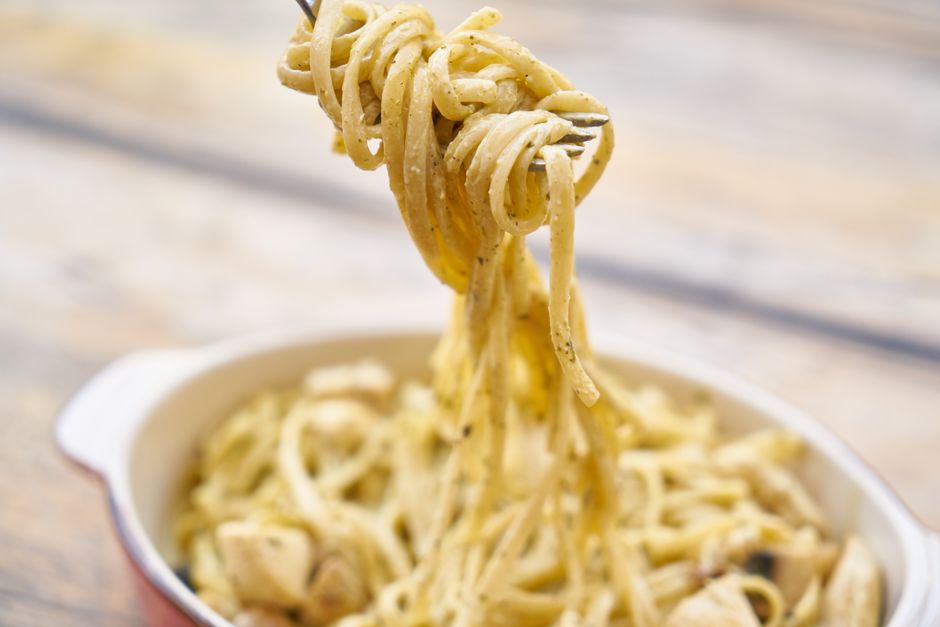
No. Pasta left out overnight is not safe to eat. Cooked pasta is a moist, low-acid food, and that combination makes it a favorable environment for bacterial growth. Food safety guidance from the USDA is clear: perishable foods left at room temperature for more than two hours should be discarded. Overnight is well past that window.
That answer surprises people. Pasta looks and smells fine the next morning. But the bacteria that cause the most common foodborne illness do not announce themselves. There is no visible mold, no sour smell, no slime. The food can look completely normal and still make you sick.
Why Does Cooked Pasta Become Unsafe So Quickly?
Cooked pasta is roughly 60 to 70 percent water by weight. That moisture, combined with starch and a pH near neutral, creates conditions where bacteria multiply rapidly. The USDA calls this range the “temperature danger zone” — between 40°F and 140°F.
Inside that zone, bacteria can double in number roughly every 20 minutes under ideal conditions. A small number of cells on a serving of pasta at 8 p.m. can become a very large number by morning. The two-hour rule exists because that is when the risk begins climbing sharply, not because something magical happens at the 120-minute mark.
Room temperature matters too. A 68°F kitchen is not the same as an 85°F kitchen. Warmer rooms push bacterial growth faster. This is why the two-hour guidance shortens to one hour when the ambient temperature is above 90°F — a detail that applies to summer picnics and hot cars.
What Bacteria Grow on Leftover Pasta?
Several organisms are relevant here, and one deserves specific attention.
Bacillus cereus is a spore-forming bacterium found widely in soil and in raw starches, including rice and pasta. Cooking kills the live bacterial cells, but the spores survive typical boiling temperatures. Once the pasta cools into the danger zone, those spores can germinate and the resulting cells produce toxins.
There are two forms of illness associated with this organism. One causes vomiting, typically within a few hours of eating. The other causes diarrhea, usually 8 to 16 hours later. The vomiting-type illness is linked to a heat-stable toxin — meaning reheating the pasta does not destroy it. This is a point many people miss. Reheating kills bacteria but does not reliably eliminate toxins that have already formed.
Other organisms that can grow on improperly stored pasta include Staphylococcus aureus and various Salmonella species, depending on handling and cross-contamination. The exact organism is often never identified, because most people who get sick do not seek medical care and no sample is tested.
Does Reheating Pasta Make It Safe?
No. Reheating is not a reset button.
Heat kills living bacteria. It does not reliably neutralize the toxins those bacteria have already produced. Some bacterial toxins are heat-stable and survive boiling, microwaving, and oven reheating. This is the core reason food safety guidance treats time in the danger zone as the deciding factor, not temperature at the moment of eating.
If pasta was refrigerated within two hours of cooking, reheating it until steaming hot is a normal and reasonable practice. If it sat out overnight, reheating it does not make it safe. The two situations are not equivalent, and treating them as the same is a common and risky mistake.


What Are the Symptoms of Foodborne Illness From Pasta?
Symptoms depend on the organism and the toxin involved, but the general pattern is uncomfortable and sometimes serious.
- Nausea and vomiting, sometimes within a few hours of eating
- Watery diarrhea, often starting later
- Abdominal cramps
- Fever, in some cases
- Headache and general weakness
Most healthy adults recover within a day or two without medical treatment. The main risk during that time is dehydration from vomiting and diarrhea. fluids and electrolytes matter more than anything else in the short term.
Some people face higher risk. Infants, young children, adults over 65, pregnant women, and anyone with a weakened immune system can develop more severe illness. For these groups, foodborne infections can lead to hospitalization. If symptoms are severe, bloody, or persistent, medical care is appropriate.
What Is the Correct Way to Store Cooked Pasta?
The rule is simple and it is not negotiable if you want to keep the food.
Refrigerate cooked pasta within two hours of cooking. If the room is above 90°F, cut that to one hour. Spread the pasta in a shallow container so it cools faster, or divide it into smaller portions. A deep, tightly packed container of hot pasta cools slowly, and the center can stay in the danger zone longer than you would expect.
Once refrigerated, cooked pasta keeps for about three to five days. That range comes from standard food safety guidance for cooked leftovers. After that, discard it. Freezing cooked pasta is also an option and extends storage considerably, though texture changes on thawing.
One clarification worth making: the two-hour clock starts when the pasta leaves a hot holding temperature, not when you sit down to eat. Pasta sitting in a serving bowl on the table during a long dinner is already accumulating time.
Is Pasta More Risky Than Other Leftovers?
Not dramatically more than other cooked starches, but it belongs in the same category as rice, potatoes, and other moist cooked foods.
Cooked rice has a well-documented association with Bacillus cereus illness, and the same spore logic applies. Pasta is not uniquely dangerous, but it is not shelf-stable either. The idea that pasta is somehow safer to leave out than meat or dairy is not supported by food safety guidance.
Dry, uncooked pasta is a different story entirely. It is shelf-stable and does not require refrigeration. The risk begins once it is cooked and hydrated.
What If You Already Ate It?
Most people who eat pasta left out overnight do not get sick. That is a statement about probability, not safety. The risk is real, and it is not worth taking, but a single exposure does not guarantee illness.
If you ate it and feel fine, there is nothing specific to do. Watch for symptoms over the next 24 hours. If vomiting or diarrhea develops, focus on hydration. Seek medical care if symptoms are severe, if there is blood in vomit or stool, if you cannot keep fluids down, or if you are in a higher-risk group.
If you have not eaten it yet, throw it out. The cost of a portion of pasta is trivial compared to the cost of a foodborne illness.
Does the Smell Test Work?
No. The smell test is not a reliable safety check for leftovers.
Pathogenic bacteria generally do not produce obvious odors at the cell densities that cause illness. By the time food smells or looks off, spoilage organisms have usually been active for a while — and spoilage organisms are not the same as the ones that make you sick. Food can be unsafe while still smelling and tasting completely normal.
This is one of the more persistent myths in home food safety. Visual and olfactory checks catch obvious spoilage. They do not catch the bacterial growth that matters most for foodborne illness risk.
Frequently Asked Questions
Can I eat pasta that sat out overnight if I reheat it?
No. Reheating kills bacteria but does not reliably destroy heat-stable toxins that may have already formed. Food safety guidance treats time in the danger zone as the deciding factor, not reheating.
How long can cooked pasta sit out before it is unsafe?
Two hours at room temperature is the standard limit, and one hour if the room is above 90°F. Beyond that, the risk of bacterial growth rises sharply and the food should be discarded.
What happens if you eat pasta left out overnight?
You may get foodborne illness, with nausea, vomiting, diarrhea, or cramps appearing within hours to a day. Many people do not get sick from a single exposure, but the risk is real and not worth taking.
Does pasta left out overnight smell bad if it is unsafe?
Often no. The bacteria most likely to cause illness do not produce obvious odors, so smell and appearance are not reliable safety indicators.
