
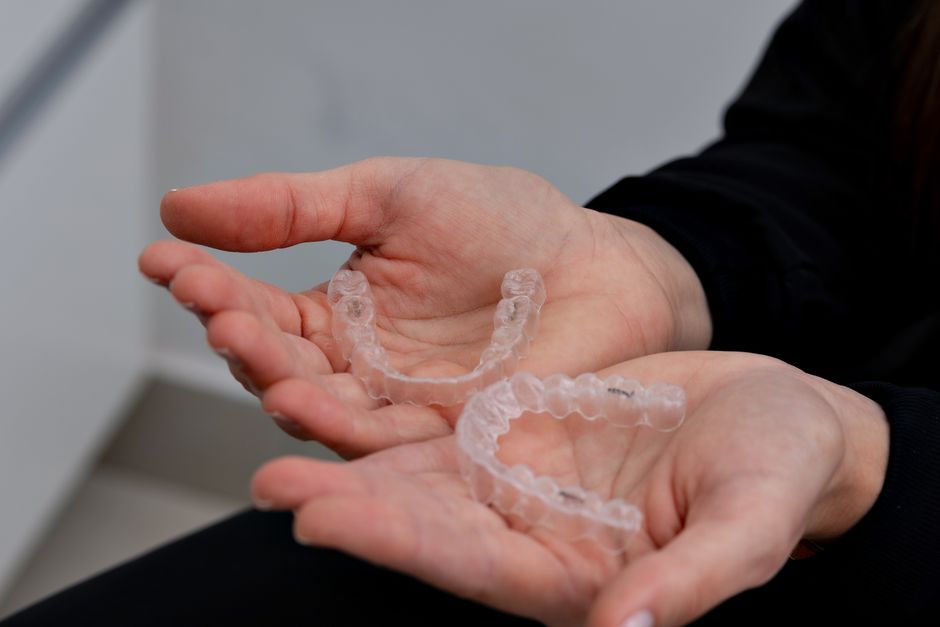
Neither Invisalign nor braces is universally “more effective.” Both can produce excellent results when the right system is matched to the right case. The honest answer is that effectiveness depends almost entirely on what needs to be corrected, how complex the movement is, and how faithfully the patient follows instructions. For mild to moderate crowding and spacing, clear aligners like Invisalign can work as well as fixed braces. For severe crowding, large bite corrections, and certain rotations, fixed braces still have the edge.
Is Invisalign More Effective Than Braces for Straightening Teeth?
For many common alignment problems, the two approaches reach similar results. Mild crowding, small gaps, and minor relapse after previous orthodontic treatment are areas where clear aligners have a solid track record.
The gap widens as complexity increases. Fixed braces are bonded to the teeth. That gives the orthodontist direct, continuous control over each tooth in three dimensions. Aligners move teeth by applying controlled pressure through a series of removable plastic trays. That works well for tipping and moderate movement. It is harder to achieve certain root movements, significant rotations, and large vertical corrections with aligners alone.
This is not a knock on aligners. It is a statement about what each tool does best. An orthodontist evaluating your case is asking a specific question: can this particular set of movements be reliably produced with a removable appliance? Sometimes the answer is yes. Sometimes it is no.
One practical point that gets lost in the marketing: aligner treatment is only as good as wear time. Aligners typically need to be worn around 20 to 22 hours a day. If someone wears them 14 hours a day, the teeth will not track the plan. This is one of the most common reasons aligner treatment underperforms — not because the technology failed, but because the trays sat in a case instead of on the teeth.
What Can Braces Do That Invisalign Cannot?
Braces handle complex tooth movement that aligners struggle to reproduce reliably.
Several categories tend to favor fixed braces:
- Severe crowding that requires significant expansion or extraction space closure
- Large rotations of rounded teeth like canines and premolars
- Significant bite problems involving the front-to-back or vertical relationship of the jaws
- Teeth that have not erupted fully or that need to be guided into position
- Cases needing precise root positioning, since braces give the orthodontist more direct control
Aligners have improved. Modern systems use attachments — small tooth-colored bumps bonded to teeth — and sometimes tiny elastics to help produce movements that older aligner systems could not. Many cases that once required braces can now be treated with aligners. But “many” is not “all.”
An orthodontist’s recommendation to use braces is not a sign that aligners are inferior across the board. It usually means the specific mechanics of your case are better served by a fixed appliance.
Does Invisalign Work as Well as Braces for Adults?
Adults are often good candidates for clear aligners. Adult teeth tend to move in predictable ways, and many adult cases involve mild to moderate crowding or spacing rather than the growth-related issues seen in children.
There is also a practical advantage. Adults often care about appearance during treatment. Aligners are nearly invisible, and they can be removed for meetings, photos, and social events. That matters to people who would otherwise avoid treatment altogether.
But adults also bring challenges. Some have crowns, bridges, or dental work that can affect how aligners fit and how teeth respond. Others have gum disease or bone loss that needs to be addressed before any orthodontic treatment, regardless of the system used. Periodontal health is a prerequisite, not an afterthought.
The evidence on adult outcomes is generally favorable for aligners in appropriate cases. The key phrase is “appropriate cases.” An orthodontist who evaluates your bite, your gum health, and the specific movements needed is in the best position to say which system fits.




Which Is Better for Complex Bite Problems?
Fixed braces are generally the more reliable choice for complex bite problems.
Bite problems involve the relationship between the upper and lower teeth and sometimes the jaws themselves. Correcting an overbite, underbite, crossbite, or open bite often requires moving teeth in multiple directions at once, sometimes over longer distances. Braces give the orthodontist continuous control and the ability to make fine adjustments at each visit.
Aligners can address some bite issues, particularly mild ones. Severe skeletal discrepancies — where the jawbones themselves are mismatched — may not be fully correctable with either braces or aligners alone. Those cases sometimes require jaw surgery in combination with orthodontics. That is a decision made with an orthodontist and often an oral surgeon, not a choice between two appliance types.
If someone tells you aligners can fix any bite, that claim does not hold up. If someone tells you braces are always necessary, that is also not accurate. The honest position is that complexity drives the recommendation.
Does Invisalign Take Longer Than Braces?
Treatment time varies by case, and general statements about which is faster are misleading.
For simple cases, aligner treatment can sometimes be completed in a similar timeframe to braces. For complex cases, aligners may take longer — or may not be recommended at all. Some clinicians report that certain movements are more efficient with fixed appliances because there is no dependence on patient wear time.
What is well established is that aligner treatment time is heavily influenced by how many hours per day the trays are worn. A patient who wears aligners as directed will generally stay on schedule. A patient who does not will fall behind, sometimes significantly.
Braces do not depend on patient compliance for wear time. They are fixed to the teeth and work continuously. That is a real difference, and it is one reason some orthodontists recommend braces for patients they suspect may struggle with aligner discipline — including some teenagers.
Are There Cases Where Braces Are Clearly the Better Choice?
Yes. Certain situations favor braces in a way that most orthodontists would agree on.
Cases involving severe crowding, major rotations, significant bite correction, or teeth that need to be moved in ways aligners handle less predictably are typically better served by fixed braces. So are cases where the patient cannot or will not commit to wearing aligners 20 to 22 hours a day.
There is also the matter of what happens after treatment. Both braces and aligners require retainers to hold the result. Teeth have a natural tendency to shift over time, and without retention, even a perfect result can relapse. This is true regardless of which system was used.
The choice between aligners and braces is not about which is “better” in a vacuum. It is about which is better for your specific teeth, your bite, your lifestyle, and your ability to follow the treatment plan. That is a conversation to have with an orthodontist who can examine your mouth and see what the marketing materials cannot.
Frequently Asked Questions
Can Invisalign fix an overbite?
Aligners can correct some mild to moderate overbites, especially when the issue is mainly tooth position. More significant overbites, particularly those involving jaw relationship, often need braces or a combination approach.
Is Invisalign as strong as braces?
Aligners and braces apply force differently, and neither is simply “stronger” across all movements. Braces give the orthodontist more direct control, which matters most in complex cases.
Why would an orthodontist recommend braces over Invisalign?
Usually because the specific tooth movements needed are more predictable with fixed appliances, or because aligner wear time is a concern. It is a case-by-case judgment, not a blanket rule.
Do Invisalign results last as long as braces results?
Long-term stability depends mainly on retainer use and how the teeth respond over time, not on which appliance straightened them. Both require ongoing retention to prevent relapse.
