
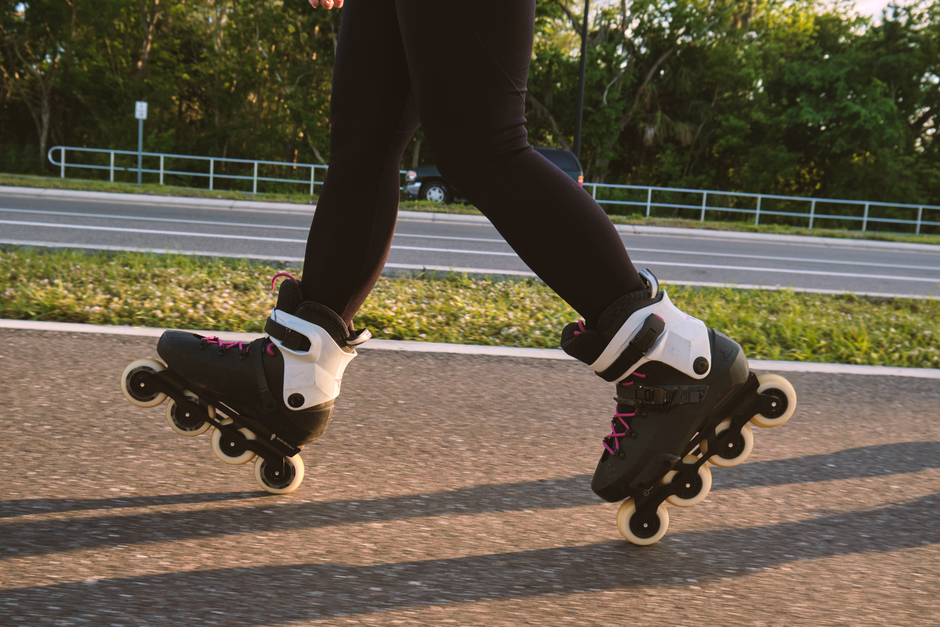
Inline skating is a genuine cardiovascular workout that builds leg strength, improves balance, and burns calories at a rate comparable to running or cycling. It is a full-body activity that recruits the glutes, quadriceps, hamstrings, calves, and core stabilizers with every stride. If you are looking for a low-impact workout that still raises your heart rate, inline skating belongs on your short list.
Is Inline Skating a Good Workout?
Yes. Inline skating is an aerobic exercise that elevates heart rate and works major muscle groups in the lower body and core. It qualifies as moderate-to-vigorous physical activity under the standard categories used by public health agencies.
The U.S. Department of Health and Human Services recommends adults get at least 150 minutes of moderate-intensity aerobic activity per week, or 75 minutes of vigorous activity. Inline skating at a steady pace falls into the moderate category. Push harder and it becomes vigorous.
What makes skating effective is the combination of demand. Unlike cycling, where the machine supports your weight, skating requires you to hold yourself upright on a narrow base while generating forward motion. That constant micro-adjustment engages stabilizer muscles in the hips, ankles, and trunk. The result is a workout that trains balance and coordination alongside your heart and lungs.
Calorie burn depends on your body weight, pace, and effort. The Compendium of Physical Activities, a widely used reference for energy expenditure, lists inline skating at a metabolic equivalent (MET) value in the range of 7 to 12 depending on speed and intensity. For context, walking at a brisk pace is about 4 METs and running a 10-minute mile is roughly 10 METs. So skating sits comfortably in the same zone as jogging, without the repetitive joint impact.
What Muscles Does Inline Skating Work?
Skating is lower-body dominant, but it is not just a leg workout. The stride pattern loads multiple muscle groups at once.
- Quadriceps drive the push-off phase and control knee extension.
- Glutes power hip extension and outward push, especially on the recovery phase of each stroke.
- Hamstrings assist with knee flexion and hip drive.
- Calves and ankles stabilize the foot inside the boot and manage the constant forward lean.
- Core muscles keep the trunk upright and resist rotation as you shift weight side to side.
- Lower back works to hold your posture, particularly on longer skates.
Your upper body gets less work. Arms mostly swing for balance rather than drive force. That is a real limitation if your goal is balanced strength. If you want a more complete session, add push-ups, rows, or overhead presses on other days.
One thing many people miss: skating is asymmetrical in demand over time. Most skaters favor a dominant side, which can create strength differences if left unchecked. Deliberately practicing turns and stops on both sides helps even this out.
How Does Inline Skating Compare to Running and Cycling?
Each activity has a different profile. The best choice depends on your joints, your goals, and what you will actually do consistently.
| Activity | Joint Impact | Muscle Focus | Balance Demand |
|---|---|---|---|
| Inline skating | Low | Legs, glutes, core | High |
| Running | High | Legs, glutes, core | Low |
| Cycling | Very low | Quads, calves | Low |
Running delivers a higher cardiovascular stimulus per minute for most people, but it loads the knees and hips with repeated impact forces. Skating gets you into a similar heart-rate zone without that pounding. Cycling is even gentler on joints but demands less from your stabilizer muscles and balance system.
The balance component is worth calling out. Skating trains proprioception — your body’s sense of where it is in space — in a way that cycling and running do not. Some research suggests that balance training becomes more important with age because falling risk rises. Skating is not a fall-prevention program, but it does challenge the systems involved in staying upright.
If you have knee osteoarthritis, skating is often better tolerated than running. That said, no activity is universally safe for every joint condition. Talk to a clinician who knows your history before starting.





How Many Calories Does Inline Skating Burn?
Calorie burn varies widely based on body weight, pace, terrain, and effort. The MET values in the Compendium of Physical Activities give a reasonable framework.
At a moderate recreational pace, skating sits around 7 METs. At a vigorous racing pace, it can reach 12 METs or higher. A MET is roughly the energy cost of sitting still. So 7 METs means you are burning about seven times the calories you would burn at rest.
To put that in practical terms: a 155-pound person skating at a moderate pace for 30 minutes burns somewhere in the range of 250 to 300 calories. The same person running at a 10-minute-mile pace for 30 minutes burns a similar amount. Skating faster or on hills pushes the number higher.
These are estimates, not precise measurements. Individual metabolism, fitness level, and technique all shift the actual number. Do not treat any calorie figure as exact. Use it as a rough guide for planning, not as a contract.
What Are the Risks and How Do You Skate Safely?
Inline skating has a real injury profile. Falls are the primary concern, and wrist fractures are among the most common injuries in recreational skaters. Head injuries, while less frequent, can be severe.
The single most effective safety measure is wearing protective gear. A helmet, wrist guards, knee pads, and elbow pads reduce the risk and severity of injuries from falls. Wrist guards in particular are widely recommended because the instinct to catch yourself with an outstretched hand is hard to override.
Other practical steps:
- Learn to stop before you learn to go fast. Master the heel brake or a controlled slide stop.
- Start on smooth, flat, traffic-free surfaces. Parking lots and paved trails work well.
- Check your equipment. Worn wheels, loose axles, and worn brake pads increase fall risk.
- Warm up before skating and cool down after. Cold muscles handle sudden loads poorly.
- Avoid skating in wet conditions or on gravel, where wheels lose grip.
Beginners should expect soreness in the hips, inner thighs, and lower back for the first few sessions. That is normal adaptation, not injury. Sharp pain, joint swelling, or pain that persists beyond a few days warrants a medical evaluation.
If you have a history of balance disorders, recent fractures, or certain neurological conditions, check with your doctor before starting. Skating demands good balance and reaction time.
How Do You Start an Inline Skating Routine?
Start shorter and easier than you think you need to. Skating uses muscles in ways that walking and cycling do not, and your first few sessions will expose weaknesses you did not know you had.
A reasonable progression for a healthy beginner:
- Session 1-2: 15 to 20 minutes of easy skating on flat ground, focusing on posture and stopping.
- Session 3-5: 20 to 30 minutes at a conversational pace.
- Week 3 onward: Build toward 30 to 45 minutes, adding hills or speed intervals as comfort allows.
These are general progression guidelines, not clinical prescriptions. Adjust based on how you feel. If you are breathless but can still talk, you are in the moderate zone. If you cannot speak a full sentence, back off.
Frequency matters more than duration for building fitness. Three sessions per week beats one long session. Your body adapts to repeated moderate stress better than to occasional extreme stress.
Cross-training helps. Skating alone will not build upper-body strength or address muscle imbalances from a dominant side. Pair it with resistance training two days a week and you have a well-rounded program.
Is Inline Skating Good for Weight Loss?
Inline skating can support weight loss because it burns a meaningful number of calories and is sustainable for many people. But no single activity causes weight loss on its own.
Weight loss depends on total energy balance — calories consumed versus calories burned. Skating adds to the burn side, but if you eat more to compensate, the deficit disappears. Some people find that hard exercise increases appetite, which can offset the calorie burn if not managed.
The advantage skating has is enjoyment and low joint stress. People who enjoy an activity tend to stick with it. Consistency over months and years matters more than the calorie count of any single session.
Research on exercise and weight loss consistently shows that physical activity alone produces modest weight loss for most people. Combining activity with dietary changes produces better results. Skating is a useful tool in that combination, not a standalone solution.
Frequently Asked Questions
Is inline skating a good workout for beginners?
Yes, inline skating is an effective workout for beginners once basic balance and stopping skills are learned. Start with short sessions on flat, smooth surfaces and build gradually.
Does inline skating build muscle?
Inline skating builds muscular endurance in the legs, glutes, and core, but it is not a primary muscle-building activity. For significant muscle growth, pair skating with resistance training.
How many calories does inline skating burn in 30 minutes?
A 155-pound person skating at a moderate pace burns roughly 250 to 300 calories in 30 minutes. Exact burn depends on body weight, pace, and terrain.
Is inline skating bad for your knees?
Inline skating is generally easier on the knees than running because it avoids repeated impact forces. People with existing knee conditions should check with a clinician before starting.
