
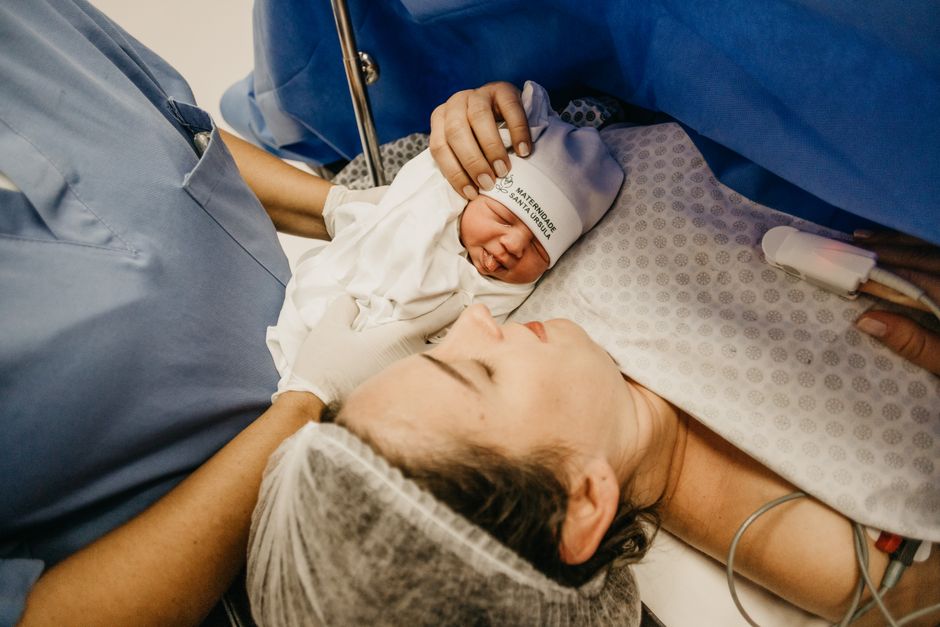
Yes, giving birth is painful for nearly everyone. The intensity varies widely from person to person and birth to birth. But pain does not mean suffering. Understanding what causes the pain and what actually helps is where the real answers are.
Why Is Giving Birth Painful?
The pain of childbirth comes from several physical processes happening at once. The uterus is a large muscle. During labor it contracts to push the baby down. These contractions squeeze blood vessels which reduces oxygen to the muscle. That causes pain similar to how any muscle cramps when it works hard without enough oxygen.
The cervix must stretch from closed to about 10 centimeters wide. That stretching activates pain receptors in a way your body has never experienced before. The baby’s head presses against the pelvic floor, bladder, and rectum. Pressure on these sensitive areas adds another layer of pain.
There is also the emotional side. Fear and anxiety make pain feel worse. The CDC reports that about 1 in 5 women report feeling frightened during labor. Fear releases stress hormones that can make contractions feel more intense. This is not weakness. It is biology.
What Does the Pain of Childbirth Actually Feel Like?
People describe it differently. Some say it feels like intense menstrual cramps that get stronger and stronger. Others describe a deep pressure like the baby is pushing through a very tight space. Many compare the peak of a contraction to a wave that builds, peaks, and then fades.
Early labor pain is usually in the lower back and lower belly. As labor progresses the pain moves lower and becomes more intense. Transition — the final stage before pushing — is often described as the most intense part. Contractions come every 2 to 3 minutes and last 60 to 90 seconds. There is little rest between them.
Pushing can feel different. Some women report relief because they finally have something active to do. Others describe a burning or stretching sensation as the baby’s head crowns. Research published in the Journal of Pain found that women rate labor pain between 7 and 9 on a 10-point scale on average. But the same study found that pain ratings vary enormously from woman to woman.
Is Giving Birth Painful for Everyone the Same Way?
No. Pain experience differs based on several factors. First time labors tend to be longer and often more painful. Subsequent labors are frequently shorter and less intense. The position of the baby matters too. Babies facing the mother’s front rather than her back can cause intense back labor that is harder to manage.
Your pain threshold plays a role. Some people naturally tolerate pain better than others. But no one should feel ashamed of needing help with labor pain. The American College of Obstetricians and Gynecologists states that pain management during labor is a standard part of care.
Psychological factors matter more than most people realize. Women who feel supported by their birth team report less pain. Women who feel in control of their choices report less pain. Women who are afraid report more pain. This is not about willpower. It is about how your nervous system processes threat.





What Pain Relief Options Actually Work?
The evidence supports several effective options. Each has different benefits and trade-offs. Here is what research shows works best.
| Method | How It Works | Evidence Level |
|---|---|---|
| Epidural | Numbs from waist down | Strong — most effective for severe pain |
| Nitrous oxide | Inhaled gas that takes edge off | Moderate — reduces but does not eliminate pain |
| Opioid injections | Short-acting pain medication | Moderate — helps but can affect baby’s breathing |
| Water immersion | Warm tub during labor | Moderate — reduces early labor pain |
| TENS unit | Electrical pulses on back | Weak — some women find it helpful |
| Breathing techniques | Focus and relaxation | Weak — helps with coping not pain itself |
Epidurals are the most effective pain relief available. A Cochrane review found that women who received epidurals reported significantly lower pain scores than those who did not. But epidurals can slow labor and increase the chance of needing instruments like forceps. They can also make it harder to feel when to push.
Nitrous oxide does not eliminate pain. It reduces anxiety and takes the sharp edge off contractions. Many women use it to stay in control without being completely numb. Opioid injections like fentanyl can help for 30 to 60 minutes but may make the baby sleepy after birth.
Do Natural Pain Management Methods Work?
Some women manage labor pain without medication. This does not mean the pain is not there. It means they have found ways to cope with it. The evidence for natural methods is mixed but some do help.
- Movement and position changes — Walking, swaying, and squatting can help the baby descend and reduce back pain. Evidence is moderate.
- Warm water — Soaking in a tub during early labor reduces pain for many women. The water supports the body and relaxes muscles.
- Massage and counterpressure — Firm pressure on the lower back during contractions helps some women significantly. A partner or doula can provide this.
- Hypnobirthing and self-hypnosis — Some studies suggest these techniques reduce anxiety and pain perception. The evidence is weak but growing.
- Acupuncture and acupressure — Some women report benefit. Research published in BMJ Open found inconclusive results. It may help some but is not reliably effective.
What matters most is having a plan but staying flexible. Many women who plan unmedicated births end up wanting an epidural. That is not failure. It is responding to what your body needs in the moment.
What Does Research on Is Giving Birth Painful Actually Show?
The question “Is giving birth painful” is not really debated in medical research. The answer is clearly yes. But researchers have looked deeper at what predicts worse pain and what changes the experience.
A large study in Obstetrics & Gynecology followed over 2000 women and found that pain intensity during labor was highest for first-time mothers, women with longer labors, and women who reported high anxiety before labor started. Induced labor was also reported as more painful than spontaneous labor by most women in the study.
Another finding that surprises many people: the pain of childbirth does not predict how satisfied women are with their birth experience. Satisfaction is much more strongly linked to feeling respected, having choices explained, and being treated with kindness by medical staff. You can have a painful birth and still feel good about it afterward if you felt supported.
Some people claim that birth does not have to be painful if you prepare enough. This is not supported by evidence. Preparation helps you cope. It does not remove the physical reality of uterine contractions and cervical stretching. Be skeptical of anyone who promises a pain-free birth through preparation alone.
Common Misconceptions About Labor Pain
Many myths circulate about labor pain. Here are the ones that cause the most confusion.
“If you are in real pain something is wrong.” This is false. Pain is a normal part of labor. It does not automatically mean complications. However sudden severe pain that is different from earlier contractions should be reported to your care team.
“Epidurars are dangerous for the baby.” This is mostly false. Epidurals are very safe for both mother and baby. The medicine stays mostly in the lower body. Very little reaches the baby. The main risk is a temporary drop in the mother’s blood pressure which is monitored and treated immediately.
“You can train yourself to feel no pain.” This is false. No amount of breathing, visualization, or preparation can stop the physical signals your body sends to your brain during labor. You can change how you respond to those signals. You cannot make them disappear.
“C-section is the easy way out.” This is false and unhelpful. Cesarean birth is major abdominal surgery. Recovery takes weeks. The pain after a C-section is different but real. There is no easy way to bring a baby into the world.
Frequently Asked Questions
How long does labor pain last?
Active labor typically lasts 4 to 8 hours for first-time mothers and 3 to 5 hours for subsequent births. Pushing can last from 20 minutes to 3 hours.
Can you sleep through early labor pain?
Some women can rest between early contractions if the pain is mild. Once contractions are regular and strong enough to keep you awake it is time to head to the hospital.
Is back labor more painful than regular labor?
Many women report back labor is more intense and harder to relieve because the baby is pressing against the mother’s spine. It often requires different pain management strategies.
Does giving birth hurt less the second time?
Labor is often shorter the second time which means less cumulative pain. But the intensity of contractions can still be very strong. Every birth is different.
