
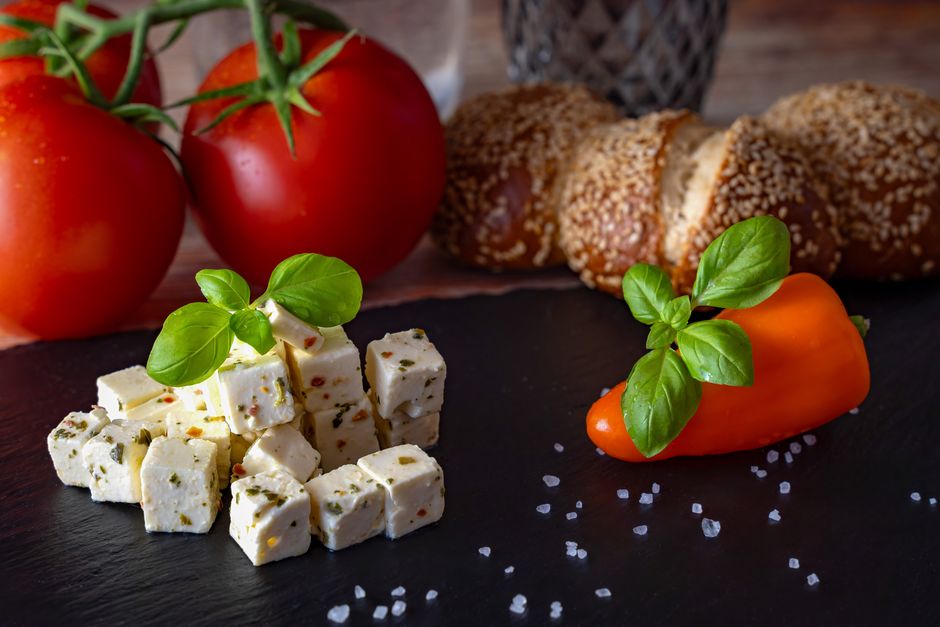
Feta is not goat cheese. Traditional Greek feta is made from sheep’s milk, or a blend of sheep’s and goat’s milk, with sheep’s milk making up the majority. Goat cheese is a broad category that includes many cheeses made entirely or mostly from goat’s milk, and feta is not one of them.
The confusion is understandable. Feta and many fresh goat cheeses share a tangy flavor and a crumbly texture. But they come from different animals, have different nutrition profiles, and carry different legal definitions. Here is what actually separates them.
What Is Feta Cheese Actually Made From?
Feta is a brined white cheese with protected status in the European Union, and that protection specifies the milk source. Under the EU Protected Designation of Origin rules, feta must be made in specific regions of Greece from sheep’s milk or a mixture of sheep’s and goat’s milk, with goat’s milk capped at 30 percent.
In practice, most traditional feta is predominantly or entirely sheep’s milk. The goat’s milk allowance exists because some Greek producers historically kept mixed flocks. It is not a requirement, and plenty of authentic feta contains no goat’s milk at all.
Outside the EU, the rules are looser. In the United States, “feta” is not a protected term. Cheeses sold as feta in US supermarkets may be made from cow’s milk, sheep’s milk, goat’s milk, or blends. Some are brined; some are not. This is a key reason the “is feta goat cheese” question gets murky — the answer depends on which feta you are holding.
If you want to know what is in your feta, read the label. US producers are required to list the milk source. Imported Greek feta will typically state sheep’s milk, goat’s milk, or a blend.
Why Do People Confuse Feta With Goat Cheese?
The confusion comes down to three things: appearance, flavor, and the way both cheeses are marketed.
Feta and fresh goat cheese (often sold as chèvre) are both white, both crumble easily, and both have a tangy, slightly sour taste. That tang in both cases comes largely from the acids produced during fermentation, not from the animal itself.
There is a widespread belief that goat’s milk and sheep’s milk taste “goaty” or “barnyardy” in a way cow’s milk does not. Some of that reputation is real — certain compounds in goat’s milk can produce distinctive flavors — but much of it is cultural expectation. Many people who dislike goat cheese on principle cannot reliably tell it apart from sheep’s milk cheese in a blind taste test.
Marketing adds to the muddle. “Goat cheese” is used as a catch-all label for dozens of unrelated cheeses, from soft fresh chèvre to aged tomme. Feta is a specific style of cheese with its own name, but US labeling does not enforce that distinction, so the two categories overlap on grocery shelves.
What Is the Difference Between Feta and Goat Cheese?
The clearest difference is the milk source, but texture, aging, and how the cheese is stored also set them apart.
Traditional feta is brined — stored in salt water — which gives it a salty, firm, crumbly texture and a longer shelf life than fresh goat cheese. Fresh chèvre is typically unbrined, softer, and more spreadable, with a milder and creamier flavor. Aged goat cheeses are a different story entirely: they can be firm, nutty, and hard, nothing like feta.
Because “goat cheese” describes a milk source rather than a single cheese, comparing it to feta is a bit like comparing “cow’s milk cheese” to cheddar. Feta is one specific cheese. Goat cheese is a whole family.
How Do Feta and Goat Cheese Compare Nutritionally?
Both are cheeses, so both are calorie-dense and high in fat and sodium. The differences are real but modest, and they depend heavily on which specific products you compare.
| Nutrient (per 1 oz / 28 g) | Feta (sheep’s milk, typical) | Fresh goat cheese (chèvre, typical) |
|---|---|---|
| Calories | ~75 | ~75 |
| Protein | ~4 g | ~5 g |
| Fat | ~6 g | ~6 g |
| Sodium | ~320 mg | ~100 mg |
| Calcium | ~140 mg | ~40 mg |
These figures are approximate and drawn from standard USDA nutrient data for typical products. Actual values vary by brand, milk blend, and brine strength.
The biggest practical difference is sodium. Feta is a brined cheese, and brining pulls salt into the cheese. A single ounce can carry a meaningful share of a day’s sodium for people watching their intake. Fresh goat cheese is much lower in sodium. Feta also tends to be higher in calcium, largely because sheep’s milk is richer in calcium than goat’s milk.
Neither cheese is a “health food” in the way marketing sometimes implies. Both fit into a balanced diet in modest portions. If you are managing blood pressure or sodium intake, feta deserves more attention than fresh goat cheese.
Is Feta Cheese Healthy?
Feta is a legitimate source of protein, calcium, and some B vitamins, and it contains conjugated linoleic acid and other fatty acids that have been studied for potential health effects. But it is also high in saturated fat and sodium, and those are not minor considerations.
The evidence on cheese and health is complicated. Some large observational studies have found that moderate cheese consumption is not associated with increased cardiovascular risk, and a few have suggested neutral or slightly favorable associations. That is not the same as cheese being protective, and observational studies cannot prove cause and effect.
The cautious, evidence-based position is this: feta can be part of a healthy eating pattern when used in reasonable amounts, but it is not a food to eat freely if you are watching sodium or saturated fat. The Mediterranean diet, which is among the better-studied dietary patterns, includes cheese in small quantities as a flavoring rather than a main protein source.
One clarification worth making: the idea that sheep’s or goat’s milk cheese is inherently easier to digest than cow’s milk cheese is only partly supported. Some people with cow’s milk protein sensitivity tolerate sheep’s and goat’s milk better because the proteins differ. But goat’s and sheep’s milk still contain lactose and casein, so people with lactose intolerance or a true milk allergy should not assume these cheeses are safe for them.
Can You Substitute Feta for Goat Cheese in Recipes?
Sometimes, but the swap changes the dish. Feta is saltier, firmer, and more crumbly than fresh goat cheese, so it will not melt or spread the same way.
In salads, grain bowls, and on flatbreads, feta and crumbled fresh goat cheese can often stand in for each other, with the understanding that feta will bring more salt. In recipes where goat cheese is meant to be creamy — whipped into a spread, folded into pasta, or used as a base for tarts — feta is a poor substitute because it will not soften the same way.
If you are substituting for dietary reasons, note that the two are not nutritionally equivalent. Swapping fresh goat cheese for feta will raise the sodium and calcium content of the dish, sometimes substantially.
How Should You Store Feta and Goat Cheese?
Feta is best kept in its brine, in a sealed container in the refrigerator, where it will keep for several weeks. If you buy feta packed in brine, keep it submerged; if it dries out, it becomes crumbly and overly salty. Some guidance suggests changing the brine periodically, though many people simply use the cheese within a few weeks.
Fresh goat cheese is more perishable. It should be kept wrapped and refrigerated and used within about a week of opening, depending on the product and its packaging date. Aged goat cheeses keep longer, similar to other hard cheeses.
Neither cheese should be left at room temperature for extended periods. Soft cheeses in particular support bacterial growth when warm, and food safety guidance is consistent on keeping them refrigerated.
Frequently Asked Questions
Is feta cheese goat cheese or sheep cheese?
Traditional Greek feta is made primarily from sheep’s milk, sometimes with up to 30 percent goat’s milk added. In the US, feta can legally be made from cow’s, sheep’s, or goat’s milk, so the label is the only reliable guide.
Is feta cheese dairy-free?
No. Feta is a dairy cheese made from animal milk and contains lactose and milk proteins. People with lactose intolerance or a milk allergy should treat it the same as other cheeses.
Is goat cheese the same as feta?
No. Goat cheese is a broad category of cheeses made from goat’s milk, while feta is a specific brined cheese defined by its production method and, in the EU, its milk source. They differ in texture, salt content, and how they are stored.
Which is healthier, feta or goat cheese?
Neither is clearly healthier overall; both are high in fat and calories. Feta is notably higher in sodium and calcium, while fresh goat cheese is lower in sodium, so the better choice depends on your dietary needs.
