
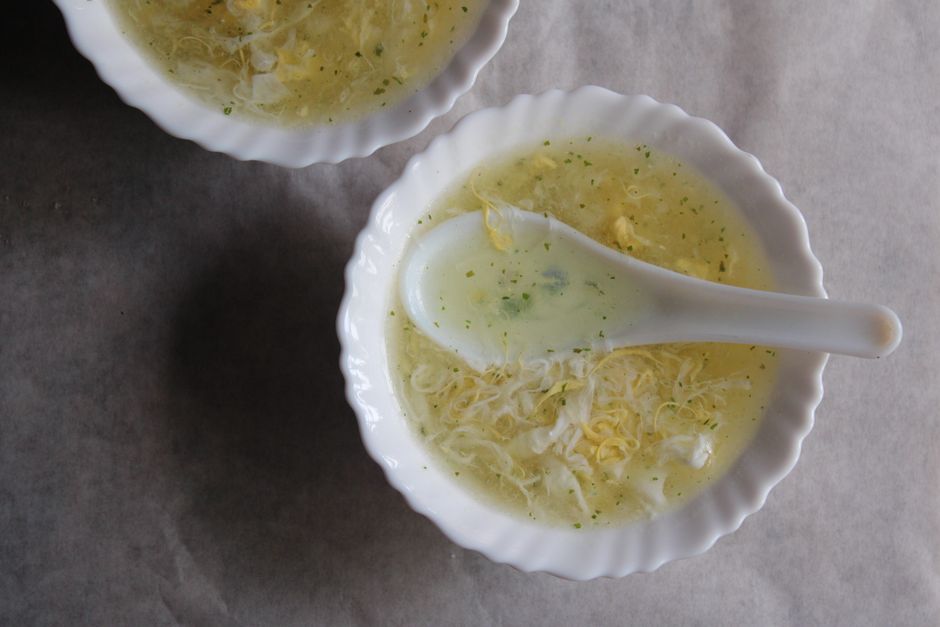
Egg drop soup can be a light, low-calorie choice or a surprisingly salty one, depending on who makes it. A typical one-cup restaurant serving has roughly 60 to 100 calories, but sodium often ranges from about 700 to 1,000 milligrams or more. Homemade versions let you control both.
So the honest answer to whether egg drop soup is healthy is: it depends almost entirely on the broth and how much salt goes into it. The eggs add protein and a little fat. The broth decides whether the bowl helps you or works against you. That is the whole story in one sentence.
How Many Calories Are in Egg Drop Soup?
A cup of egg drop soup is a low-calorie food by almost any standard. Most restaurant versions land between 60 and 100 calories per cup. The range comes from three things: how much egg is used, whether the kitchen adds oil or sesame oil, and whether cornstarch is used to thicken the broth.
Eggs themselves are modest in calories. One large egg has about 72 calories, roughly 6 grams of protein, and about 5 grams of fat, according to USDA data. A pot of soup serving four people might use two or three eggs total, so each bowl gets a fraction of one egg.
The broth is where the rest comes from. Plain chicken or vegetable broth is close to calorie-free. Cornstarch slurry, used to give the soup its silky body, adds carbohydrate and a few calories per serving. A restaurant that finishes the soup with a drizzle of sesame oil adds fat and flavor but not many calories at one cup.
Because the total is low, egg drop soup is not a meal on its own for most adults. It is a starter, a side, or a light snack. Pairing it with a protein and a vegetable makes it part of a balanced meal rather than the whole thing.
Is Egg Drop Soup High in Sodium?
Yes, restaurant egg drop soup is usually high in sodium. This is the single biggest nutritional concern with the dish. A one-cup serving commonly contains 700 to 1,000 milligrams of sodium, and some versions run higher. That is a large share of the daily limit for most adults.
Federal dietary guidelines advise keeping sodium under 2,300 milligrams per day for most adults. One cup of restaurant egg drop soup can supply roughly a third to nearly half of that. Two cups could push you close to the full day’s limit before you eat anything else.
The sodium comes from the broth, not the eggs. Commercial broths, bouillon cubes, and soup bases are heavily salted. Soy sauce, often added at the table, adds more. A single tablespoon of soy sauce carries close to 900 milligrams of sodium on its own.
This matters most for people with high blood pressure, heart failure, or kidney disease, and for anyone whose doctor has told them to watch salt. For those groups, restaurant egg drop soup is not a good everyday choice. For a healthy person with normal blood pressure, an occasional bowl is unlikely to be a problem. The concern is frequency, not a single serving.
What Nutrients Does Egg Drop Soup Actually Provide?
The eggs are the nutritional center of the dish. They supply complete protein, meaning they contain all nine essential amino acids the body cannot make on its own. They also provide vitamin B12, riboflavin, selenium, and choline.
Choline is worth a mention because it is less talked about than other nutrients. It supports cell membranes and nerve signaling, and eggs are one of the better food sources. Many people do not get enough of it from diet alone.
The broth contributes very little nutrition beyond fluid and sodium. If the soup includes vegetables like scallions, spinach, or mushrooms, you pick up small amounts of vitamins and fiber. Those additions are common but not guaranteed. In a plain restaurant version, the vegetable content may be a garnish rather than a real serving.
So the honest nutritional picture is: a little protein, a little fat, some micronutrients from eggs, and almost nothing else of note unless vegetables are added. It is not a nutrient-dense food. It is a light one.





How Does Egg Drop Soup Compare With Other Soups?
| Soup (1 cup) | Calories | Sodium | Protein |
|---|---|---|---|
| Egg drop soup | 60-100 | 700-1,000 mg | 3-6 g |
| Miso soup | 35-85 | 600-900 mg | 3-5 g |
| Chicken noodle soup (canned) | 60-120 | 700-900 mg | 3-7 g |
| Cream of tomato soup (canned) | 90-160 | 450-700 mg | 2-3 g |
These ranges are typical values, not exact figures, because recipes and brands vary widely. The pattern is what matters. Most soups built on commercial broth sit in a similar sodium range. Egg drop soup is not an outlier among restaurant soups. It is average.
Compared with cream-based soups, egg drop soup is lower in calories and fat. Compared with a hearty bean or lentil soup, it is lower in protein and fiber. It sits in the middle of the soup world: light on calories, heavy on salt, modest on everything else.
Can You Make Egg Drop Soup Healthier at Home?
Homemade egg drop soup can be genuinely healthy, and the fix is straightforward. The two levers are the broth and the salt.
- Use low-sodium or unsalted broth instead of regular or bouillon-based broth. This alone can cut sodium substantially.
- Skip or reduce added soy sauce, or use a low-sodium version.
- Add vegetables such as spinach, bok choy, mushrooms, or peas for fiber and micronutrients.
- Use two to three eggs for a pot serving several people to raise the protein a little.
- Go light on cornstarch if you want a thinner, lower-carb soup.
Even with these changes, homemade soup will still contain some sodium, because broth has salt even in reduced versions. The goal is not zero sodium. It is a bowl that fits your day rather than dominating it.
One clarification worth knowing: the classic ribbons in egg drop soup form when beaten egg is streamed slowly into simmering broth while the liquid is stirred gently. The egg sets into thin threads almost instantly. That is a technique detail, not a health one, but it explains why the soup looks the way it does and why the egg stays tender.
Who Should Be Careful With Egg Drop Soup?
Anyone on a sodium-restricted diet should treat restaurant egg drop soup as an occasional food, not a routine one. That includes people with high blood pressure, heart failure, kidney disease, and those who have been told by a clinician to limit salt.
People with egg allergy should avoid it entirely, since egg is the defining ingredient. Egg is one of the more common food allergens, and reactions can range from mild to serious.
For most healthy adults, the soup is not a concern in itself. The realistic risk is the salt load adding up across a day of eating out. A bowl of egg drop soup plus a soy-sauce-heavy entree plus a salty appetizer can push sodium well past the daily guideline without any single item looking extreme.
There is no established clinical guidance suggesting egg drop soup is harmful for the general population. The caution is about sodium and about egg allergy, not about the dish being inherently unhealthy.
Is Egg Drop Soup Healthy Calories Sodium More?
Egg drop soup is low in calories and usually high in sodium. Those two facts sit side by side, and neither cancels the other out. It is light on protein and nutrients unless you add vegetables or extra egg. It is not a superfood, and it is not a villain.
For a healthy person, an occasional bowl fits fine into a normal diet. For someone watching salt, the restaurant version is a poor everyday pick, and the homemade version with low-sodium broth is a much better one. The eggs are the good part. The broth is the part to watch.
Frequently Asked Questions
Is egg drop soup healthy?
It can be, especially homemade with low-sodium broth and added vegetables. Restaurant versions are low in calories but often high in sodium, so they are better as an occasional choice than a daily one.
How many calories are in a cup of egg drop soup?
A typical one-cup serving has roughly 60 to 100 calories. The exact number depends on how much egg, oil, and cornstarch the recipe uses.
Is egg drop soup high in sodium?
Restaurant egg drop soup commonly has 700 to 1,000 milligrams of sodium per cup. That is a large share of the 2,300-milligram daily limit advised for most adults.
Is egg drop soup good for you if you have high blood pressure?
Restaurant versions are usually too high in sodium to eat often if you have high blood pressure. A homemade version with unsalted or low-sodium broth is a better fit.
