
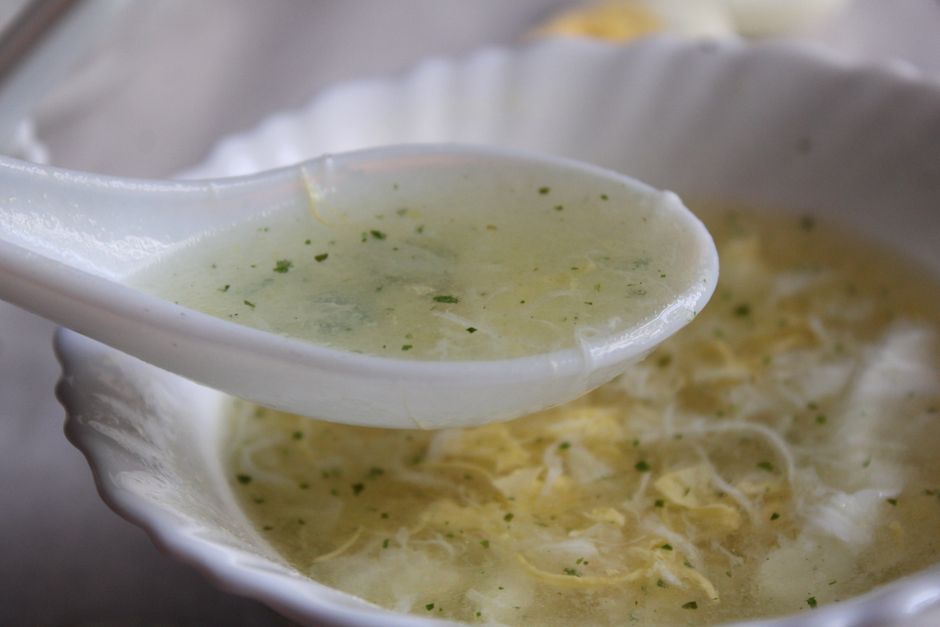
Egg drop soup is not fattening on its own. A typical cup made with broth, egg, and a little cornstarch has roughly 60 to 90 calories, and most of those calories come from the egg’s protein. Whether it helps or hinders weight loss depends almost entirely on how it’s made and what you eat with it.
The soup earns its reputation as a lighter choice for good reason. It is mostly water and broth, which means it fills you up with very little energy. The egg adds protein, and protein tends to keep hunger down longer than an equal number of calories from fat or carbohydrate. That combination is why a small bowl before a meal can take the edge off your appetite.
The trouble starts with restaurant versions. Some are thickened with extra starch, loaded with sodium, or served alongside fried food that does the real calorie damage. Read on for what actually changes the numbers.
How Many Calories Are in Egg Drop Soup?
A homemade cup of egg drop soup usually lands between 60 and 90 calories. That estimate assumes a light hand with the cornstarch and no added oil. The egg itself is the main source of calories, and a single egg contributes about 70 calories on its own, though one cup of soup uses only part of an egg.
Restaurant portions vary widely, so treat any single number with caution. A bowl served at a Chinese restaurant may be larger than a cup and thicker than what you’d make at home. Some versions add oil, extra starch, or richer broth, which pushes the count higher. The exact figure depends on the recipe.
Here is a rough breakdown of what a basic homemade cup contains:
- Calories: roughly 60 to 90
- Protein: about 4 to 6 grams, mostly from egg
- Carbohydrate: about 4 to 8 grams, mostly from cornstarch
- Fat: about 2 to 4 grams, mostly from egg yolk
- Sodium: varies a lot, often 500 to 900 milligrams depending on the broth
Those numbers are estimates, not a label. Sodium in particular swings widely because it comes almost entirely from the broth and any soy sauce or seasoning added.
Why Egg Drop Soup Can Support Weight Loss
Soup is one of the more reliable tools for managing hunger. Research on what researchers call “preloads” — a course of soup or a watery food eaten before a meal — has generally found that people eat fewer total calories at that meal. The water and volume fill the stomach without adding many calories. This is a well-documented effect, and it is the strongest argument for egg drop soup as a weight-loss food.
The egg matters too. Protein is the most satiating of the three macronutrients, meaning it does the most to blunt hunger per calorie. A soup built on broth and egg gives you a warm, savory, protein-containing starter for very little energy cost.
There is also a practical, behavioral side. A hot, savory soup feels like a real course of a meal rather than a deprivation food. People tend to stick with eating patterns that feel satisfying. A light soup that tastes good is easier to keep in rotation than a bland salad you dread.
What Makes Egg Drop Soup Fattening?
Egg drop soup becomes fattening when the recipe or the setting adds calories that the basic ingredients don’t have. The soup itself is rarely the problem. The additions are.
The biggest variable is cornstarch. Traditional egg drop soup uses a cornstarch slurry to give the broth its silky body and to help the egg form ribbons. A little is fine. A lot turns a light broth into a starchy one, and starch is carbohydrate. Some restaurant versions use more than home cooks would.
Oil is the second variable. A drizzle of sesame oil for flavor adds fat and calories. That’s not necessarily bad, but it counts. Some recipes also finish the soup with more oil than a home cook might expect.
Sodium deserves a separate mention. It doesn’t add calories, so it doesn’t make soup fattening. But restaurant egg drop soup can be quite salty, and a high-sodium diet is linked to elevated blood pressure in people who are salt-sensitive. If you watch your sodium, the broth is where to look.
Finally, consider the meal around the soup. Egg drop soup served as a starter before a plate of fried rice, sweet-and-sour pork, and egg rolls is part of a very high-calorie meal. The soup is not the culprit. The context is.
Is Egg Drop Soup Good for Weight Loss?
Yes, with conditions. As a low-calorie, high-volume, protein-containing starter, egg drop soup fits well into a weight-loss eating pattern. It is not a magic food, and no single soup causes weight loss on its own. Weight loss comes from eating fewer calories than you burn over time, and the soup helps by making that easier.
The conditions matter. A homemade version with modest cornstarch and a low-sodium broth is a genuinely light food. A restaurant version thick with starch and salt, eaten as a prelude to fried food, is a different story. The soup is only as good for weight loss as the way it’s made and the meal it belongs to.
One clarification worth making: “good for weight loss” does not mean “eat it constantly.” Any food eaten in large enough portions can contribute to weight gain. Egg drop soup is low in calories per cup, but several cups a day still add up, and it is not a complete meal on its own. It lacks the fiber and range of nutrients a balanced meal provides.
How to Make Egg Drop Soup Lighter
You can keep the soup light with a few simple adjustments. None of them require special ingredients, and the soup still tastes like egg drop soup.
- Use a low-sodium broth or dilute regular broth with water to cut salt.
- Reduce the cornstarch to just enough to give the broth a little body, or skip it entirely for a thinner soup.
- Use mostly egg whites or a mix of whole egg and whites to keep protein high and fat modest.
- Add vegetables like spinach, scallions, or mushrooms for volume, fiber, and nutrients with few calories.
- Go easy on sesame oil and soy sauce, which add calories and sodium respectively.
Adding vegetables is the most impactful change. Fiber from vegetables adds bulk and slows digestion, which supports fullness. It also turns a thin starter into something closer to a light meal.
Egg Drop Soup vs. Other Soups
Egg drop soup compares favorably to many soups on calories, but not all. Cream-based soups carry far more fat and calories per cup. Broth-based vegetable soups are similarly light. The table below shows the general pattern, using approximate ranges rather than exact figures.
| Soup type (1 cup) | Approximate calories | Notes |
|---|---|---|
| Egg drop soup (homemade) | 60–90 | Protein from egg; sodium varies |
| Cream of mushroom or tomato | Higher, often 100–200+ | Cream adds fat and calories |
| Broth-based vegetable | Low, often under 100 | Fiber from vegetables; little protein |
| Chicken noodle | Moderate, often 100–150 | Protein and starch from noodles |
| Restaurant egg drop (thick) | Varies; can be higher | Extra starch, oil, and sodium |
These are general ranges, not precise values. Recipes differ enough that a single number would be misleading. The pattern is what matters: clear, broth-based soups are lighter than cream-based ones, and egg drop sits among the lighter options when made simply.
The Bottom Line on Egg Drop Soup and Weight
Egg drop soup is a light food that fits comfortably into a weight-loss plan. Its main strengths are low calories per cup, high water content, and a modest amount of satisfying protein from egg. Its main risks are added starch, oil, and sodium, plus the high-calorie meal it often accompanies at restaurants.
No soup causes weight loss by itself. What matters is the overall pattern of what you eat and how much. Egg drop soup is a reasonable, filling, low-calorie choice within that pattern — especially when you make it at home and keep the recipe simple.
Frequently Asked Questions
Is egg drop soup fattening?
No, a basic cup is low in calories, roughly 60 to 90, and is not fattening on its own. Restaurant versions with extra starch and oil, or a meal built around fried food, are where the calories add up.
Can I eat egg drop soup while trying to lose weight?
Yes, it fits well into a weight-loss eating pattern as a low-calorie, filling starter. It is not a complete meal, so pair it with vegetables and a protein source for balance.
How many calories are in a bowl of restaurant egg drop soup?
It varies too much to give one reliable number, since portion size, starch, and oil differ by kitchen. Treat any single figure with caution and assume it is higher than a simple homemade cup.
Is egg drop soup high in sodium?
Often yes, because most sodium comes from the broth and any soy sauce added. Choosing low-sodium broth and going easy on soy sauce lowers it substantially.
