
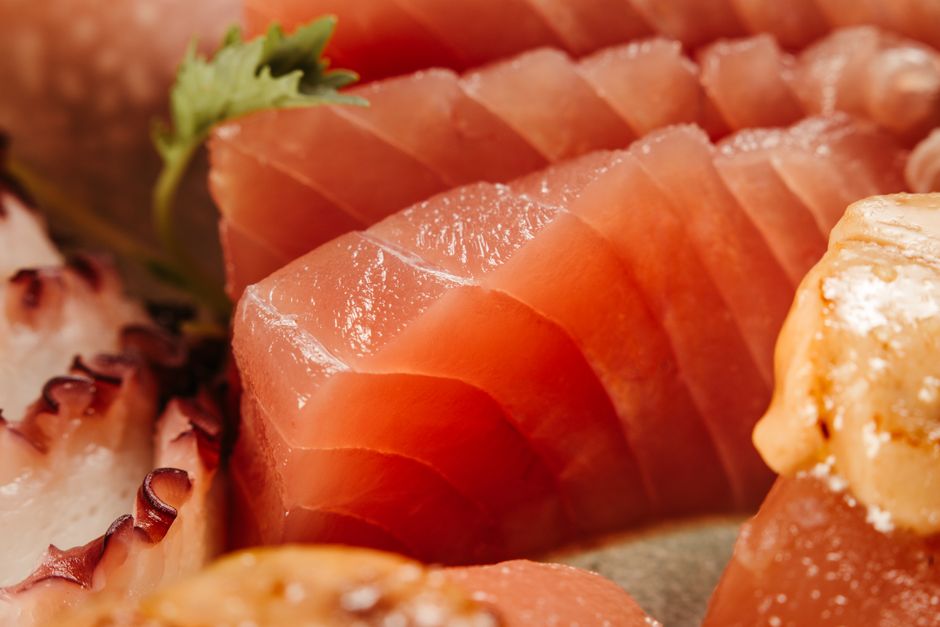
Eating tuna every day is not automatically bad, but for most adults it is not a good idea either. The reason is mercury, a metal that builds up in tuna flesh and can accumulate in your body over time. Whether daily tuna is risky depends on which type you eat, how much, and who you are. Canned light tuna is far lower in mercury than albacore or bluefin, and small portions of the low-mercury types are unlikely to cause harm for most healthy adults.
Is Eating Tuna Daily Bad for Most Adults?
For most healthy adults, eating a small serving of low-mercury tuna every day is unlikely to cause mercury-related harm. The problem is that “tuna” covers very different fish with very different mercury levels, and portion size matters as much as frequency.
Mercury in fish comes mostly as methylmercury, an organic form that the human gut absorbs efficiently. Once absorbed, it binds to proteins and is distributed through the bloodstream. The body clears methylmercury slowly, mainly through bile and feces, with a biological half-life measured in weeks to a few months. That long clearance time is why regular daily intake matters more than a single large meal.
The nervous system is the main target of methylmercury toxicity in adults. Early effects can include numbness or tingling in the hands and feet, trouble with coordination, and subtle changes in memory or concentration. These effects generally appear with sustained higher exposure, not from occasional tuna meals.
Government agencies set reference levels for how much methylmercury a person can take in per unit of body weight per day without expected harm. Those levels include a safety margin. Different agencies have set slightly different numbers, and they are updated periodically, so the exact figure is best checked against current guidance rather than memorized.
Which Types of Tuna Have the Most Mercury?
Mercury content varies enormously across tuna species, and this is the single most useful fact for anyone eating tuna often. Larger, longer-lived predatory fish accumulate more mercury because they eat smaller fish that already contain mercury, and they live long enough for it to build up.
Bluefin tuna sits at the top of the mercury scale among commonly eaten tuna. It is a large, long-lived, apex predator and tends to carry the highest concentrations.
Albacore, often sold as “white tuna” in cans, is generally higher in mercury than skipjack. Skipjack is the species most often used in “light” canned tuna, and it is smaller and shorter-lived, so it accumulates less.
Yellowfin falls somewhere in between and varies by size and catch location. Bigeye tuna tends to be higher, closer to bluefin.
A common point of confusion: “white tuna” on a sushi menu is usually not tuna at all. It is frequently escolar, a different fish entirely, and it is known for causing digestive upset in some people rather than mercury problems. This is a labeling issue, not a mercury one, but it is worth knowing.
Because mercury levels depend on species, size, and where the fish was caught, no single number applies to all tuna. Canned light tuna is consistently among the lower-mercury options, while fresh bluefin steaks are among the highest.
How Much Tuna Is Considered Safe?
There is no single universal “safe” number of tuna meals per week, because the answer depends on the type of tuna, the portion size, your body weight, and whether you are pregnant or planning to become pregnant. What exists instead are advisory limits from public health agencies.
These advisories typically distinguish between “best choices,” “good choices,” and fish to avoid, based on mercury content and how often they can be eaten. Canned light tuna generally falls into a lower-mercury category, while albacore and fresh bluefin fall higher, with more restrictive advice.
For adults who are not pregnant, the general principle is that variety and moderation reduce risk. Eating tuna a few times a week and rotating in other low-mercury fish and seafood is the pattern most advisories encourage. Daily tuna is not forbidden, but it leaves less room for error and offers no nutritional advantage over eating tuna several times a week.
The nutrition in tuna is real. It is a strong source of protein, and it provides omega-3 fatty acids, vitamin D, selenium, and B vitamins. Selenium is worth noting because it can bind to mercury and may modify its toxicity, though the extent of that protective effect in humans is not fully settled. That is a genuine area of ongoing research, not a settled fact.





Who Should Be Most Careful About Tuna?
Pregnant and breastfeeding women, women who may become pregnant, and young children face the greatest concern from mercury in fish. This is because methylmercury crosses the placenta and reaches the developing fetal brain, and because the developing nervous system is more vulnerable to its effects than the adult brain.
For these groups, public health agencies issue specific guidance that is more restrictive than advice for the general adult population. The general direction of that guidance is to choose low-mercury fish, limit or avoid higher-mercury types such as albacore and bluefin, and follow the specific limits set for pregnancy and childhood. Because these recommendations are updated periodically, the current version from a national health agency or your clinician is the one to follow.
No clinical guidelines currently exist that set a single universal daily tuna limit for every person. The advice is individualized by group, and pregnancy and childhood are the groups where the limits are tightest.
People with pre-existing neurological conditions, or those who eat large amounts of fish from locally contaminated waters, may also want to discuss intake with a clinician. That is a judgment call, not a fixed rule.
Does Canned Tuna Carry the Same Risk as Fresh Tuna?
Canned light tuna generally carries less mercury risk than fresh or canned albacore and fresh bluefin. The difference comes down to species, not the canning process itself.
Canning does not remove or add mercury. What matters is which fish went into the can. Light canned tuna is mostly skipjack, a smaller species. White canned tuna is albacore, a larger species with higher mercury levels. So the choice between “light” and “white” on the label is more meaningful than the choice between canned and fresh.
One practical wrinkle: canned tuna is often eaten in larger portions than a fresh tuna steak would be, and it is easy to eat several cans a week without thinking about it. Portion awareness matters here. A can of tuna is a substantial serving of fish, and eating it daily adds up.
Draining the liquid from the can does not meaningfully reduce mercury, because methylmercury is bound to the muscle tissue itself, not floating in the water or oil.
What Are the Benefits of Eating Tuna?
Tuna is a nutrient-dense food, and the benefits of eating fish are well established. Seafood is a major dietary source of long-chain omega-3 fatty acids, which are linked to cardiovascular health. Tuna also provides high-quality protein, vitamin D, selenium, and several B vitamins.
For many people, the health concern is not eating too much tuna but eating too little fish overall. Dietary guidelines in the United States encourage eating seafood as part of a healthy eating pattern, with the specific caveat to choose varieties lower in mercury.
So the question is not really tuna versus no tuna. It is how to get the nutritional benefits of fish while keeping mercury intake low. That means favoring lower-mercury species, varying your choices, and watching portion sizes if you eat tuna often.
There is no evidence that eating tuna daily provides benefits beyond eating it a few times a week. The nutritional upside plateaus, while mercury exposure keeps accumulating. That asymmetry is the core reason daily tuna is not the best pattern for most adults.
Is Eating Tuna Daily Bad — The Bottom Line
Daily tuna is a risk-management question, not a yes-or-no one. For a healthy adult eating small portions of canned light tuna, the mercury exposure is likely low enough that harm is unlikely. For someone eating fresh bluefin or large amounts of albacore every day, the exposure is meaningfully higher.
The groups who need the most caution are pregnant and breastfeeding women, women who may become pregnant, and young children. For everyone else, the sensible approach is variety, lower-mercury choices, and attention to how much and how often.
If you eat tuna often, the most useful change is to rotate in other low-mercury seafood and to know which tuna species you are actually eating. If you have specific health concerns or are pregnant, follow current guidance from a national health agency or your clinician rather than a general rule.
Frequently Asked Questions
Is it safe to eat tuna every day?
For most healthy adults, small daily portions of low-mercury canned light tuna are unlikely to cause harm, but it is not the recommended pattern. Higher-mercury types like albacore or bluefin eaten daily can push mercury intake too high over time.
Which tuna has the least mercury?
Canned light tuna, usually made from skipjack, generally has the lowest mercury among common tuna types. Albacore and bluefin tend to be higher because they are larger, longer-lived fish.
Can pregnant women eat tuna?
Pregnant women are advised to choose low-mercury fish and to limit or avoid higher-mercury types like albacore and bluefin. Because the specific limits are updated periodically, follow current guidance from a national health agency or your clinician.
Does draining canned tuna reduce mercury?
No. Methylmercury is bound to the fish muscle tissue itself, so draining the liquid does not meaningfully lower the mercury content of the tuna you eat.
