
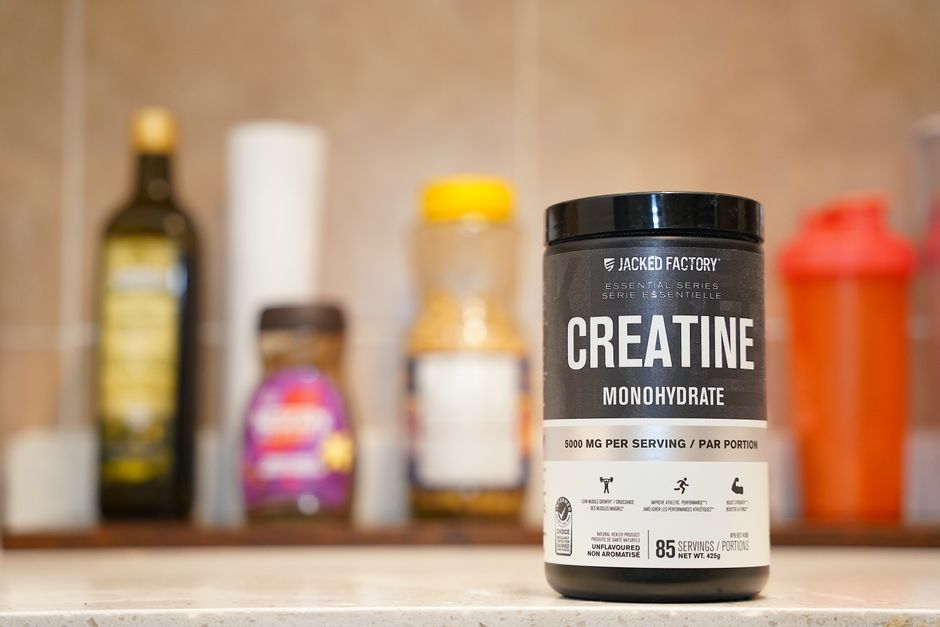
No, creatine is not a peptide. It is a small nitrogen-containing compound that your body makes and stores mostly in muscle. Its full chemical name is methylguanidinoacetic acid, and it belongs to a class of molecules called guanidino compounds, not peptides.
Peptides are short chains of amino acids linked together. Creatine is built from three amino acids, but once assembled it is no longer a chain. It is a single finished molecule. That distinction matters because it explains how creatine works, how it is absorbed, and why it is sold as a free compound rather than a protein fragment.
What Is Creatine, Exactly?
Creatine is a naturally occurring compound found mainly in muscle tissue. Your body produces it, and you also get it from food, mostly meat and fish.
The average adult stores roughly 120 to 140 grams of creatine in the body, with the vast majority held in skeletal muscle. About 95 percent of the body’s creatine sits in muscle, where it plays a direct role in energy production during short bursts of intense activity. The remaining small amount is found in the brain, heart, and other tissues.
Your body makes about 1 to 2 grams of creatine per day. A typical omnivorous diet adds another 1 to 2 grams. That balance keeps muscle stores topped up within a normal range. Vegetarians and vegans tend to have lower baseline muscle creatine because they get little from food.
Creatine is one of the most studied sports nutrition compounds in existence. That is worth stating plainly because it separates it from the many supplements with thin or absent evidence. The research base here is large, though that does not make every marketing claim attached to it true.
What Makes a Molecule a Peptide?
A peptide is a chain of amino acids joined by chemical bonds called peptide bonds. Two amino acids linked together form a dipeptide. A handful form an oligopeptide. A long chain, generally more than about 50 amino acids, is called a protein.
The defining feature of a peptide is the chain itself. Amino acids are strung together end to end. The chain length determines the category, but the linked structure is what makes something a peptide in the first place.
Here is where the confusion often starts. Creatine is made from three amino acids: glycine, arginine, and methionine. Because amino acids are involved, some people assume the end product is a peptide. That reasoning does not hold.
The three amino acids are used as raw building blocks, then chemically transformed into a new single molecule. The peptide bonds are not retained. The finished creatine is not a chain of anything. It is one small molecule, and it behaves very differently from a peptide in the body.
This is the same logic that applies to many compounds. A car is built from steel, rubber, and glass, but the finished car is not steel. The starting materials get restructured into something with new properties.
How Is Creatine Made in the Body?
Creatine synthesis happens in two main steps, split between the kidneys and the liver.
First, the kidneys combine two amino acids, glycine and arginine, to form a compound called guanidinoacetate. This reaction uses an enzyme called glycine amidinotransferase. The arginine is converted in the process, and a molecule called ornithine is released.
Second, the guanidinoacetate travels to the liver. There, a methyl group is added to it using the amino acid methionine. This step uses an enzyme called guanidinoacetate methyltransferase. The result is creatine.
From there, creatine enters the bloodstream and is taken up by tissues, especially muscle. Muscle cells pull it in through a specific transporter protein. Once inside, most of it is converted into a storage form called phosphocreatine.
This whole pathway is well established in human physiology. It is not a theory or a marketing angle. It is basic biochemistry taught in medical and nutrition courses.
Why Does the Peptide Confusion Happen?
Several overlapping ideas probably feed the mix-up.
Creatine is sometimes grouped loosely with amino acid products on supplement shelves. It is also often discussed alongside protein and amino acid supplements, which are genuinely peptide or protein based. That proximity creates a false association.
Another source is the word “peptide” itself. It sounds technical and gets attached to many products. Collagen peptides, for instance, really are peptides. They are short chains of amino acids. Creatine is not, but the shared vocabulary can blur the line for a casual reader.
There is also a naming issue. Some creatine forms are sold with names that sound like peptides or are blended with peptide ingredients. A product containing creatine and collagen peptides is not the same as creatine being a peptide. The label describes a mixture, not the nature of creatine.
None of this changes what creatine is at the molecular level. It remains a single guanidino compound, regardless of how it is packaged or marketed.
Is Creatine a Protein or an Amino Acid?
Creatine is neither a protein nor an amino acid. It is its own category of molecule.
It is often called a “non-protein amino acid” in older or looser writing, but that label is misleading. A true amino acid has a specific chemical structure, with an amino group and a carboxyl group attached to the same carbon. Creatine does not fit that structure.
It is also not a protein. Proteins are long chains of amino acids, usually hundreds of units long. Creatine is a single small molecule. Calling it a protein is simply incorrect.
The clearest way to describe it is this: creatine is a nitrogen-containing organic acid that the body synthesizes and uses for energy storage in muscle. That description is accurate and avoids the common traps.
Is Creatine a Peptide? The Direct Answer
No. Creatine is not a peptide, not a protein, and not an amino acid. It is a distinct small molecule made from amino acids but structurally unrelated to peptides.
This matters for a few practical reasons.
- Peptides are typically broken down by digestive enzymes called peptidases. Creatine is not, because there is no peptide chain to break.
- Peptides are often poorly absorbed intact and may need special delivery formats. Creatine is absorbed efficiently as a free molecule.
- The function is different. Peptides serve signaling, structural, or enzymatic roles. Creatine’s main job is to help regenerate energy during short, intense muscle activity.
Understanding the category also helps you read labels. If a product claims to be a “creatine peptide,” that phrasing is not describing real chemistry. It is a marketing construction. No such molecule exists in the way the phrase implies.
Does the Difference Matter for How Creatine Works?
Yes, and this is where the science gets interesting.
Creatine works through the phosphocreatine system. When your muscles need quick energy, they break down a molecule called ATP. That breakdown releases energy but also leaves behind ADP, a depleted form.
Phosphocreatine donates a phosphate group back to ADP, rebuilding it into ATP. This lets muscle keep producing energy during the first several seconds of intense effort, like a sprint or a heavy lift.
Because creatine is a small, stable molecule, it can be stored in muscle in large amounts as phosphocreatine. A peptide could not serve this role the same way. Peptides are built for different jobs and are handled differently by the body.
This is also why creatine supplementation can raise muscle phosphocreatine stores. When you take in more creatine, muscle can hold more of it, within a limit. Once stores are saturated, extra creatine is generally excreted. This saturation concept is well documented and is why some people respond more than others.
People with lower starting levels, such as vegetarians, often see a larger rise in muscle creatine from supplementation. Those who already eat a lot of meat may see less change.
Common Myths About Creatine and Peptides
Several persistent claims deserve a clear response.
Myth: Creatine is a peptide because it is made from amino acids. Being made from amino acids does not make the end product a peptide. The structure is what counts, and creatine has no peptide bonds.
Myth: Creatine peptides are a superior form. There is no established molecule called a creatine peptide. Products using this language are not describing a recognized compound. No clinical evidence confirms that such a form offers any advantage.
Myth: Because it is not a peptide, creatine must be a steroid. This is false and worth correcting directly. Creatine is not a steroid, not a hormone, and not related to anabolic steroids in structure or mechanism. It is a naturally occurring compound found in food.
Myth: Peptide forms absorb better. Creatine is already well absorbed as a free molecule. There is no reliable evidence that a peptide version would improve absorption, because that version does not exist as a defined substance.
How Does This Affect What You Buy?
Knowing that creatine is not a peptide can help you avoid overpriced or misleading products.
The most studied form is creatine monohydrate. The bulk of the research on safety and effects uses this form. Other forms, including creatine hydrochloride, creatine ethyl ester, and buffered versions, have far less supporting evidence. Some are marketed with claims that are not backed by large human trials.
When a label leans on the word “peptide” to suggest a premium product, treat that as a signal to look closer. The claim is not grounded in how creatine is actually structured. It is a naming tactic.
None of this is a recommendation about whether to use creatine. That is a decision for you and, where relevant, your clinician. The point here is narrower: understand what the molecule is, so marketing language does not mislead you about the science.
Is Creatine Safe? What the Evidence Shows
Creatine monohydrate has been studied more than most supplements, and the evidence on short-term use in healthy adults is generally reassuring. Longer-term data exist but are more limited, and the picture is less complete for some groups.
People with kidney disease, liver disease, or other chronic conditions should talk to a clinician before using creatine. The same applies to pregnant or breastfeeding women, and to children. No clinical guidelines currently establish safe dosing for these populations, so the honest position is that the evidence is limited.
This article is informational and is not medical advice. If you take medications or manage a health condition, a clinician who knows your situation is the right source for guidance.
Frequently Asked Questions
Is creatine a peptide?
No, creatine is not a peptide. It is a single small molecule made from amino acids but without any peptide bonds.
Is creatine a protein or an amino acid?
It is neither. Creatine is a distinct nitrogen-containing compound that the body makes and stores mainly in muscle.
Why do some people think creatine is a peptide?
Because creatine is built from three amino acids, people sometimes assume the end product is a peptide. The amino acids are restructured into a new molecule, so the peptide structure is not retained.
Are there creatine peptides sold as supplements?
No recognized molecule called a creatine peptide exists. Products using that phrase are describing a marketing term, not a defined compound with supporting clinical evidence.
