
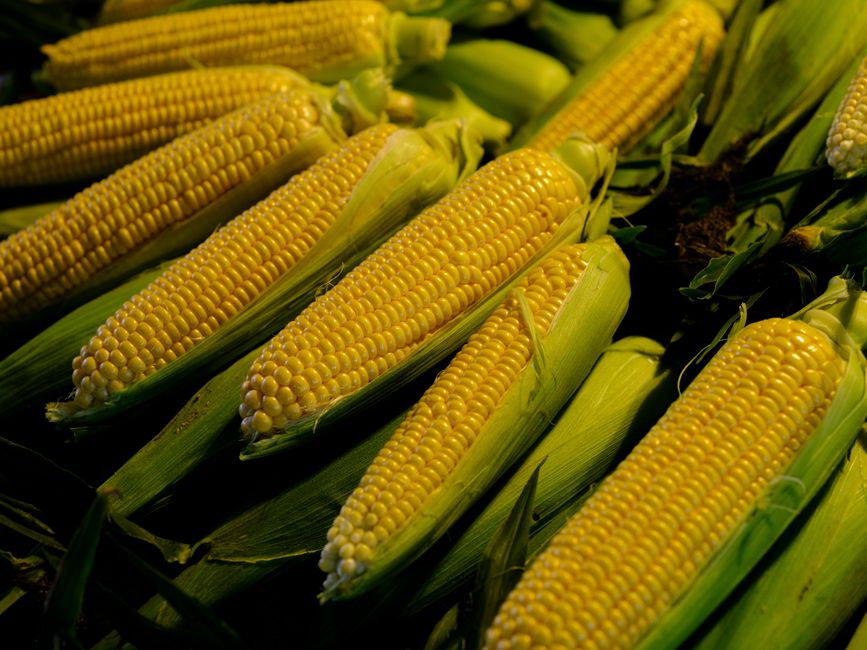
Is corn a vegetable? Botanically, no. Corn is a grain — a caryopsis, or dry fruit — and it belongs to the grass family. In the kitchen and on nutrition labels, though, it usually gets treated as a vegetable. Both answers are correct depending on who is asking and why.
That split isn’t a loophole or a technicality. It reflects two different systems that classify food for two different purposes. Botanists group plants by how they reproduce and how their seeds develop. Nutritionists and cooks group food by how it’s eaten and what nutrients it delivers. Corn lands in a different bucket in each system.
Why Is Corn Botanically A Grain?
Corn is the seed of a grass, and that single fact settles its botanical identity. The plant is Zea mays, a member of the grass family Poaceae — the same family as wheat, rice, oats, and barley. Every one of those plants produces a dry, one-seeded fruit that doesn’t split open at maturity. Botanists call that fruit type a caryopsis. In everyday language, we call it a grain.
Each kernel you eat is a complete fruit with a seed fused to its outer wall. The little strands at the top of an ear — the silk — are the female flower’s stigmas, one per kernel. Each silk strand catches pollen and grows a tube down to fertilize a single kernel. That’s why an ear with missing kernels had poor pollination, not poor soil.
The botanical definition of a vegetable doesn’t really exist in the strict sense. Botanists don’t classify things as vegetables at all. They classify by plant part: root, stem, leaf, flower, fruit, seed. Corn is a seed. A tomato is a fruit. A carrot is a root. “Vegetable” is a culinary and nutritional category, not a botanical one.
This is the same reason a tomato is legally a vegetable in the United States. In 1893, the Supreme Court ruled in Nix v. Hedden that tomatoes were vegetables for tariff purposes because people cook and eat them like vegetables, even though botanically they are fruit. Corn sits in a similar gray zone.
Is Corn A Vegetable Or A Grain In Nutrition?
In nutrition and on food labels, corn is usually counted as a vegetable — but sweet corn and field corn behave very differently. This is where most of the confusion lives.
Sweet corn is harvested while the kernels are still immature and full of sugar. It’s eaten fresh, frozen, or canned. Field corn (also called dent corn) is left to mature and dry, then processed into cornmeal, tortillas, corn syrup, ethanol, and animal feed. Over 99% of the corn grown in the US is field corn, not the sweet corn you buy at the store.
The USDA’s dietary guidance has historically counted sweet corn as a starchy vegetable, alongside potatoes, peas, and winter squash. That classification matters because starchy vegetables are grouped separately from non-starchy vegetables like broccoli, spinach, and peppers. They contain more carbohydrate per serving.
Here’s the non-obvious part: the same plant can be a grain or a vegetable depending on when it’s picked. Sweet corn is a young grain eaten fresh. Field corn is the mature grain. The botanical identity doesn’t change — only the harvest stage does.
How Corn Compares Nutritionally
One cup of cooked sweet corn (about 164 grams) contains roughly:
- Calories: about 143
- Carbohydrate: about 31 grams
- Fiber: about 3.6 grams
- Protein: about 5 grams
- Sugar: about 6 grams
Those figures come from USDA nutritional data. Sweet corn delivers vitamin C, some B vitamins, magnesium, and potassium. It also contains lutein and zeaxanthin, two carotenoids that concentrate in the retina. Research has linked higher intake of these carotenoids to lower risk of age-related macular degeneration, though the evidence base is stronger for supplements than for corn specifically.
Corn is not a low-carbohydrate food. A cup has about as much carbohydrate as a slice of bread. That matters for people managing blood sugar or following a low-carb diet.
Why Do People Disagree About Whether Corn Is A Vegetable?
The disagreement comes from three overlapping systems that each answer a different question.
Botany asks what the plant part is. Corn is a seed from a grass, so it’s a grain.
Culinary tradition asks how it’s used. Corn is served as a side dish, mixed into salads, and eaten off the cob. That’s vegetable behavior.
Nutrition policy asks where it fits in dietary patterns. Sweet corn is grouped with starchy vegetables because of its carbohydrate content and how it’s typically eaten.
None of these systems is wrong. They are answering different questions. When someone insists corn is a grain, they’re usually speaking botanically. When someone calls it a vegetable, they’re usually speaking nutritionally or culinarily.





Is Corn A Vegetable On The Food Pyramid?
Corn has appeared in the vegetable group in US dietary guidance for decades, including the older Food Guide Pyramid and the MyPlate framework that replaced it. Sweet corn and starchy vegetables like potatoes, peas, and lima beans sit in the vegetable group but are counted separately from non-starchy vegetables.
The reason for the split is carbohydrate density. Dietary guidelines generally encourage eating more non-starchy vegetables because they deliver fiber, vitamins, and minerals with fewer calories and less carbohydrate. Starchy vegetables still count, but they occupy a different nutritional role — closer to a grain or starch on the plate than to a leafy green.
This is why some dietitians suggest thinking of corn and potatoes as starch servings rather than vegetable servings when building a balanced meal. That’s a practical guideline, not a botanical statement. It’s also not a universal recommendation — different clinical contexts call for different approaches, and no single rule fits everyone.
Does It Matter What You Call Corn?
For most people, the label changes nothing about how they eat it. Corn is corn. The classification only matters in specific situations.
It matters if you’re counting carbohydrates for diabetes management. Corn’s carbohydrate content is closer to a grain than to a non-starchy vegetable, so treating it as a free vegetable can throw off blood sugar planning.
It matters if you’re following a grain-free or paleo-style diet. Those diets exclude grains, and whether corn is allowed depends on whether you classify it botanically or culinarily. Most grain-free frameworks exclude it.
It matters if you’re reading food labels or dietary guidelines and trying to hit a target number of vegetable servings. Whether corn counts toward that target depends on which guidance you’re following.
It doesn’t matter much if you’re just deciding whether to put corn in a salad. That’s a taste question, and both answers work.
Is Corn A Vegetable, A Fruit, Or A Grain?
All three labels get used, but only one is botanically precise. Corn is a grain. The kernel is a dry fruit containing a seed — the definition of a caryopsis. Botanically, it’s also technically a fruit, because a grain is a type of fruit. It is never a vegetable in the botanical sense, because botanists don’t use that category.
In everyday language, corn is a vegetable when it’s sweet corn eaten as a side dish, and a grain when it’s dried and ground into flour or processed into corn syrup. The word “vegetable” describes a use, not a biological fact.
So the honest answer is layered. Botanically, corn is a grain. Nutritionally, sweet corn is often counted as a starchy vegetable. Culinarily, it depends on the dish. Anyone who tells you it’s only one of those things is leaving out the part that makes the question interesting.
Frequently Asked Questions
Is corn a vegetable or a grain?
Botanically, corn is a grain — the seed of a grass plant. Nutritionally and culinarily, sweet corn is usually grouped with starchy vegetables.
Why is corn considered a grain and not a vegetable?
Botanists classify plants by their reproductive structures, and corn produces a caryopsis, the same dry fruit type as wheat and rice. “Vegetable” is a culinary and nutritional category that botany doesn’t use.
Is sweet corn a vegetable?
In nutrition guidance, sweet corn is counted as a starchy vegetable because of how it’s eaten and its carbohydrate content. The botanical identity of the plant doesn’t change based on when it’s harvested.
Does corn count as a vegetable serving?
Under US dietary guidance, sweet corn counts toward the vegetable group but sits in the starchy vegetable subgroup. Some clinicians suggest treating it as a starch serving instead, especially for blood sugar management.
