
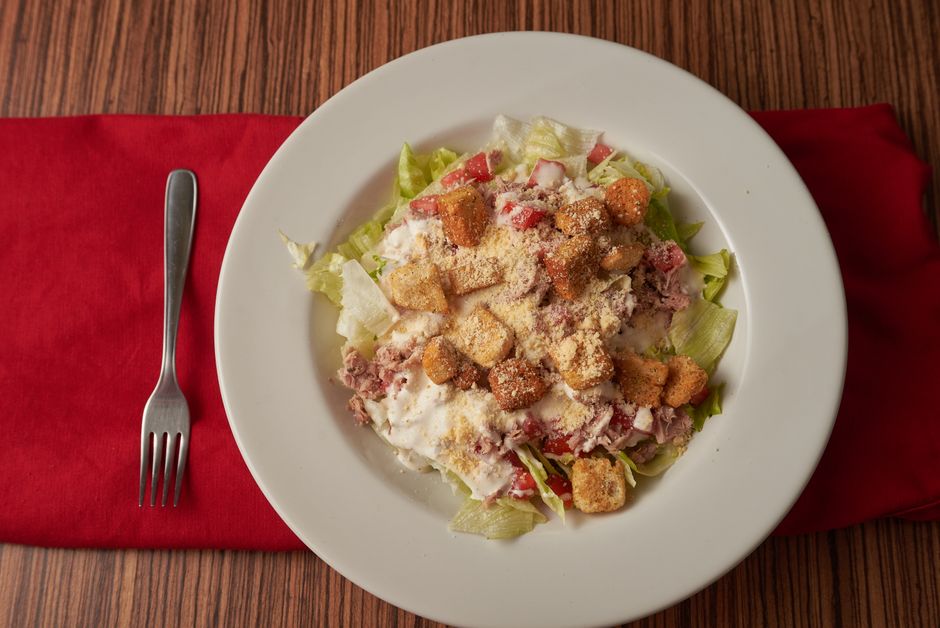
A Caesar salad can be a genuinely healthy choice or a nutritional disaster, and the difference comes down almost entirely to how it is made and what you add to it. The romaine lettuce at its base is low in calories and a real source of vitamins A, K, and folate. But the classic dressing is built on oil, egg yolk, and hard cheese, and many restaurant versions pile on croutons, fried chicken, and enough dressing to push a single bowl past 1,000 calories. The salad itself is neither good nor bad. The version in front of you is what matters.
What Is Actually in a Caesar Salad?
The traditional recipe has a short ingredient list. Romaine lettuce, croutons, parmesan cheese, and a dressing made from olive oil, egg yolk, lemon juice, garlic, anchovy, mustard, and Worcestershire sauce.
That is the original. Modern versions vary enormously. Some add grilled chicken, shrimp, or salmon. Some use fried chicken tenders. Some swap the romaine for kale or mixed greens. Some pour on a bottled dressing that shares little with the traditional emulsion beyond the name.
The nutritional profile of the dish changes with every one of those choices. A side Caesar with light dressing and no croutons is a very different food from a large chicken Caesar with extra dressing and a breadstick on the side. Treating them as the same dish is where most confusion starts.
Is Caesar Salad Healthy For You Compared to Other Salads?
Compared with a plain garden salad, a classic Caesar is heavier in calories, fat, and sodium. That is not a flaw in the salad. It is a direct result of the dressing and cheese.
Olive oil is a source of monounsaturated fat, and the evidence linking diets rich in olive oil to cardiovascular health is strong. Parmesan adds protein and calcium. Egg yolk contributes fat-soluble vitamins. None of these ingredients are inherently unhealthy in reasonable amounts.
The problem is quantity and proportion. A typical restaurant Caesar can carry two to three times the dressing of a homemade version. That shifts the balance from “vegetables with some fat” to “fat with some vegetables.”
Compared with a vinaigrette-based salad, a Caesar will usually be higher in calories and saturated fat and lower in the sharp acidity that comes from vinegar. Whether that matters depends on the rest of your day, not on the salad alone.
How Many Calories Are in a Caesar Salad?
There is no single number. The range is wide, and it depends on portion size, dressing amount, and add-ins.
A small side Caesar with a modest amount of dressing and croutons might land in the 200 to 300 calorie range. A large restaurant Caesar with grilled chicken can easily reach 600 to 800 calories. Add fried chicken, extra dressing, and a breadstick, and you can pass 1,000 calories in one bowl.
These are general ranges, not precise figures. Chain restaurants publish their own nutrition data, and those numbers vary significantly from one establishment to another. If you want an accurate count for a specific restaurant salad, the restaurant’s own published information is the only reliable source.
What is consistent is where the calories come from. Dressing and croutons, not lettuce, drive the total. Lettuce is roughly 10 to 15 calories per cup. A single tablespoon of creamy Caesar dressing can carry 70 to 90 calories. Two or three tablespoons, which is a normal pour, changes everything.





Is Caesar Dressing the Problem?
Caesar dressing is where most of the nutritional weight of this salad lives. It is an emulsion of oil, egg yolk, and acid, plus anchovy, garlic, and cheese.
That means it is calorie-dense by design. Fat carries nine calories per gram, compared with four for protein and carbohydrates. A creamy dressing is mostly fat, so a small volume delivers a large calorie load.
Not all of that fat is the same. Olive oil, when it is the base, is predominantly monounsaturated. Many bottled dressings use soybean or other seed oils instead, and some add sugar, stabilizers, and higher sodium. Reading the label on a bottled dressing tells you more than the word “Caesar” on the front.
Homemade dressing gives you control. You decide the oil, the amount, and whether to use a raw egg or a pasteurized alternative. That control is the single biggest lever on how healthy your Caesar turns out.
A Note on Raw Egg
Traditional Caesar dressing uses raw or lightly cooked egg yolk. Raw eggs can carry Salmonella, and the risk, while low, is real. People who are pregnant, older adults, young children, and anyone with a weakened immune system face higher risk from foodborne illness. Pasteurized eggs or a mayonnaise-based dressing avoid the raw egg issue entirely. This is standard food safety guidance, not a judgment about any particular recipe.
What About the Croutons and Cheese?
Croutons are toasted bread, usually with oil or butter and salt. They are not harmful, but they add refined carbohydrate, fat, and sodium without much else. A handful is fine. A cup is a lot of empty calories sitting on top of your greens.
Parmesan is a hard, aged cheese. It delivers protein and calcium, and it is high in sodium. A light grating adds flavor for relatively few calories. A heavy dusting, or a version loaded with creamy dressing and extra cheese, adds up quickly.
Anchovies deserve a mention because they get a bad reputation they do not fully deserve. They are a source of omega-3 fatty acids and protein, and the amount in a typical dressing is small. If you dislike them, that is a taste preference, not a health concern.
How to Make a Healthier Caesar Salad
The salad can be made lighter without giving up what makes it a Caesar. The adjustments are simple and they work.
- Use romaine or another crisp green as the base, and use plenty of it. Volume from vegetables is the point.
- Measure the dressing instead of pouring. One to two tablespoons is usually enough to coat a large bowl.
- Try a yogurt-based or vinaigrette-style dressing if you want to cut calories and saturated fat.
- Use pasteurized eggs or a mayonnaise base if you are avoiding raw egg.
- Keep croutons to a small handful, or replace them with toasted nuts or seeds for more protein and minerals.
- Add grilled chicken, shrimp, salmon, or chickpeas for protein rather than fried toppings.
- Go light on the parmesan, or use a strongly flavored cheese so a little goes further.
- Ask for dressing on the side at restaurants. This is the single most effective change you can make.
None of these steps turn the salad into a different dish. They restore the balance that a heavy pour of dressing throws off.
Is Caesar Salad Good for Weight Loss?
A Caesar salad can fit into a weight-loss eating pattern, but it is not automatically a low-calorie food. The word “salad” does not guarantee a low calorie count.
Weight management comes down to total energy intake over time, not to any single meal. A Caesar salad that fits your calorie needs and keeps you full can be a useful meal. One that quietly delivers 900 calories because of dressing and fried toppings can work against you without you realizing it.
The good news is that a well-made Caesar is satisfying. Protein from chicken or cheese, fat from the dressing, and fiber from the lettuce all contribute to feeling full. That satiety is part of why salads can help with weight management when they are built sensibly.
If weight loss is the goal, the dressing is the first thing to measure. It is also the easiest thing to overlook.
Who Should Be Careful With Caesar Salad?
Most people can enjoy a Caesar salad without concern. A few groups have specific reasons to pay attention.
People watching their sodium should note that Caesar dressing, parmesan, and croutons are all salty. A single restaurant Caesar can carry a meaningful share of a day’s sodium, which matters for anyone managing high blood pressure or heart failure.
People avoiding raw egg, including those who are pregnant or immunocompromised, should choose a pasteurized or mayonnaise-based dressing. This is a food safety precaution, not a nutritional one.
Anyone with a dairy allergy or lactose intolerance should know that parmesan is low in lactose but not lactose-free, and the dressing may contain additional dairy. People with a fish allergy need to know that traditional Caesar dressing contains anchovy. That is easy to miss.
For everyone else, the main caution is portion awareness. A Caesar salad is a rich dish dressed up as a light one, and the label can be misleading.
The Bottom Line on Caesar Salad
A Caesar salad is not inherently healthy or unhealthy. It sits on a spectrum, and where it lands depends on the dressing, the toppings, and the portion.
At its best, it is a plate of nutrient-dense greens with healthy fats, some protein, and real flavor. At its worst, it is a calorie and sodium bomb wearing a salad’s reputation. The gap between those two versions is almost entirely about how much dressing and how many fried or starchy add-ins go into the bowl.
If you like Caesar salad, there is no reason to give it up. Just know what you are eating, and adjust the parts that carry the most weight. Lettuce is rarely the problem. The dressing usually is.
Frequently Asked Questions
Is Caesar salad healthy for weight loss?
It can be, but only if the dressing and toppings are controlled, since a restaurant version can exceed 800 calories. The lettuce is low in calories, but dressing, croutons, and cheese are not.
How many calories are in a Caesar salad?
A small side Caesar may have around 200 to 300 calories, while a large restaurant Caesar with chicken and heavy dressing can exceed 800. The exact number depends on the specific recipe and portion.
Is Caesar dressing bad for you?
Caesar dressing is not bad, but it is calorie-dense because it is mostly oil and egg yolk. Using one to two tablespoons instead of a heavy pour keeps the salad in a healthier range.
Does Caesar salad have raw egg?
Traditional Caesar dressing is made with raw or lightly cooked egg yolk, which can carry Salmonella. Pasteurized eggs or a mayonnaise-based dressing avoid that risk, and people who are pregnant or immunocompromised should choose those options.
