
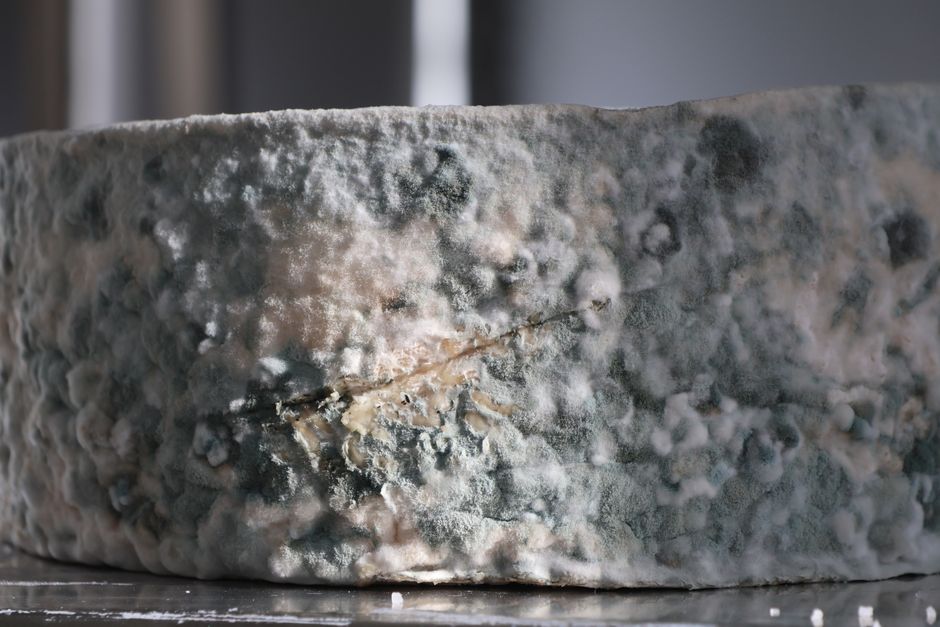
Yes, blue cheese is moldy cheese. The blue or green streaks running through a wedge of Roquefort or Gorgonzola are colonies of a mold called Penicillium, and that mold is not a defect. It is the entire point. A cheesemaker adds it on purpose, then creates the exact conditions it needs to grow.
That single fact surprises people, because we are taught that mold on food means throw it out. Blue cheese is the exception that proves how narrow that rule really is. The mold is safe to eat, it is intentionally introduced, and it is what gives these cheeses their sharp, salty, slightly bitter flavor.
Is Blue Cheese Moldy Cheese?
Blue cheese is made with mold, and the mold is edible. The specific organism is usually Penicillium roqueforti, a species that has been used in cheesemaking for centuries.
Here is where the process gets interesting. The mold does not just sit on the surface the way the white rind on Brie does. A cheesemaker stirs Penicillium spores directly into the milk or the curds. The mold is distributed throughout the cheese from the start.
But mold needs air to grow. A solid block of cheese has no air inside it. So makers do something clever: they pierce the young cheese with thin stainless steel needles. Those tiny channels let oxygen reach the interior. The mold grows along those channels, which is why blue cheese has streaks and veins rather than an even blue color throughout.
So the answer is yes. Blue cheese is deliberately moldy cheese, and the blue part is the mold itself.
What Kind of Mold Grows in Blue Cheese?
The main species is Penicillium roqueforti, named for Roquefort, the French cheese where it was first studied. A related species, Penicillium glaucum, is used in some styles. Both belong to the same broad genus as the mold that gives us penicillin, but they are different species.
That distinction matters. Penicillium roqueforti does not produce penicillin in any meaningful amount. Eating blue cheese will not give you a dose of antibiotic, and it will not treat an infection. This is a common misunderstanding worth clearing up.
The mold is also not the same as the fuzzy green growth that appears on old bread. That growth is often a different organism entirely, and some of those molds can produce harmful substances called mycotoxins. Penicillium roqueforti has been selected over generations specifically because it does not.
Cheesemakers also control which mold grows. The salt in the recipe, the acidity of the curd, and the temperature and humidity of the aging cave all favor Penicillium and discourage competitors. It is a managed environment, not a random one.
Is the Mold in Blue Cheese Safe to Eat?
The mold used to make blue cheese is considered safe for most people. It has a long history of human consumption, and food safety authorities in the United States and Europe permit it as a standard cheesemaking culture.
That said, “safe for most people” is not the same as “safe for everyone.” There are two groups who should be careful.
- People with weakened immune systems. This includes those undergoing chemotherapy, organ transplant recipients, and people with advanced HIV. Molds in general can pose a risk when the immune system cannot keep them in check. Pasteurization kills bacteria, not mold spores, so pasteurized blue cheese still contains live mold.
- People with a penicillin allergy. This one is genuinely debated. Penicillium roqueforti is a distant relative of the mold that produces penicillin, and some clinicians advise caution. The evidence for actual allergic reactions to blue cheese in penicillin-allergic people is limited and mixed. If you have a serious penicillin allergy, ask your doctor rather than deciding on your own.
For a healthy adult, the mold itself is not the concern. The bigger dietary consideration with blue cheese is sodium and saturated fat, both of which run high in most varieties.




Why Doesn’t the Mold in Blue Cheese Make You Sick?
Not all molds are dangerous, and the ones used in food production are a carefully selected group. The key difference is whether a mold produces mycotoxins, which are toxic compounds some molds release as they grow.
Penicillium roqueforti is not a significant mycotoxin producer under normal cheesemaking conditions. That is not luck. It is the result of centuries of selection. Cheesemakers kept using the strains that made good cheese and did not make people ill, and those strains became the standard.
Modern production adds another layer of control. Commercial starter cultures are tested and standardized, so a given brand produces a predictable result. The aging environment is monitored. The whole process is designed to let one specific mold thrive and nothing else.
This is also why you should not try to make blue cheese at home by leaving cheese out and hoping for the best. The right mold and the wrong mold look similar. Without controlled cultures, you have no way to know which one you got.
What About the Mold on the Outside of Blue Cheese?
The rind of a blue cheese is a separate matter from the blue veins inside it. Some blue cheeses develop a natural rind during aging. Others are wrapped or coated.
If you see fuzzy green, gray, or black growth on the surface of blue cheese that does not look like the blue veining, that is likely a contaminant, not the intended mold. The intended mold is blue or blue-green and follows the pierced channels. Surface fuzz that spreads and changes color is a different situation.
For hard blue cheeses, some people trim away a small spot of surface mold and eat the rest. That is a judgment call, and it is not the same as the safety of the blue veins themselves. Soft cheeses are a different story. With a soft cheese like Brie or a soft blue, mold can send threads below the surface, so trimming the visible part does not remove it.
If you are unsure whether what you are seeing is the intended mold or something else, throw it out. The cost of a wedge of cheese is not worth the risk of foodborne illness.
Blue Cheese vs. Other Moldy Cheeses
Blue cheese is not the only cheese made with mold. It is just the most obvious about it. The table below shows how the main mold-ripened cheeses differ.
| Cheese Type | Mold Used | Where the Mold Grows | Edible Rind? |
|---|---|---|---|
| Blue cheese (Roquefort, Gorgonzola, Stilton) | Penicillium roqueforti | Interior veins along pierced channels | Usually not |
| Brie, Camembert | Penicillium camemberti | Surface only, white bloomy rind | Yes |
| Fresh cheeses (cottage, cream cheese) | None | Not applicable | Not applicable |
The white rind on Brie is a different mold species, and it is meant to be eaten. The blue veins in Stilton are Penicillium roqueforti, and the rind is usually not. Two moldy cheeses, two different molds, two different sets of rules.
How to Store Blue Cheese So the Mold Stays Right
Blue cheese keeps well, but it needs the right conditions. The goal is to slow the mold’s growth without letting other organisms take over.
Wrap it in parchment or wax paper, then loosely in plastic. The paper lets the cheese breathe while the plastic keeps it from drying out. Fully sealing blue cheese in tight plastic traps moisture and can encourage the wrong kind of growth.
Keep it in the coldest part of the refrigerator, ideally in a drawer or container away from other foods. Blue cheese is strong, and its aroma will spread to anything nearby. A sealed container helps with that.
Expect the blue veining to keep developing over time. That is normal. What is not normal is slimy texture, a strong ammonia smell, or fuzzy growth in colors other than blue or blue-green. Any of those are signs to discard it.
One more practical note: blue cheese does not freeze well for eating plain. The texture turns crumbly and grainy. It is fine to freeze if you plan to use it in cooking, where the texture will not matter.
Common Myths About Blue Cheese and Mold
A few ideas about blue cheese circulate widely and are worth correcting.
Myth: The blue veins are injected. They are not. The mold grows from spores mixed into the curd, and the piercing needles only create the air channels it needs. The color appears where the mold grows, not where a needle went.
Myth: Blue cheese is unsafe during pregnancy. The concern with soft cheeses during pregnancy is generally about Listeria, a bacterium, not the mold. Pasteurized blue cheese is often considered acceptable, but guidance varies and some clinicians advise avoiding soft cheeses entirely. This is a case where you should follow your own doctor’s advice rather than a general rule.
Myth: You can eat any moldy cheese if you cut off the mold. This is false for soft and semi-soft cheeses, where mold can spread below the surface. For hard cheeses, trimming a small surface spot is sometimes considered acceptable, but it depends on the cheese and the mold.
Frequently Asked Questions
Is blue cheese actually mold?
Yes, the blue or green veins are a mold called Penicillium roqueforti that is added on purpose during cheesemaking. It is safe to eat for most healthy adults.
Can you eat the mold in blue cheese?
Yes, the blue veining is meant to be eaten and is part of the cheese. The outer rind is a separate matter and is often not eaten.
Is blue cheese safe if you have a penicillin allergy?
The evidence here is limited and mixed, so this is not a clear yes or no. If you have a serious penicillin allergy, ask your doctor before eating blue cheese.
What happens if you eat moldy blue cheese that has gone bad?
If the cheese shows fuzzy growth in colors other than blue or blue-green, or smells strongly of ammonia, discard it. Eating spoiled cheese can cause foodborne illness.
