
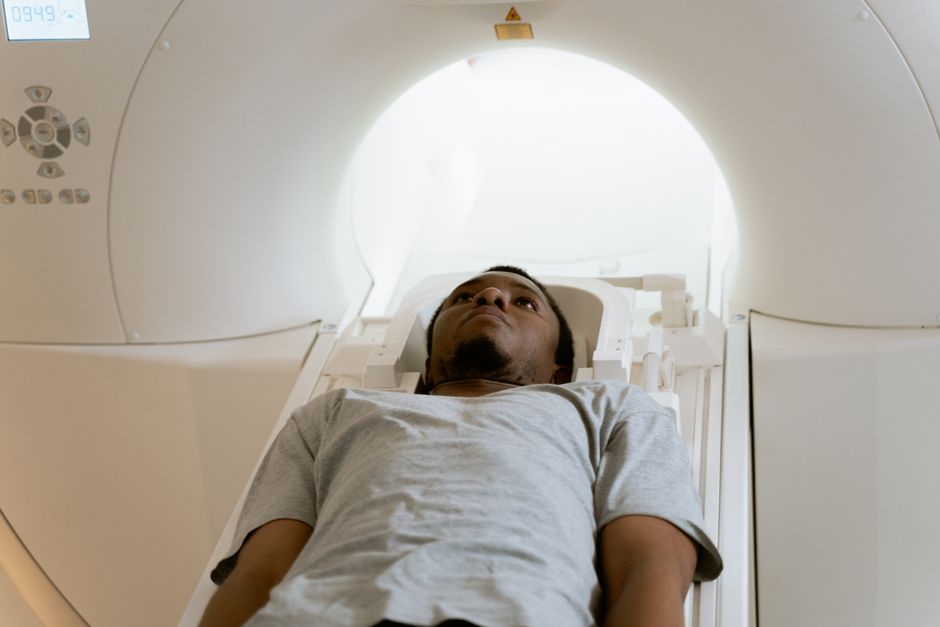
If you have ever felt trapped inside an MRI tube, you already know the feeling: your heart races, your chest tightens, and every second feels like an hour. A PET scan is usually easier to tolerate because the scanner is wider and shorter, so your head often stays outside the opening. That single design difference is why many people who cannot finish an MRI can complete a PET scan without distress.
The two scans work in completely different ways, though. Understanding what each machine actually does, and how each one is built, explains why the claustrophobia is not the same. It also helps you know what you can ask for before your appointment.
What Makes An MRI Feel So Cramped?
An MRI scanner is a long, narrow tunnel. Most machines have a bore, the opening you slide into, with a diameter of roughly 60 to 70 centimeters. You lie on a table that moves you deep inside that tunnel, sometimes with your head near the center of the magnet.
The tunnel is open at both ends, but once you are inside, you cannot easily see out. That combination of tight space and limited sight lines is what triggers claustrophobia for many people. Add the loud knocking and banging sounds the machine makes, and the experience can feel overwhelming.
Claustrophobia during MRI is common enough that it is a recognized clinical problem. Estimates vary, but a meaningful share of patients report significant anxiety, and some cannot complete the exam without help. This is why many radiology centers offer open MRI machines, which have a wider opening and shorter tunnel, though image quality and scanner strength can differ from a standard closed unit.
How Is A PET Scan Different From An MRI?
A PET scan uses a different machine entirely. The PET scanner is shaped like a large ring or donut. You lie on a table that passes through the ring, but the tunnel is much shorter front to back than an MRI bore.
The ring itself is still enclosed on the sides, so it is not wide open like a room. But because the tunnel is shallow, your head is often outside the scanner for much of the exam, or only briefly inside it. For many patients, that changes the entire experience.
There is also a practical difference in how the two scans are used. PET scans are often combined with a CT scan in a single machine, called PET/CT. The CT portion is also a short ring, so the overall setup stays relatively open compared with a long MRI tube.
Is A PET Scan As Claustrophobic As An MRI?
For most people, a PET scan is less claustrophobic than an MRI. The shorter tunnel and the fact that your head is frequently outside the opening make it easier to tolerate. Someone who panics in a closed MRI can often complete a PET scan with little or no anxiety.
That does not mean PET scans never cause discomfort. The ring is still an enclosed space, and lying still for a long stretch can feel confining. People with severe claustrophobia may still struggle.
Timing also matters, and it cuts both ways. A PET scan involves an injection of a radioactive tracer, followed by a waiting period while the tracer distributes through your body, and then the scan itself. The time on the table varies by what is being imaged. An MRI can run longer or shorter depending on the study. So a PET scan is not automatically faster, even if the enclosed part feels shorter.
One detail people often miss: the tracer waiting period happens in a quiet room, not inside the machine. You are free to move, read, or rest during that time. The claustrophobic part, if there is one, is only the scanning portion.





How Do The Two Scans Compare?
| Feature | MRI | PET Scan |
|---|---|---|
| Machine shape | Long narrow tunnel | Short ring or donut |
| Typical bore or opening | Roughly 60 to 70 centimeters | Wider opening, shorter tunnel |
| Head position | Often deep inside the tunnel | Frequently outside or near the edge |
| Noise | Loud knocking and banging | Generally quieter |
| What it shows | Structure of organs and tissue | Metabolic activity in cells |
| Contrast or tracer | Sometimes a contrast dye | Radioactive tracer injected first |
The key point in that table is not the measurements. It is that the two scans answer different questions. MRI shows anatomy, what tissue looks like. PET shows activity, how actively cells are using energy. That is why they are sometimes used together rather than as substitutes.
What Actually Causes The Claustrophobic Feeling?
Claustrophobia is not just a reaction to small spaces. It is a learned fear response, and it usually involves two triggers: the sense of being physically confined and the sense that escape would be difficult.
An MRI hits both triggers hard. The bore is narrow, the tunnel is long, and once the table moves you in, getting out takes time. The noise adds stress on top of that.
A PET scanner hits the first trigger more gently. The ring is shorter, and your head is often outside it. The sense of being trapped is weaker because the exit is closer and more visible.
This is also why the same person can react differently on different days. Anxiety, fatigue, and how well the procedure was explained all affect how confined you feel. A calm, informed patient often tolerates the same machine that panicked them before.
What Can You Do If You Are Worried?
Tell your doctor and the imaging staff about your claustrophobia before the appointment. This is common, and centers have ways to help. Being upfront is far better than white-knuckling it and having to stop partway through.
Options that radiology centers may offer include:
- A wider or open MRI machine, if one is available and suitable for your study
- An eye mask or prism glasses so you can see out without lifting your head
- Headphones with music to block the machine noise
- A hand-held call button so you can signal staff at any time
- Having a support person in the room for part of the scan, if the facility allows it
- Short breaks during the exam, when the study permits
For some patients, a doctor may prescribe a mild sedative to take before the scan. This is a decision to make with your physician, not on your own, and it usually requires someone else to drive you home. Whether it is appropriate depends on your health, your medications, and the facility’s policy.
Practice can help too. Some centers let you lie on the table and slide in briefly before the real scan starts. A short trial run takes the surprise out of the experience.
Do You Need To Choose One Over The Other?
In most cases, you do not get to choose. Your doctor orders the scan that answers the clinical question at hand. MRI and PET are not interchangeable, so the choice is driven by what needs to be seen, not by which machine feels easier.
If claustrophobia is a real barrier, the conversation is not about switching scans. It is about how to make the ordered scan work for you. That might mean a different machine, a sedative, or extra support from staff.
It is also worth knowing that not every PET scan requires the same amount of time in the machine, and not every MRI is a long tunnel. Protocols vary by body part and by facility. Asking the imaging center what to expect for your specific study is more useful than general comparisons.
Frequently Asked Questions
Is a PET scan open or closed?
A PET scanner is a short ring rather than a long tunnel, so it feels more open than a closed MRI. Your head is often outside the opening during much of the scan.
Can I have a PET scan if I am claustrophobic?
Many people with claustrophobia complete a PET scan without difficulty because the tunnel is short. If anxiety is severe, tell your doctor in advance so support options can be arranged.
Why is an MRI worse for claustrophobia than a PET scan?
An MRI has a long, narrow tunnel that your whole body slides into, often with your head deep inside. A PET scanner is much shorter front to back, so the sense of being trapped is weaker.
Does a PET scan make noise like an MRI?
No. MRI machines produce loud knocking and banging sounds, while PET scanners are generally much quieter. Ear protection is still sometimes offered.
