
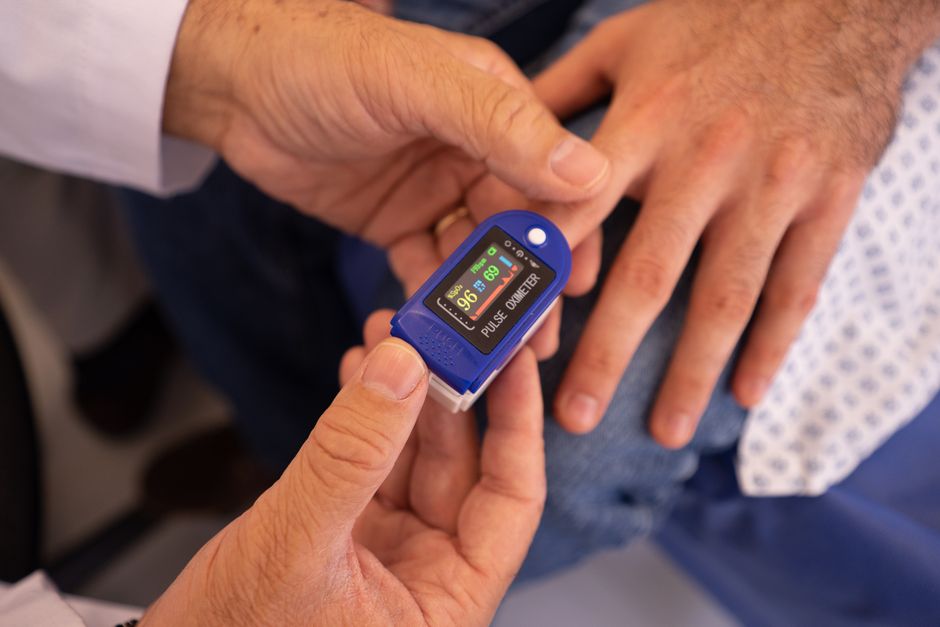
A blood oxygen level of 98% is normal for a healthy adult at sea level. Pulse oximeters generally read normal oxygen saturation between 95% and 100%, so a reading of 98% sits comfortably inside that range. It is not low, and it is not a sign of a problem on its own.
That said, a single number rarely tells the whole story. Oxygen saturation is one measure among several, and how you feel matters as much as what the device says. Here is what the number means, where the line for “low” actually sits, and when a reading deserves attention.
What Does a 98% Blood Oxygen Reading Actually Mean?
A pulse oximeter estimates how much of the hemoglobin in your blood is carrying oxygen. Hemoglobin is the protein in red blood cells that transports oxygen from your lungs to the rest of your body. When the device shows 98%, it estimates that about 98% of your hemoglobin binding sites are occupied by oxygen.
The word “estimates” matters. Pulse oximeters do not measure arterial blood directly. They shine light through your fingertip and calculate oxygen saturation based on how much light the blood absorbs. Oxygen-rich blood and oxygen-poor blood absorb light differently, and the device uses that difference to produce a number.
This is why a pulse oximeter reading is not the same as an arterial blood gas test, which measures oxygen saturation directly from a blood sample drawn from an artery. The blood gas test is the clinical gold standard. A fingertip device is a convenient approximation, and it is usually close, but it is not exact.
What Is a Normal Blood Oxygen Range?
For healthy adults at sea level, normal oxygen saturation is generally considered to be 95% to 100%. A reading of 98% falls well within that range.
Some context on how clinicians interpret these numbers:
- 95% to 100% is typically considered normal for a healthy adult.
- Below 95% is often treated as a signal to check further, especially if it persists.
- Below 90% is generally considered low and warrants medical attention.
- Below 88% is often the threshold where clinicians consider supplemental oxygen, particularly in certain chronic lung conditions.
These cutoffs are widely used in clinical practice, but they are not universal. A person with chronic obstructive pulmonary disease (COPD) may have a lower baseline oxygen level that their doctor considers acceptable for them. Someone at high altitude may also have a naturally lower reading. Age and overall health shape what counts as normal for any individual.
One clarification worth knowing: a pulse oximeter reading of 98% does not mean your blood is “98% oxygen.” It means roughly 98% of your hemoglobin’s oxygen-carrying capacity is being used. The two are related but not identical.
Is 98% Ever a Concern?
For most healthy people, 98% is not a concern. But the number alone does not tell you everything. How you feel, your symptoms, and your medical history all matter.
If you have a reading of 98% and you feel fine, there is generally no reason to worry. If you have a reading of 98% but you feel short of breath, dizzy, or unusually tired, that combination deserves attention regardless of the number. A normal reading does not rule out a problem, and a slightly lower reading does not always mean something is wrong.
Pulse oximeters can also be inaccurate. Cold fingers, poor circulation, nail polish, and motion can all affect a reading. So can the device’s quality. A single reading that seems off is worth repeating before drawing conclusions.
There is also a well-documented limitation worth mentioning. Research has shown that pulse oximeters can be less accurate in people with darker skin tones, sometimes reading higher than the true oxygen level. This has been recognized in clinical settings and is a known source of measurement error. It does not mean the devices are useless, but it is a reason to take symptoms seriously even when the number looks normal.
What Causes Low Blood Oxygen?
Oxygen saturation drops when the lungs cannot transfer enough oxygen into the blood, or when the blood cannot carry it efficiently. Common causes include:
- Lung conditions such as pneumonia, asthma flare-ups, COPD, or pulmonary fibrosis
- Heart conditions that affect blood flow through the lungs
- Sleep apnea, where breathing pauses during sleep
- High altitude, where the air contains less oxygen
- Anemia, where there are too few red blood cells to carry oxygen
- Certain medications that suppress breathing
The mechanism is straightforward in most cases. If the lungs are inflamed or filled with fluid, oxygen has a harder time crossing into the bloodstream. If the heart is not pumping efficiently, blood may not circulate through the lungs as it should. If there are too few red blood cells, there is less hemoglobin available to carry oxygen even if the lungs are working well.
When Should You Check Your Blood Oxygen?
Routine checking is not necessary for most healthy people. Pulse oximeters became widely available during the COVID-19 pandemic, and many households now have one. That is reasonable, but it is not a substitute for paying attention to how you feel.
Checking makes more sense if you have a known respiratory or cardiac condition, if you are recovering from an illness that affects breathing, or if a doctor has asked you to monitor your levels. In those situations, a reading below your usual baseline is more meaningful than any single number.
If you check and get a reading below 95%, sit quietly for a few minutes and check again. If it stays low, or if you have symptoms like shortness of breath, chest pain, confusion, or bluish lips, seek medical care. Those symptoms matter more than the number itself.
Does a Normal Reading Mean Everything Is Fine?
No. A normal oxygen saturation does not rule out every problem. Early in some illnesses, oxygen levels can stay normal even as a person feels unwell. The body compensates in ways that keep the number in range for a while.
This is why clinicians do not rely on oxygen saturation alone. They look at breathing rate, heart rate, symptoms, and the whole clinical picture. A pulse oximeter is a useful tool, not a diagnosis.
For most healthy adults, a reading of 98% is simply a normal number. It confirms that oxygen saturation is where it should be at that moment. It does not replace how you feel, and it does not need to be checked constantly unless a doctor has recommended it.
Frequently Asked Questions
Is 98 blood oxygen good?
Yes, 98% is within the normal range of 95% to 100% for a healthy adult at sea level. It is not low and does not require action on its own.
What is a dangerously low oxygen level?
Readings below 90% are generally considered low and warrant medical attention. Below 88% is often the point where clinicians consider supplemental oxygen in certain conditions.
Can a pulse oximeter be wrong?
Yes, readings can be affected by cold fingers, poor circulation, nail polish, motion, and device quality. Research also shows they can be less accurate in people with darker skin tones.
Should I worry if my oxygen is 98% but I feel short of breath?
Yes, symptoms matter regardless of the number. Shortness of breath with a normal reading deserves medical evaluation.
