
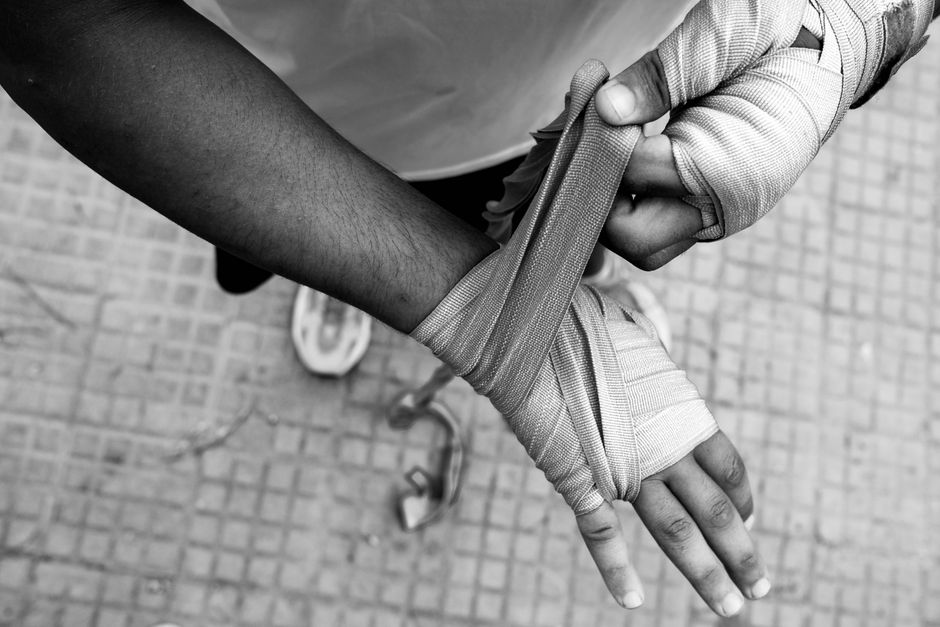
Wrapping boxing wrist wraps correctly takes about a minute per hand. You anchor the loop at your thumb, wrap firmly around the wrist and back of the hand, and finish with the Velcro strap snug enough to support the joint without cutting off circulation. The wrap should feel tight but not painful, and your fingers should stay warm and pink.
Getting this right matters more than most beginners realize. A loose wrap slides and does nothing. An overly tight one can compress nerves and blood vessels. The technique below is the standard one taught in boxing gyms.
What Do Boxing Wrist Wraps Actually Do?
Wrist wraps stabilize the wrist joint and the base of the hand during punching. They do not make your wrist stronger, and they do not prevent all injuries. What they do is limit excessive bending and reduce the load on the small ligaments and tendons that take stress every time you land a punch.
When you throw a hook or a cross, force travels through the knuckles, into the metacarpals, and down through the wrist. Without support, the wrist can flex or deviate sideways on impact. Wraps add a layer of external stiffness that keeps the joint closer to neutral.
Hand wraps and wrist wraps are related but not identical. Traditional hand wraps are long cotton strips that cover the knuckles, hand, and wrist. Many modern boxing wraps combine both functions in one piece with a thumb loop and a Velcro closure. The wrapping method below works for either style.
One clarification worth making: wraps support the wrist and hand. They do not protect the knuckles the way padded gloves do. You still need properly fitted gloves for any contact work.
What You Need Before You Start
You need one wrap per hand and a flat surface to work on. That is it. Most boxing wraps run about 120 inches (roughly 3 meters) long, though lengths vary by brand. Longer wraps give you more coverage; shorter ones are quicker to put on.
Check the wrap before you begin. Look for frayed edges, a stretched-out Velcro strap, or a broken thumb loop. A worn strap will not hold tension, and a wrap that keeps loosening mid-session is worse than no wrap at all.
Your hands should be clean and dry. Moisture makes cotton wraps slip. If your hands sweat heavily, some boxers keep a spare pair and rotate them.
How To Wrap Boxing Wrist Wraps Step By Step
Follow these steps in order. The whole process takes under a minute once you have done it a few times.
- Step 1 — Slide your thumb through the loop. Place the loop over your thumb with the Velcro strap facing outward, away from your palm. The wrap should sit on the back of your hand.
- Step 2 — Anchor across the back of the hand. Pull the wrap across the back of your hand toward your pinky side. Keep it flat, not twisted.
- Step 3 — Wrap around the wrist. Bring the wrap around the back of your wrist and toward the inside. This first pass sets your anchor.
- Step 4 — Cover the wrist joint. Make two or three passes around the wrist, each one slightly overlapping the last. Keep tension even. This is the part that does the supporting.
- Step 5 — Support the base of the hand. Angle the wrap so it crosses the back of your hand and the base of your palm. This adds stability where the hand meets the wrist.
- Step 6 — Cover the knuckles if your wrap is long enough. Some boxers wrap across the knuckles for extra padding under the glove. This is optional and depends on wrap length.
- Step 7 — Finish at the wrist. End your last pass on the wrist, not the fingers or the palm.
- Step 8 — Secure the Velcro strap. Press the strap down firmly. It should sit flat and hold tension without pulling.
Repeat on the other hand. Most people find one side noticeably easier. That is normal.
How Tight Should a Wrist Wrap Be?
Snug, supportive, and comfortable. Not tight enough to hurt, and not loose enough to slide. This is the single most common mistake beginners make, and it goes in both directions.
Here is a simple test. After you finish wrapping, make a fist and open your hand a few times. Your fingers should feel normal. They should not tingle, go numb, or turn pale or blue. If any of that happens, the wrap is too tight. Unwrap it and start again with less tension.
Signs a wrap is too loose:
- It shifts or bunches when you make a fist
- The Velcro strap comes undone during movement
- You feel no support when you press your palm against a wall
Signs a wrap is too tight:
- Tingling or numbness in the fingers
- Cool or pale fingers
- Throbbing at the wrist
- Discomfort that does not ease after a minute
Tingling or numbness is not something to push through. It means the wrap is pressing on nerves or blood vessels. Take it off and rewrap. If numbness continues after you remove the wrap, stop training and speak to a healthcare professional.
Common Wrapping Mistakes to Avoid
Twisted wraps are the most frequent error. A twist creates a pressure point that digs into the skin and concentrates force in one spot. Keep the wrap flat against your skin at all times. If it twists, unwind to that point and start again.
Wrapping only the wrist and skipping the hand is another common one. The base of the hand needs support too, because that is where a lot of impact force transfers. A wrap that stops at the wrist leaves the hand unsupported.
Wrapping too low on the forearm is a third mistake. The wrap should sit over the wrist joint, not slide down toward the elbow. It will not support the joint from there.
Finally, do not reuse a wrap that has lost its stretch or has a stretched-out strap. Velcro wears out over time. A wrap that will not hold tension is not doing its job.
Do Wraps Prevent Wrist Injuries?
Wraps reduce some stress on the wrist, but the evidence that they prevent injuries is limited. No large trials have confirmed that wrist wraps lower injury rates in boxers. What is clear is that they support the joint during impact and are standard practice in the sport.
Proper punching technique, well-fitted gloves, and sensible training progression matter more for injury prevention than wraps alone. A wrap cannot compensate for poor form or for hitting too hard too soon.
If you have an existing wrist injury or ongoing wrist pain, talk to a doctor or a physical therapist before relying on wraps to train through it. Wraps are a support tool, not a treatment.
How to Care for Your Wrist Wraps
Wash your wraps regularly. They collect sweat, and that breaks down the fabric and the Velcro over time. Most cotton wraps can be hand-washed or machine-washed on a gentle cycle, but check the label on your specific pair first.
Fasten the Velcro strap to itself before washing so it does not snag other fabric. Air dry them rather than putting them in a hot dryer, which can shrink cotton and weaken the strap. Replace wraps when the elastic loses its stretch or the Velcro stops gripping.
Frequently Asked Questions
How long should boxing wrist wraps be?
Most boxing wraps are about 120 inches long, though lengths vary by brand. Longer wraps allow more coverage of the hand and knuckles.
Can you wrap boxing wrist wraps too tight?
Yes. A wrap that causes tingling, numbness, or pale fingers is too tight and should be rewrapped with less tension.
Do you wrap wrist wraps over or under the glove?
Wraps go on your bare hands first, then the boxing glove goes over the wrap. Never wear wraps over gloves.
How often should you replace boxing wrist wraps?
Replace them when the elastic loses stretch or the Velcro stops holding firmly. There is no fixed timeline, since wear depends on how often you train.
