
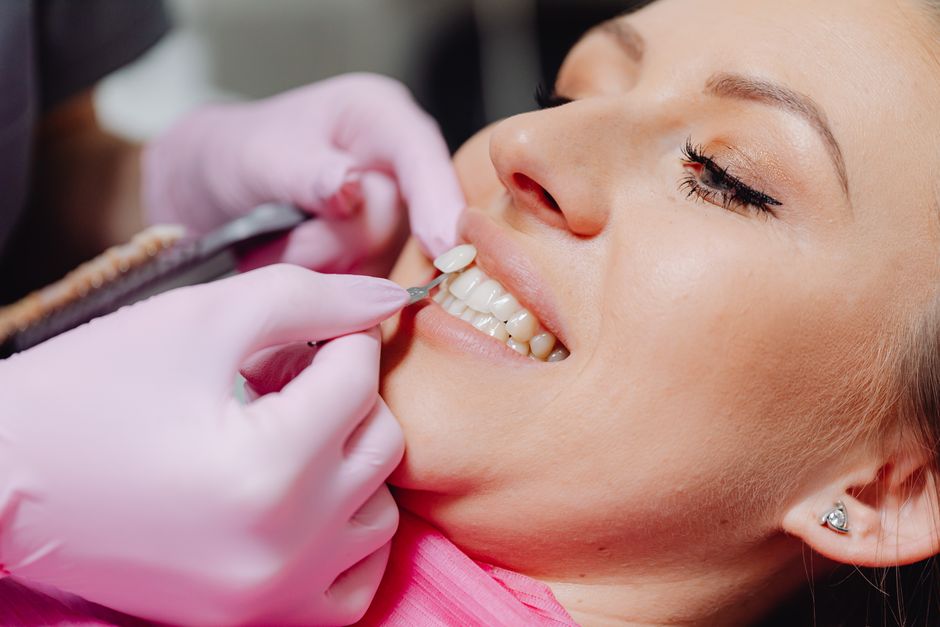
Composite veneers don’t respond to whitening the way natural teeth do. That’s the single most important fact here. Whitening gels and strips work by penetrating tooth structure and breaking down stain molecules inside enamel and dentin. Composite resin is a plastic-based material. It doesn’t let those chemicals in the same way, and it doesn’t contain the pigment structures that respond to peroxide. So if your natural teeth lighten and your composite veneers stay the same shade, you end up with a visible mismatch. The realistic options are professional cleaning and polishing, replacement of the veneers, or — in some cases — surface stains that can be removed without changing the material itself.
Why Composite Veneers Don’t Whiten Like Natural Teeth
To understand what works, you need to understand what composite is. Dental composite is a mixture of resin matrix and inorganic filler particles. It’s cured with a light to harden it into place. That structure is fundamentally different from enamel and dentin.
Natural tooth whitening relies on peroxide compounds. These molecules are small enough to move through the microscopic pores in enamel and dentin. Once inside, they oxidize the colored compounds that have built up over years. The tooth lightens from the inside out.
Composite resin doesn’t have that same porous, mineral structure. Peroxide can’t penetrate it the way it penetrates tooth structure. And even if some surface interaction occurs, the pigments in composite are locked into the resin matrix itself. They aren’t sitting there waiting to be oxidized. This is why whitening products that work well on natural teeth produce little or no change on composite.
There’s a second problem. Composite is also more prone to picking up surface stains than enamel is. The resin surface is softer and can develop microscopic scratches over time. Coffee, tea, red wine, and tobacco smoke settle into those scratches. That’s surface staining, and it behaves differently from the internal staining that whitening targets.
What Actually Works To Lighten Composite Veneers
The honest answer is that there is no at-home or in-office whitening product that reliably changes the shade of composite resin. No clinical evidence confirms that peroxide gels, whitening strips, or LED whitening devices lighten composite material. Manufacturers of whitening products generally don’t claim they do.
What can work depends on what’s actually causing the discoloration.
- Surface stains from food, drink, or tobacco can sometimes be reduced with professional polishing or a gentle prophylaxis. This is a cleaning effect, not a whitening effect. It restores the composite closer to its original shade.
- Replacement of the veneers is the only way to change the actual shade of composite. The old material is removed and new composite is placed in the shade you want.
- Refinishing or re-polishing the surface can address roughness and minor staining, but it won’t lighten the material itself.
If you’ve tried whitening strips on composite veneers and seen no change, that’s expected. It’s not a product failure. It’s the material behaving the way it should.
Can You Whiten Natural Teeth Without Affecting Your Veneers?
This is where the real complication shows up. Many people with composite veneers also have natural teeth that could be whitened. If you whiten those natural teeth and the veneers don’t change, the veneers may now look darker by comparison.
This creates a mismatch that can be more noticeable than the original discoloration. A single dark tooth next to lighter ones draws the eye.
Dentists who work with veneer patients typically plan for this. If whitening is going to happen, it’s usually done before veneers are placed, so the veneers can be matched to the final tooth shade. Once veneers are bonded in place, changing the shade of the surrounding teeth without changing the veneers often creates a problem rather than solving one.
If you’re considering whitening your natural teeth while you have composite veneers, the practical question is whether the resulting color difference will bother you. For some people it does. For others, it’s not noticeable if the veneers are on back teeth or if the shade difference is small. This is a conversation to have with your dentist before you start, not after.




Does Whitening Toothpaste Help Composite Veneers?
Whitening toothpastes work mainly by abrasion. They contain mild polishing agents that scrub surface stains off teeth. Some also contain low concentrations of peroxide, but the contact time is short and the concentration is low.
On composite veneers, whitening toothpaste may help remove light surface stains. It won’t change the shade of the material. And there’s a downside worth knowing about.
Abrasive toothpastes can scratch the surface of composite resin over time. Those scratches make the surface rougher, which makes it easier for new stains to settle in. So a toothpaste that seems to help in the short term may contribute to faster staining later. This is a well-recognized issue with composite restorations. If you use a whitening toothpaste, a gentler formula is generally a better choice for composite surfaces than a highly abrasive one.
How To Keep Composite Veneers Looking Their Best
Since you can’t whiten composite, prevention and maintenance carry more weight. The goal is to slow down the staining and surface changes that make veneers look dull or discolored.
- Rinse with water after coffee, tea, red wine, or dark-colored foods.
- Use a soft-bristled toothbrush and avoid brushing too hard.
- Ask your dentist about a non-abrasive or low-abrasive toothpaste.
- Keep up with regular professional cleanings, which can address surface buildup.
- Avoid tobacco, which stains composite noticeably.
Composite resin also has a limited lifespan. Over time, it can discolor, wear, or pick up stains that polishing can’t remove. Many composite veneers need to be replaced or refreshed at some point. When that happens, you can choose a lighter shade than you had before. That’s the realistic path to a lighter look.
Composite vs. Porcelain Veneers: Why The Material Matters
Porcelain veneers behave differently from composite in one important way. Porcelain is more stain-resistant. Its surface is smoother and less porous, so it picks up surface stains more slowly. But porcelain also doesn’t respond to whitening. Once a porcelain veneer is made, its shade is fixed.
So the whitening limitation isn’t unique to composite. It applies to any fabricated restoration, including porcelain veneers, crowns, and bonding. The difference is mainly in how quickly each material stains and how well it holds up over time.
| Property | Composite Veneers | Porcelain Veneers |
|---|---|---|
| Responds to whitening | No | No |
| Stain resistance | Lower | Higher |
| Surface texture | Softer, can scratch | Smoother, harder |
| Can be repaired in mouth | Often yes | Usually no |
| Typical lifespan | Shorter | Longer |
Lifespan estimates vary by source, by patient habits, and by how well the veneers are maintained. Broad ranges are often cited, but individual results differ enough that a specific number isn’t reliable for any one person.
What To Ask Your Dentist Before Trying Anything
Before you spend money on whitening products or at-home kits hoping to lighten composite veneers, it’s worth confirming what’s actually causing the discoloration. Surface staining and internal discoloration look similar to the eye but have different solutions.
Ask your dentist whether the discoloration is on the surface or within the material. If it’s surface staining, a professional cleaning may help. If it’s internal, no whitening product will change it, and the options narrow to replacement or acceptance.
Also ask whether whitening your natural teeth would create a visible mismatch. That answer depends on where the veneers are, how many you have, and how much lighter your natural teeth could go. A dentist who can see your teeth in person can give you a far more useful answer than any general guidance can.
Frequently Asked Questions
Can you whiten composite veneers with regular whitening strips?
No. Whitening strips rely on peroxide, which doesn’t penetrate composite resin the way it penetrates natural tooth structure. You may see no change at all, or only removal of light surface stains.
Why did my natural teeth get whiter but my veneers stayed the same?
Because the two materials respond differently to peroxide. Natural teeth lighten from the inside; composite doesn’t. This is why whitening before veneers are placed is usually the better approach.
Can composite veneers be made lighter without replacing them?
Professional polishing can remove surface stains and restore the original shade, but it can’t change the material’s actual color. A true shade change requires replacing the veneers.
Do whitening toothpastes damage composite veneers?
Abrasive toothpastes can scratch the composite surface over time, which may make it stain faster. A gentler, lower-abrasion toothpaste is generally a better choice for composite.
