
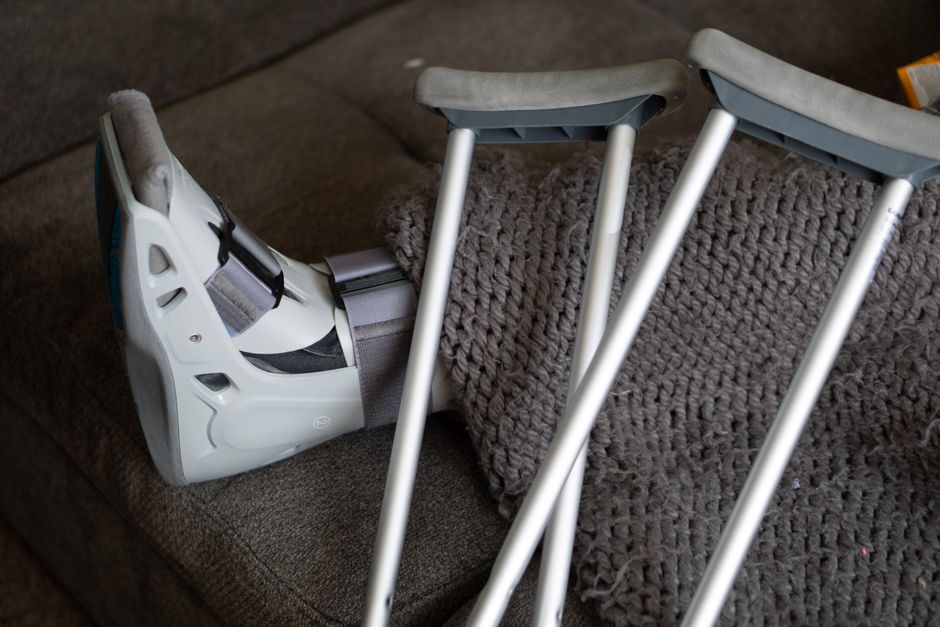
Walking with crutches is a skill, not an instinct. Most people get handed a pair in an emergency room or an orthopedic clinic and are shown the basics in a few minutes. The mechanics are simple once you know them: move the crutches first, then step through with your injured leg, keeping your weight on your hands and arms rather than your armpits.
The details matter more than most people expect. Armpit pressure can injure nerves. The wrong gait for your injury can slow healing or cause a fall. And small setup errors — crutch height, handgrip position, footwear — make the whole thing harder than it needs to be.
This guide covers how to walk with crutches safely, how to adjust them, how to handle stairs and curbs, and what to do when something feels wrong.
How Do You Take Your First Steps On Crutches?
Start on a flat, dry surface with someone nearby if possible. Stand with your weight on your good leg and both crutches under your arms.
Move both crutches forward about a foot, then step the injured leg forward so it lands roughly even with the crutch tips. Then push down through your hands and step your good leg past the crutches. Repeat. The rhythm is crutches, injured leg, good leg.
Your body weight should travel through your palms and forearms. The top of the crutch should sit a few finger-widths below your armpit — not jammed into it. If you feel pressure in your armpit, the crutches are too tall or you are leaning on them incorrectly.
Look forward, not down at your feet. Looking down shifts your center of gravity and makes balance harder.
How Should Crutches Be Adjusted For Your Body?
Crutch fit is the difference between a manageable recovery and a painful one. Two measurements matter: height and handgrip position.
For height, stand as straight as you can with your shoes on. The top of the crutch should sit about two to three finger-widths below your armpit. When you grip the handgrips, your elbow should bend at roughly a 15 to 30 degree angle.
For the handgrip, your wrist should be at the same level as the handgrip when your arm hangs at your side. That position lets you push down without straining your wrist.
If you are between settings, go slightly higher rather than lower. Crutches that are too short force you to stoop, which throws off your balance and puts more strain on your shoulders.
Check the rubber tips before every use. Worn tips are a common cause of slips, especially on smooth floors. Replace them as soon as the tread disappears.
What Is The Right Crutch Walking Pattern For Your Injury?
There is no single correct gait. The pattern depends on how much weight your doctor or physical therapist wants you to put on the injured leg. This is a medical instruction, not a preference — follow it exactly.
- Non-weight-bearing: Keep the injured foot completely off the floor. Hop or swing through on the good leg while the crutches bear all your weight.
- Toe-touch or touch-down weight-bearing: Rest the toe of the injured foot on the floor for balance only. Little to no real weight goes through it.
- Partial weight-bearing: Put some of your weight on the injured leg, as directed. The exact amount is usually set by your clinician.
- Weight-bearing as tolerated: Use the injured leg as much as feels comfortable, with crutches for support and balance.
If you are not sure which category you are in, ask. Guessing wrong can delay healing or damage a repair.




How Do You Walk Up And Down Stairs With Crutches?
Stairs are where most crutch injuries happen. The rule is easy to remember: up with the good, down with the bad.
Going up: stand close to the bottom step. Put your good leg up onto the step first, then bring the crutches and injured leg up to meet it. One step at a time.
Going down: place both crutches down onto the lower step first, then lower your injured leg, then bring your good leg down. The crutches and injured leg lead; the good leg follows.
Use the handrail whenever one is available. Hold both crutches in one hand, grip the rail with the other, and move one step at a time. If there is no rail, take it slowly and keep your weight centered.
Curbs follow the same logic. Step up with the good leg first. Step down with the crutches and injured leg first.
How Do You Sit, Stand, And Get Out Of A Chair?
To sit down, back up to the chair until you feel it against the back of your legs. Keep both crutches in one hand. Reach back with your free hand, then lower yourself slowly onto the seat using your good leg.
To stand up, slide forward to the edge of the chair. Put both crutches in one hand and push up with your free hand and your good leg. Once you are steady, place the crutches back under your arms.
Toilets and low seats are harder than chairs because there is less height to work with. If you have a raised toilet seat or a firm cushion, use it. Anything that reduces how far you have to lower and lift yourself makes the process safer.
What Are The Most Common Crutch Mistakes?
The biggest one is leaning into the armpits. Crutches are designed to be pushed down through the hands, not rested under the arms. Sustained pressure in the armpit can compress nerves in that area, which can cause numbness, tingling, or weakness in the arm and hand. This is sometimes called crutch palsy, and it is preventable.
Other common mistakes:
- Setting the crutches too tall or too short
- Looking down at your feet instead of ahead
- Taking long strides instead of short, controlled steps
- Wearing loose slippers or backless shoes
- Skipping the handrail on stairs
- Using worn or missing rubber tips
- Rushing on wet, icy, or uneven surfaces
Wear shoes with a firm sole and a closed back. Bare feet and loose footwear both raise your fall risk.
How Long Will You Need Crutches?
There is no standard timeline. It depends entirely on your injury, your surgery if you had one, and how your healing progresses. Some people use crutches for a few days. Others use them for several weeks or longer.
Your clinician will tell you when it is safe to start putting more weight on the leg and when you can stop using the crutches. Do not decide this on your own based on how you feel. Pain and swelling do not always match what is happening inside a healing bone or joint.
If you are still on crutches well past when you expected to be off them, that is worth a conversation with your doctor rather than a reason to push through.
When Should You Call Your Doctor?
Contact your clinician if you notice numbness, tingling, or weakness in your hands or arms. These can be signs of nerve pressure from the crutches.
Also call if you have new or worsening pain in the injured leg, swelling that keeps increasing, or a cast or splint that feels too tight. Any fall while using crutches is worth reporting, even if nothing seems broken.
Signs of a blood clot — swelling in one leg, warmth, redness, or pain in the calf — need urgent medical attention. So does shortness of breath or chest pain, which can indicate a clot that has traveled to the lungs.
Frequently Asked Questions
Should crutches go under your arms or in your hands?
Your weight should go through your hands and palms, not your armpits. The top of the crutch should sit a few finger-widths below the armpit and should not press into it.
How do you go up and down stairs with crutches?
Going up, lead with your good leg. Going down, lead with the crutches and your injured leg. Use the handrail whenever possible and move one step at a time.
How do you know if your crutches are the right height?
With your shoes on, the top of the crutch should sit about two to three finger-widths below your armpit, and your elbow should bend at roughly 15 to 30 degrees when you grip the handle.
Can crutches cause nerve damage?
Yes, sustained pressure in the armpit can compress nerves and cause numbness, tingling, or weakness in the arm. Keeping your weight on your hands instead of your armpits prevents this.
