
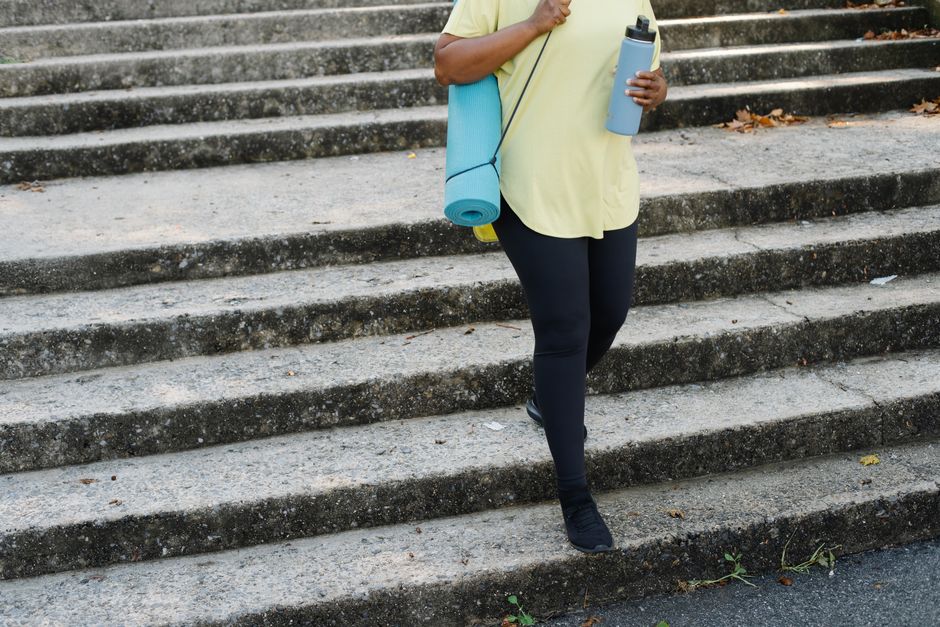
Going up and down stairs on crutches is a skill, not a test of courage. The rule that keeps you safe is simple: the good leg leads going up, and the crutches plus the injured leg go first going down. Move one step at a time, keep your hands on the rails or crutches, and never rush. Most people can manage a full flight within a few days of practice with the right technique.
What Is the Basic Rule for Stairs With Crutches?
The rule is worth memorizing because it protects the injured leg from bearing weight it cannot handle. Going up, you lead with your strong leg. Going down, you lead with the crutches and the injured leg. The phrase many physical therapists use is “up with the good, down with the bad.”
The logic is about control. When you climb, your good leg does the pushing and pulling, so it goes first and takes the load. When you descend, the crutches touch the lower step before your body moves, giving you a stable base. The injured leg follows the crutches down so it never has to catch your weight alone.
If you are on a non-weight-bearing order, meaning your doctor has told you to keep all weight off the injured leg, this rule matters even more. The crutches carry you. The injured leg only hovers.
How Do You Walk Up Stairs With Crutches?
Going up is the easier direction for most people. You start by standing close to the bottom step with your crutches planted firmly. If there is a handrail, grip it with one hand and keep one crutch under the opposite arm. If there is no rail, use both crutches.
Here is the sequence, one step at a time:
- Stand tall with your weight on your good leg.
- Push down through the handrail or crutches and step up with your strong leg first.
- Bring the crutches and the injured leg up onto the same step.
- Check your balance before starting the next step.
Do not try to take two steps at once. Do not lean forward toward the next step before your strong leg is planted. And keep your crutches close to your body, not stretched out in front of you, because a wide base tips you backward.
One detail people miss: place the crutch tips on the step beside your foot, not on the step above. If a crutch tip sits on a higher step than your planted foot, it can slide or wobble when you push.
How Do You Walk Down Stairs With Crutches?
Going down feels riskier because gravity is working against your control. The sequence reverses. You lower the crutches and the injured leg first, then bring your good leg down to meet them.
Step by step:
- Stand at the edge of the top step with your weight on your good leg.
- Lower both crutches and the injured leg onto the step below.
- Shift your weight onto the crutches and bring your good leg down to the same step.
- Pause and reset before the next step.
Keep your body upright rather than leaning far forward. Leaning shifts your center of gravity over the edge of the step, which is where falls happen. Let the crutches take the load, and lower your good leg slowly rather than dropping it.
If your injury is on the leg you would normally lead with going down, the order stays the same. The injured leg and crutches always go first, no matter which side the injury is on.
Should You Use the Handrail or Both Crutches?
Use the handrail whenever one is available. A fixed rail is more stable than a crutch, and it lets you keep one hand anchored while the other manages a crutch. This is the setup most physical therapists teach for home stairs.
To use a rail, hold it with the hand on the same side as your good leg, and keep the single crutch under the opposite arm. Move the crutch and your injured leg together, using the rail for balance and support. If the rail is on the other side, you can still use it, but practice the coordination first on a single step.
When there is no rail, use both crutches and take the stairs more slowly. Some people feel safer going down backward on their bottom, one step at a time, especially in the first days after surgery or an injury. That is a reasonable choice, not a failure. Ask your physical therapist which method fits your specific injury.
How Do You Stay Safe on Stairs With Crutches?
Most crutch falls on stairs come from speed, distraction, or slippery surfaces, not from bad technique. A few habits reduce the risk a lot.
- Clear the stairs of loose rugs, shoes, toys, and clutter before you start.
- Wear shoes with grippy soles. Socks and slippers slide.
- Take one step at a time and say the sequence out loud if it helps you stay focused.
- Keep your crutches at the correct height. The handgrips should sit at wrist level when your arms hang at your sides, and your elbows should bend slightly when you grip them.
- Check the rubber tips on your crutches for wear. Worn tips lose grip on hard stairs.
- Avoid carrying anything in your hands. Use a backpack or ask for help.
If your stairs are steep, narrow, or have no rail, consider staying on one floor for the first days, or ask someone to spot you from below. A spotter stands one or two steps below and to the side, close enough to steady you but not in your path.
If you feel unsteady, dizzy, or weak, do not attempt the stairs alone. Lightheadedness is a real fall risk, and it is not something to push through.
What If You Cannot Put Weight on One Leg?
If your doctor has restricted weight-bearing, the stair method stays the same, but your arms do all the work. You will need to build arm and shoulder strength, and the first few trips may tire you quickly. That is normal.
Some people use a technique called a “step-to” gait on flat ground, where the crutches and injured leg move together and the good leg follows. On stairs, keep the up-with-the-good, down-with-the-bad rule. The step-to pattern applies to walking on level surfaces, not to climbing.
If your arms are weak or you have balance problems, talk to your care team before tackling stairs at home. They may recommend a different aid, a temporary setup on one floor, or help from a family member. There is no shame in asking for a spotter or using a stairlift temporarily.
For a broader look at recovery and mobility, see our guides at HBmag.com.
How Long Does It Take to Get Comfortable on Stairs?
Most people feel steady on stairs within a few days of daily practice. The first attempts are the hardest, and confidence builds with repetition. Start on a single step or a low curb before a full flight.
If you are still anxious after a week of practice, or if pain or instability makes stairs feel unsafe, talk to your physical therapist. They can watch your technique and adjust it for your injury. Some people need a different crutch height or a gait belt for extra support during practice.
Do not measure progress by speed. Measure it by control. A slow, steady trip with no wobble is a success, even if it takes a minute.
Frequently Asked Questions
Which leg goes first when going up stairs with crutches?
Your strong leg goes first when going up. Then bring the crutches and the injured leg up to the same step.
Which leg goes first when going down stairs with crutches?
The crutches and the injured leg go down first. Your good leg follows onto the same step.
Can you use just one crutch on stairs?
Yes, if you have a handrail to hold with the other hand. Keep one crutch under the arm opposite the rail and move slowly.
What if there is no handrail on the stairs?
Use both crutches and take one step at a time. If you feel unsteady, ask someone to spot you or consider going down on your bottom.
