
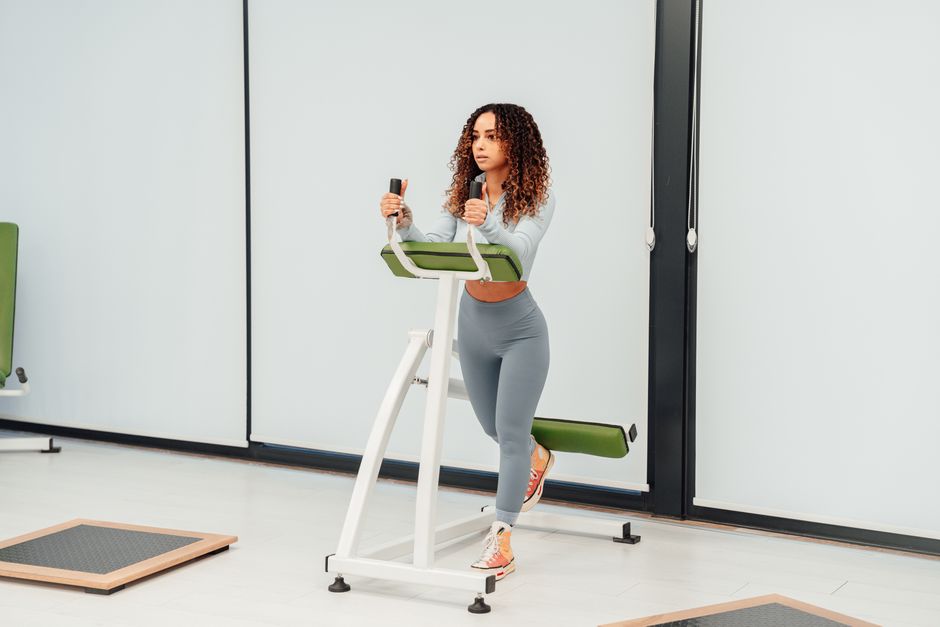
The arm extension machine is one of the simplest pieces of gym equipment to set up, and that simplicity is exactly why so many people use it wrong. To set it up, adjust the seat so the handles sit at roughly shoulder height, keep your back flat against the pad, and position your elbows so they stay fixed at your sides throughout the movement. Push the handles down until your arms are nearly straight, then let them return under control. Get those four things right and the machine does most of the work for you.
What Does The Arm Extension Machine Actually Train?
The arm extension machine trains the triceps — the muscle group on the back of your upper arm. That is the whole point of the movement.
The triceps has three heads: the long head, the lateral head, and the medial head. All three extend the elbow, which is the motion the machine is built around. The long head crosses the shoulder joint as well, so its involvement changes depending on where your upper arm sits relative to your torso.
People often assume the machine hits “the triceps” as one uniform block. It does not work quite that way. Shoulder position shifts which heads contribute more, which is why you will see some variation in how lifters set up. None of that variation makes the exercise better or worse on its own — it just changes the emphasis.
What the machine does not train is your chest, shoulders, or back in any meaningful way. If you feel those working hard, your setup or your path of motion has drifted.
How Should You Set The Seat And Handles?
Seat height is the single adjustment that matters most, and it is the one most people skip.
The goal is to get your shoulder joint roughly level with the axis of the machine — the pivot point the handles rotate around. In practice, that usually means the handles sit near shoulder height when your elbows are bent at the start.
If the seat is too low, you end up pressing from a position that pushes your shoulders up toward your ears. If it is too high, you lose range of motion at the bottom and your elbows drift forward. Both reduce how well the movement targets the triceps.
- Adjust the seat so the handles start near shoulder height.
- Check the back pad — your shoulders should rest against it, not float in front of it.
- Set the weight stack low for your first set while you dial in position.
Machines vary. Some have a single seat pin, others have both a seat and a back pad adjustment. Spend the extra thirty seconds. A well-fitted setup is worth more than adding weight.
What Is The Correct Starting Position?
Start with your back flat against the pad and your feet planted on the floor or footrests.
Grip the handles with your palms facing down or in, depending on how the machine is built. Your elbows should be bent and tucked close to your sides, not flared out wide.
This is where most form breaks down. When the elbows drift away from the torso, the movement stops being a clean elbow extension and turns into a press. That shifts work away from the triceps and puts more load through the shoulder joint.
Keep your wrists neutral — straight, not bent back. A bent wrist under load is a common source of discomfort that has nothing to do with the triceps.
Your shoulders should stay down and back. If they creep up toward your ears during the set, the weight is probably too heavy or the seat is set wrong.




How Do You Perform The Repetition?
Push the handles down by straightening your elbows. That is the entire movement.
Stop just short of locking your elbows out completely. Full lockout is not dangerous for everyone, but it transfers tension away from the muscle and onto the joint at the end of every rep. Most people get more out of stopping a few degrees short.
Then reverse it. Let the handles come back up slowly. This lowering phase — the eccentric portion — is where a lot of the muscle-building stimulus happens, and it is the part almost everyone rushes.
A common mistake is letting the weight stack slam down between reps. That turns a controlled exercise into a bouncing motion and removes most of the benefit.
Breathe out as you push down, in as you return. Do not hold your breath through the set.
What Are The Most Common Form Mistakes?
Five errors show up again and again on this machine.
- Elbows flaring out. They should stay pinned near your ribs.
- Using momentum. Rocking your torso to move the weight means your triceps are not doing the work.
- Going too heavy. If you cannot control the return, the weight is too much.
- Cutting range of motion. Partial reps limit the exercise.
- Shrugging the shoulders. This signals a setup problem or excessive load.
The shoulder shrug is worth a closer look. It usually means the seat is too low, so you are reaching for the handles instead of sitting into them. Fix the seat before you lighten the weight.
One thing that gets overstated online: the idea that the arm extension machine is inherently bad for your elbows. There is no strong evidence that the machine itself causes elbow problems. What does tend to cause trouble is heavy load combined with fast, uncontrolled reps. That is a technique issue, not a machine issue.
How Much Weight And How Many Reps?
There is no single correct number here, and anyone who tells you otherwise is guessing.
General resistance training guidance — the kind reflected in major public health and sports medicine recommendations — points toward working each major muscle group a couple of times per week, with a load that challenges you while letting you keep good form. For most healthy adults, that means a weight you can move for roughly 8 to 12 controlled reps with the last few feeling difficult but not sloppy.
That range is a common starting point, not a rule. People training for pure strength often use heavier loads and fewer reps. People newer to training or returning from a break often do better with lighter loads and more reps.
What matters more than the exact number is that your form holds. The moment your elbows drift or your torso starts rocking, the set is over regardless of what the rep counter says.
If you have an elbow, shoulder, or wrist condition, or you are recovering from an injury, talk to a clinician or a qualified trainer before loading this movement. No general article can tell you what is safe for a specific joint problem.
How Does It Compare To Other Triceps Exercises?
The arm extension machine is a fixed-path movement. Your joints follow a set track, which makes it easier to learn than a free weight exercise.
That fixed path is both the strength and the limitation. It is easier to control, which helps beginners and people who want to isolate the triceps. It also means your stabilizer muscles do less work than they would with dumbbells or cables.
Cable pushdowns and overhead dumbbell extensions are common alternatives. Overhead positions put the long head of the triceps under more stretch, which some evidence suggests may matter for muscle growth. That research is still developing, and it does not mean the machine is inferior — it means different exercises stress the muscle differently.
For most people, the best choice is the one they can perform consistently with good form. Variety across a training week tends to serve people better than any single exercise done perfectly.
Frequently Asked Questions
Where should the seat be set on an arm extension machine?
Set the seat so the handles start near shoulder height, with your shoulder joint roughly level with the machine’s pivot point. Your back should rest flat against the pad in that position.
Should you lock your elbows out at the bottom of an arm extension?
Most people do better stopping just short of full lockout. Locking out transfers tension off the muscle and onto the joint at the end of every rep.
How many sets of arm extensions should you do?
There is no single correct number, and it depends on your overall training plan. General resistance training guidance suggests training each major muscle group about twice per week with a load you can control.
Is the arm extension machine bad for your elbows?
No strong evidence shows the machine itself causes elbow problems. Fast, uncontrolled reps with heavy weight are the more common source of joint irritation.
