
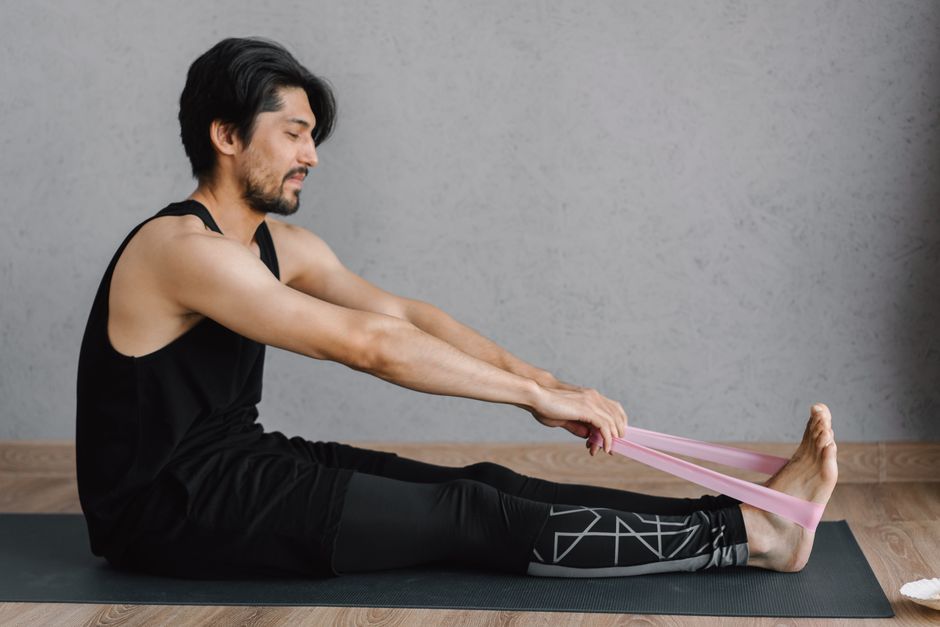
Stretch bands can help you gain flexibility faster than static stretching alone because they let you add controlled resistance at the end of a range of motion. The most effective approach is to hold each stretch for 30 to 60 seconds, use light tension rather than heavy resistance, and stretch consistently — at least 3 to 5 days per week. Bands do not create flexibility on their own; they simply let you apply steady, measurable tension that you can adjust as your range improves.
How To Use Stretch Bands For Flexibility Fast
The fastest path to flexibility with bands follows a simple loop: warm up, move into the stretch, add light band tension, hold, then relax deeper. Each step matters.
Start with 5 to 10 minutes of light activity — walking, marching in place, or arm circles. Warm muscle tissue lengthens more readily than cold tissue. This is not optional if speed is your goal.
Next, loop the band around your foot, hand, or a fixed anchor and move into the target stretch. The band should add gentle pull, not force. If you cannot breathe normally, the tension is too high.
Hold the position for 30 to 60 seconds. During the hold, exhale slowly and let the muscle relax into the stretch. You are not pulling harder — you are waiting for the tissue to give.
Repeat 2 to 4 times per muscle group. Total session time: 10 to 15 minutes. That is enough. Longer sessions do not produce proportionally faster results.
One detail most people miss: the band’s real advantage is that it lets you measure your progress. If you stretched to a certain band length last week and you reach further this week, you have objective evidence of change. That feedback loop keeps you consistent, and consistency is what actually drives flexibility gains.
Why Do Stretch Bands Work Better Than Static Stretching Alone?
Stretch bands add something static stretching cannot: progressive resistance through the full arc of motion. When you stretch without a band, the tension on the muscle decreases as you move deeper into the stretch. A band reverses that — tension increases as you lengthen, which keeps the muscle under load throughout the hold.
This matters because flexibility gains come from two sources. The first is neurological: your nervous system learns to tolerate a longer muscle length without triggering a protective contraction. The second is structural: over time, connective tissue adapts to repeated tension.
Bands address both. The steady pull teaches your nervous system that the lengthened position is safe. The resistance provides the mechanical stimulus that connective tissue responds to over weeks and months.
Research on stretching consistently shows that gains depend more on total time under tension and frequency than on any single technique. Bands simply make it easier to accumulate that time with controlled, adjustable load.
Which Stretch Bands Should You Use?
Flat resistance bands and loop bands are the two main types. Flat bands work well for hamstring, calf, and shoulder stretches because you can grip them easily. Loop bands are better for hip and glute stretches where you need a continuous loop around a limb.
For flexibility work, choose light to medium resistance. Heavy bands encourage forcing, which triggers the stretch reflex — your muscle contracts to protect itself, and you end up tighter, not looser.
If you are new to bands, start with the lightest band available. You can always move up. Most people doing flexibility work never need more than medium resistance.
Band material matters less than you might think. Latex and fabric bands both work. What matters is that the band does not snap or slip during a hold, and that you can control the tension smoothly.





What Stretches Give The Fastest Results?
Focus on the areas that limit you most. For most people, that means hamstrings, hip flexors, shoulders, and calves. These four areas affect posture, walking mechanics, and overhead reach.
Here are effective band stretches for each:
- Hamstrings: Lie on your back, loop the band around one foot, and gently pull the leg toward you while keeping it straight. Hold 30 to 60 seconds.
- Hip flexors: Loop the band around your back foot and anchor it behind you. Step forward into a lunge position and press the hip forward. Hold 30 to 60 seconds.
- Shoulders: Hold the band behind your back with both hands and slowly raise your arms. Keep the band taut but not tight. Hold 30 to 60 seconds.
- Calves: Sit with legs extended, loop the band around the ball of one foot, and pull your toes toward you. Hold 30 to 60 seconds.
Do not stretch cold muscles. Do not bounce. Do not push into sharp pain. Discomfort from stretching should feel like a strong pull, not a sting or pinch.
How Often Should You Stretch With Bands?
Daily is fine for light stretching. For meaningful flexibility gains, research generally supports stretching at least 3 to 5 days per week, with each muscle group held for a total of about 60 seconds per session.
If you are stretching for general flexibility, 3 days per week works. If you are trying to gain range quickly for a specific goal — a sport, a performance, a mobility test — daily sessions produce faster results.
What does not work: stretching hard twice a week and expecting change. Frequency beats intensity for flexibility. A gentle daily stretch outperforms an aggressive twice-weekly session.
Recovery matters too. If a muscle feels sore from yesterday’s stretching, back off the intensity but do not skip the session. Light stretching on sore tissue supports recovery.
How Long Until You See Results?
Most people notice some improvement within 2 to 4 weeks of consistent stretching. Measurable, lasting changes in range of motion typically take 6 to 8 weeks of regular practice.
The early gains are mostly neurological — your nervous system tolerates more length. The later gains involve actual tissue adaptation, which takes longer.
This timeline assumes you are stretching most days and holding each stretch for at least 30 seconds. If you stretch once a week, expect little to no change. Flexibility is a use-it-or-lose-it quality. Stop stretching and you will lose gains within weeks.
Age affects the timeline but does not prevent progress. Older adults can gain flexibility with bands at rates that are meaningful, though possibly slower than younger adults. The limiting factor is almost always consistency, not age.
What Mistakes Slow Down Progress?
Forcing the stretch is the most common mistake. Pushing past a strong pull triggers the stretch reflex, and your muscle tightens instead of lengthening. The result is the opposite of what you want.
Holding your breath is another. Breathing keeps you relaxed, and relaxation is what allows the muscle to lengthen. If you are holding your breath, you are bracing, not stretching.
Skipping warm-up costs you. Cold tissue does not stretch well. Five minutes of light movement before you stretch makes the session more productive.
Using too heavy a band is a subtle error. Heavy resistance feels productive but usually leads to shorter holds and more tension than the tissue can adapt to. Light bands, long holds, frequent sessions — that is the formula.
Finally, stretching only one side. Most people have a tighter side and unconsciously favor it. Stretch both sides equally, even if one feels looser.
Frequently Asked Questions
How long should you hold a stretch band for flexibility?
Hold each stretch for 30 to 60 seconds. Total time per muscle group per session should reach about 60 seconds across 2 to 4 repetitions.
Can you gain flexibility in one week with bands?
Some people notice small improvements within a week, but lasting flexibility gains typically take 6 to 8 weeks of consistent stretching. Early changes are mostly neurological, not structural.
Are stretch bands better than static stretching?
Bands are not inherently better, but they make it easier to apply controlled, measurable tension through a full range of motion. Research shows total time under tension and frequency matter more than the specific method.
Should you stretch with bands every day?
Daily light stretching is generally safe. For meaningful gains, aim for at least 3 to 5 days per week, with each muscle group held for about 60 seconds per session.
