
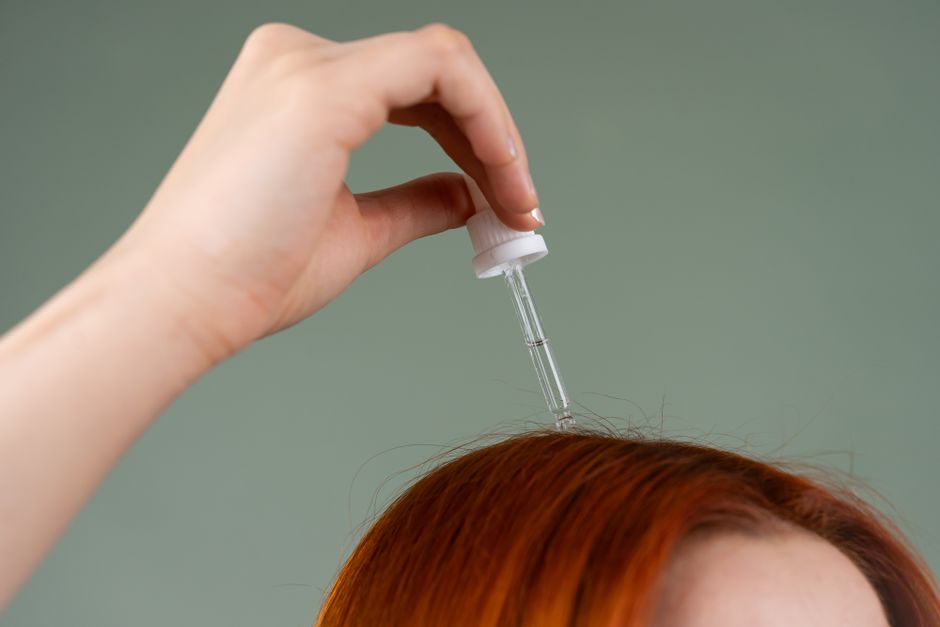
MCT oil is a concentrated form of medium-chain triglycerides, the fats found in coconut oil and palm kernel oil. People use it on the scalp and hair as a lightweight moisturizer and carrier oil, usually by massaging a small amount into the scalp before washing or smoothing a few drops through the ends. There is no clinical evidence that MCT oil grows hair, and it should not be presented as a hair loss treatment.
What it can reasonably do is soften the hair shaft and reduce moisture loss. What it cannot do is replace proven treatments for pattern hair loss or scalp disease. Understanding that difference matters before you spend money on a bottle.
What Is MCT Oil and Why Do People Put It on Their Hair?
MCT oil is made by isolating medium-chain fatty acids, mainly caprylic acid (C8) and capric acid (C10), from coconut or palm kernel oil. The result is a thin, clear liquid that stays liquid at room temperature and feels far lighter than whole coconut oil.
That lightness is the main reason it became popular in hair care. Coconut oil is solid at room temperature and can leave fine hair greasy and weighed down. MCT oil spreads easily, absorbs quickly into the surface of the hair, and rinses out with less effort. For people with fine or low-porosity hair, that difference is practical.
One clarification worth making: MCT oil is not the same as whole coconut oil, even though it comes from coconut. Most of coconut oil’s lauric acid is removed during processing. Lauric acid is the fatty acid with the most research behind it for penetrating the hair shaft. MCT oil does not contain much of it. So claims that MCT oil delivers coconut oil’s hair benefits do not hold up on the chemistry.
What MCT oil does have is a mild, generally low-irritation profile for most skin types. That makes it a reasonable option for people who find heavier oils uncomfortable or comedogenic.
Does MCT Oil Actually Grow Hair?
No clinical evidence currently confirms that MCT oil stimulates hair growth. There are no published human trials showing that applying MCT oil increases hair density, thickness, or growth rate.
The theory people cite is that medium-chain triglycerides have antimicrobial properties and may support a healthier scalp environment. Caprylic and capric acid do show antifungal and antibacterial activity in laboratory studies. Whether that translates into better hair growth in real people has not been established in clinical research.
This is where biological plausibility gets mistaken for proven benefit. A substance killing fungus in a petri dish does not mean rubbing it on your scalp regrows hair. Those are different questions, and only one of them has been tested properly.
Hair growth depends on genetics, hormones, nutrition, thyroid function, and the health of the hair follicle itself. An oil applied to the surface cannot change the hormonal drivers behind common pattern hair loss. If you are experiencing noticeable thinning, a dermatologist can assess the cause. Proven treatments exist for several types of hair loss, and they are not oils.
How To Use MCT Oil For Hair Growth And Scalp Care
Used as a scalp and hair conditioning oil, MCT oil is simple to apply. The approach below focuses on conditioning and comfort, not on treating hair loss.
Before washing
- Start with a small amount, roughly a teaspoon for short hair and up to a tablespoon for long or thick hair. Amounts are practical guidance, not a clinical dose.
- Warm it between your palms. There is no need to heat the bottle.
- Massage into the scalp with fingertips, not nails, for a minute or two. Gentle massage increases blood flow to the skin surface, which feels pleasant and may help distribute the oil.
- Work any remainder through the mid-lengths and ends, where hair tends to be driest.
- Leave it on for 20 to 30 minutes, or longer if your scalp tolerates it. There is no evidence that a specific duration improves results.
- Shampoo out. You may need two rounds of shampoo, especially on fine hair.
As a leave-in for dry ends
Put two or three drops in your palm, rub your hands together, and smooth over the ends only. Avoid the roots. A little goes a long way, and over-application is the most common mistake.
As a scalp oil for dryness
Apply a thin layer to dry patches and massage gently. If your scalp is flaking or itchy, see a clinician before self-treating. Flaking has several possible causes, including seborrheic dermatitis, psoriasis, and fungal infection, and they respond to different treatments. An oil alone will not resolve most of them.
Is MCT Oil Safe for Your Scalp?
For most people, MCT oil causes little irritation when applied to intact skin. It is generally well tolerated, and its low comedogenic rating makes it less likely than heavier oils to clog pores on the scalp.
That said, no topical oil is risk-free. Possible issues include:
- Irritation or contact reactions. Uncommon but possible with any oil.
- Build-up. Oil that is not fully washed out can leave hair limp and the scalp coated.
- Worsened flaking in some cases. If you have a scalp condition driven by yeast, adding oil can sometimes feed the problem rather than calm it. This is a real concern with seborrheic dermatitis.
- Slipping. Oil in a shower or bath makes surfaces slippery. Rinse carefully.
Do a patch test on your inner forearm and wait a day before applying anything to your scalp, especially if you have sensitive skin or a history of reactions to coconut-derived products. People with a known coconut allergy should avoid MCT oil, since it is derived from coconut or palm kernel oil.
Keep it away from the eyes. If you get it in your eyes, rinse with water.
MCT Oil vs Other Oils for Hair
Different oils behave differently on hair. Here is how MCT oil compares with a few common options.
| Oil | Texture | Notable characteristics |
|---|---|---|
| MCT oil | Thin, light | Low comedogenic, easy to rinse, low lauric acid content |
| Coconut oil | Solid at room temperature | High lauric acid; research indicates it can penetrate the hair shaft and reduce protein loss |
| Jojoba oil | Light, liquid wax ester | Chemically similar to human sebum; often well tolerated |
| Argan oil | Medium weight | Popular as a finishing oil; mainly conditions the surface |
| Mineral oil | Heavy | Very effective at reducing water loss from hair; can feel greasy |
The coconut oil point is worth stating plainly. Research published in the Journal of Cosmetic Science found that coconut oil reduced protein loss from hair during washing, and that mineral oil did not show the same effect. MCT oil, with most of its lauric acid removed, has not been studied that way. If shaft protection is your goal, whole coconut oil has better evidence behind it than MCT oil does.
MCT oil’s advantage is comfort. It suits people who want light conditioning without residue, not people seeking the strongest possible hair treatment.
What MCT Oil Cannot Do
Setting expectations honestly is the most useful thing this article can do. MCT oil will not regrow hair lost to pattern baldness, hormonal changes, or scarring conditions. It will not treat an underlying scalp infection. It will not reverse damage from chemical processing beyond temporary softening.
If your concern is hair loss, the evidence-supported paths are different. Some types of hair loss respond to medications that have been studied in clinical trials. Others improve when an underlying cause such as thyroid disease or iron deficiency is corrected. A dermatologist or physician can help identify which situation applies to you.
If your concern is dry, rough, or frizzy hair, MCT oil is a reasonable lightweight option alongside other conditioning products. It is a cosmetic aid, not a treatment.
Frequently Asked Questions
How often should I use MCT oil on my hair?
Once or twice a week as a pre-wash treatment is a common approach, though no clinical guideline sets a frequency. Adjust based on how your hair and scalp respond.
Can MCT oil cause hair loss?
There is no evidence that MCT oil itself causes hair loss. Poorly rinsed build-up can make hair look thinner and flatter, so wash it out thoroughly.
Is MCT oil better than coconut oil for hair?
Not for hair shaft protection, since coconut oil has research showing it reduces protein loss and MCT oil does not. MCT oil is lighter and easier to rinse, which some people prefer.
Can I leave MCT oil on my scalp overnight?
Some people do, but there is no evidence it works better than a shorter application. Overnight oiling raises the risk of build-up and pillow staining, so test it cautiously.
