
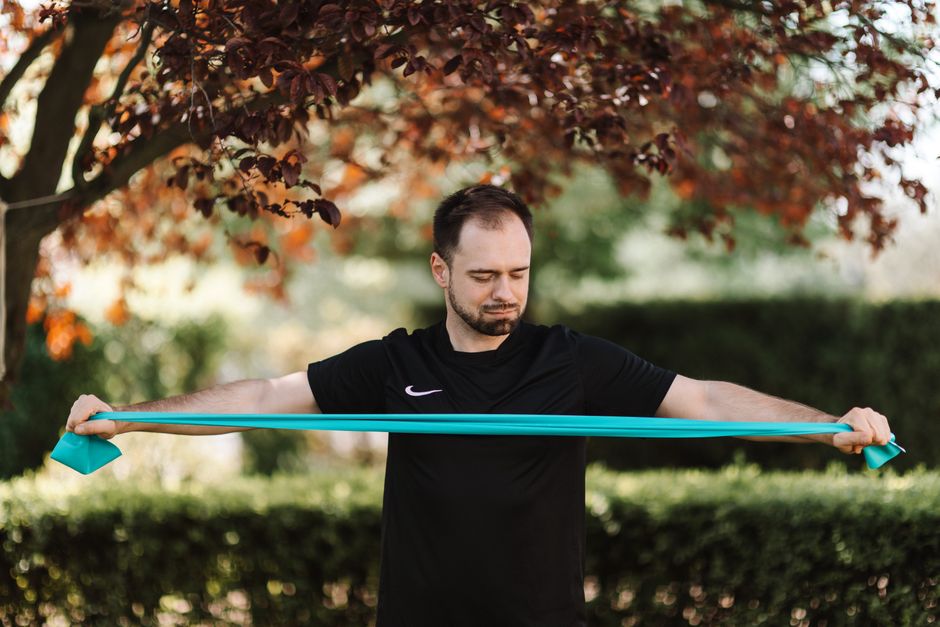
Floss bands are thick, elastic latex strips that you wrap tightly around a joint or limb, then move the joint through its range while the band stays on. The wrap is left in place for a short time — usually under two minutes — and then removed. The idea is to compress tissue briefly, move through range, then release. Most people use them as a warm-up tool or a way to prepare a stiff joint before training. They are not a treatment for injury, and they do not replace strength work or medical care.
What Are Floss Bands and How Do They Work?
Floss bands are wide rubber strips, typically two inches or so across, made of natural latex. They look like giant rubber bands. You wrap them around an arm, a leg, or across a joint in overlapping layers, pulling them tight as you go.
The proposed mechanism is compression. When you wrap tightly, blood flow into and out of that area is reduced. While the band is on, you move the joint through its available range. When you take the band off, blood rushes back in. That rush is what people describe as a warm, tingly feeling.
Some clinicians and coaches believe this brief compression-and-release cycle changes how the tissue feels and moves. The exact reason is not fully settled. One common explanation is that the compression alters nerve signaling and fluid movement around the joint, which may temporarily change how much range you can access.
Here is the honest part. The physiology of blood flow restriction is well documented. What is not well documented is that flossing a joint produces lasting mobility gains. Most of what people feel is temporary. That does not make it useless, but it does mean you should understand what you are getting.
Floss bands are different from resistance bands you train with. Training bands build strength over time. Floss bands are a short-duration compression tool. Mixing up the two is a common mistake.
How To Use Floss Bands For Better Joint Mobility
Start with a clean, dry area of skin. Latex grips better on dry skin, and lotion makes the band slide. If you have a latex allergy, do not use these at all — natural latex is the material.
The basic method:
- Wrap the band around the limb or joint with about 50 percent stretch. Overlapping each pass by half is standard.
- Keep the wrap snug but not painful. You should feel pressure, not numbness or a sharp pinch.
- Move the joint through its full range slowly, several times, while the band is on.
- Keep the band on for a short window — commonly under two minutes. Many users stay well under that.
- Remove the band slowly. Never leave it on and walk away.
The movement matters more than the wrap. The band creates the compression; your joint motion does the work. If you wrap tightly and then sit still, you have mostly just cut off circulation for no reason.
Skin color is your guide. If the area turns pale, gray, or blue, the wrap is too tight. Remove it. Some pink or red flushing after removal is normal and expected.
Which Joints Respond Best to Flossing?
People most often floss the joints that feel stiff before activity — knees, elbows, ankles, and shoulders. Wrists and hips get used too.
Knees and elbows tend to be the easiest to wrap because they are relatively cylindrical. Ankles are harder because of the bony points. Shoulders are the hardest, and many people skip them or use a different tool.
There is no strong evidence that one joint responds better than another. What people report is that a stiff joint feels looser right after. Whether that translates into better performance or less injury is a separate question, and the answer there is much less clear.
A practical note: floss bands work best on joints with a normal range that just feels tight. If a joint is genuinely restricted by injury, scar tissue, or a structural problem, a rubber band is not going to fix it. That is a job for a clinician.





Floss Bands vs Other Mobility Tools
Floss bands are one option among several. Knowing how they compare helps you decide where to spend your time.
| Tool | What it does | How long you use it |
|---|---|---|
| Floss band | Brief compression around a joint | Under 2 minutes per area |
| Foam roller | Broad pressure on muscle tissue | 1-2 minutes per area |
| Static stretching | Lengthens tissue over time | Seconds to minutes per stretch |
| Strength training | Builds capacity and control | Ongoing, weeks to months |
The comparison is not really fair, because these tools do different things. Flossing is a quick pre-activity option. Foam rolling is a broader self-massage. Stretching and strength work are the things that actually change your range over weeks and months.
If you only have time for one, strength training through full range is the choice with the most support behind it. Floss bands are a nice-to-have, not a foundation.
Are Floss Bands Safe? What Are the Risks?
Floss bands are generally tolerated when used briefly and correctly. The risks come from doing it wrong or too long.
Leaving a tight wrap on too long can cause numbness, tingling, and skin damage. In rare cases, prolonged compression can injure nerves or blood vessels. This is why the short time window matters. It is not a suggestion — it is the safety margin.
People who should not use floss bands without checking with a clinician first:
- Anyone with a latex allergy
- People with circulation problems or blood clotting disorders
- Anyone with a current injury, fracture, or recent surgery in that area
- People with nerve conditions like neuropathy
- Anyone who is pregnant — no guidelines exist for this group, so treat it as unknown
If you feel sharp pain, numbness that does not go away, or a cold limb, remove the band immediately. Do not push through it.
No large human trials have confirmed that floss bands improve long-term joint health. The evidence for short-term range changes is limited and mostly based on small studies and clinical observation. That is the honest state of things.
How Often Should You Use Floss Bands?
There is no established guideline for frequency. Most people use them a few times a week at most, often right before training. Some use them daily for a short period, then back off.
The lack of a standard is worth stating plainly. No clinical body has published a recommended schedule for floss band use in healthy adults. Anything you read that gives precise numbers is coming from individual practice, not from guidelines.
A reasonable approach, based on how the tool is commonly used, is to treat it as a warm-up aid rather than a daily habit. Use it when a joint feels stiff before activity. Skip it when it does not.
If you find yourself needing to floss the same joint every single day to feel normal, that is a signal to look at the bigger picture. It may point to a strength gap, a movement problem, or an underlying issue worth having assessed.
Frequently Asked Questions
How long should you leave floss bands on?
Keep them on for a short window, commonly under two minutes, while you move the joint. Remove them right after — never leave them on and walk away.
Do floss bands actually improve joint mobility?
They often feel like they loosen a joint right after use, but the evidence for lasting mobility gains is limited. No large human trials have confirmed long-term benefits.
Can you use floss bands every day?
There is no established guideline for how often to use them. Most people use them a few times a week as a warm-up, not daily as a routine.
Who should not use floss bands?
Anyone with a latex allergy, circulation problems, nerve conditions, or a current injury in that area should avoid them or check with a clinician first. No guidelines exist for use during pregnancy.
