
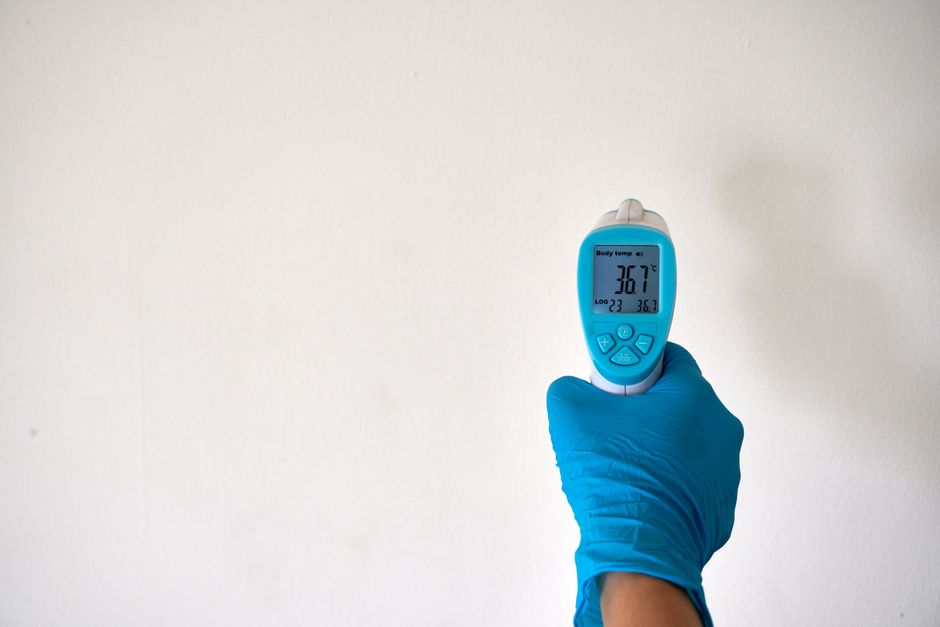
An infrared thermometer reads the surface temperature of food in about a second, making it a fast tool for checking a hot pan, grill grate, or oil before cooking. Point the device at the target from a few inches away, pull the trigger, and read the number. It does not measure internal food temperature, so you still need a probe thermometer to check if meat is fully cooked.
What Is an Infrared Thermometer and How Does It Work?
Every object gives off invisible infrared energy. The hotter the object, the more energy it releases. An infrared thermometer captures that energy with a lens and converts it into a temperature reading on a screen.
This is why it is sometimes called a laser thermometer. The laser is only a pointer. It shows you the spot you are measuring. The laser does not heat the food or take the reading.
These devices are common in kitchens because they are fast and do not touch the food. No probe to clean. No waiting for a reading. Just point and shoot.
How To Use An Infrared Thermometer For Cooking Correctly
Hold the thermometer about 2 to 5 inches from the surface you want to measure. Pull the trigger and hold it for one second. Read the number on the display.
Keep the device steady while measuring. If you move it during the reading, the number may change because you are aiming at a different spot.
Read the instruction manual for your specific model. Some units have a distance-to-spot ratio, often written as 8:1 or 12:1. This means at 8 inches away, the device measures a spot about 1 inch wide. At 16 inches, the spot is about 2 inches wide. The closer you are, the more precise the reading.
For most cooking tasks, a distance of 2 to 4 inches gives the most reliable surface temperature.
What an Infrared Thermometer Can and Cannot Measure
An infrared thermometer measures surface temperature only. It cannot see inside food. A thick steak may read 130°F on the outside while the center is still raw at 80°F.
Use it for these tasks:
- Checking a cast iron skillet before adding food
- Confirming grill grates are hot enough
- Testing oil temperature in a shallow pan
- Checking the temperature of a pizza stone or baking steel
- Verifying a sous vide water bath is at the set temperature
Do not use it for these tasks:
- Checking if chicken, beef, or pork is fully cooked inside
- Measuring the center of a casserole or loaf
- Confirming safe reheating of leftovers
For internal temperature, use an instant-read probe thermometer. This is not optional. Food safety depends on internal temperature, not surface temperature.





Common Mistakes When Using an Infrared Thermometer
One of the most common errors is measuring shiny metal surfaces. Polished stainless steel reflects infrared energy instead of emitting it. The thermometer reads the reflection, not the pan. The number may be far off from the real temperature.
To solve this, measure a dull or matte spot on the pan. Or place a small piece of dark tape on the metal and measure that. Dark, non-shiny surfaces give the most accurate readings.
Another mistake is measuring through glass. Glass blocks or distorts infrared energy. The reading will not reflect the food or liquid behind the glass.
Steam is also a problem. If you measure a pot of boiling water, the steam between the thermometer and the water can interfere with the reading. Aim at a spot away from rising steam when possible.
Finally, do not measure food straight out of the refrigerator and assume the reading is the internal temperature. The surface warms quickly when exposed to room air, even in a minute. The reading reflects the surface only, not the cold center.
How Accurate Are Infrared Thermometers for Cooking?
Most consumer infrared thermometers claim an accuracy of about ±2°F or ±1°C. This is for surface temperature under good conditions. In practice, several factors affect accuracy.
Distance matters. The farther you stand from the target, the larger the area the device measures. If you aim at a small pan from 3 feet away, the reading may include the countertop or the stove around the pan. That mix of temperatures produces an average that is not useful.
Emissivity matters too. Emissivity is a measure of how well a surface emits infrared energy. A perfect emitter has an emissivity of 1.0. Most food surfaces are close to 0.95, which is fine. Shiny metal is much lower, often around 0.1 to 0.3. This is why shiny pans read incorrectly.
Some thermometers allow you to adjust the emissivity setting. If yours has this feature, set it to about 0.95 for food. For matte cookware, a setting around 0.90 to 0.95 works well.
Using an Infrared Thermometer for Oil and Frying
Deep frying requires oil at a specific temperature, usually between 325°F and 375°F depending on what you are cooking. An infrared thermometer can check the surface temperature of the oil, but it cannot measure the temperature deeper in the pot.
For shallow frying in a pan, the infrared thermometer works well. Point it at the oil in the center of the pan. Wait a few seconds after adjusting the stove heat so the oil stabilizes.
For deep frying, a clip-on probe thermometer that sits in the oil is more reliable. The oil temperature varies from top to bottom, and the infrared device only sees the top layer.
If you use an infrared thermometer for oil, be aware that the surface may be cooler than the oil below it. This is especially true right after adding cold food to the pot. The surface cools first, then the heat recovers.
Infrared Thermometer vs. Probe Thermometer
| Feature | Infrared Thermometer | Probe Thermometer |
|---|---|---|
| Measures | Surface temperature only | Internal temperature |
| Response time | About 1 second | 5 to 15 seconds |
| Contact with food | None | Yes, probe inserted |
| Best for | Pans, grills, oil surfaces | Meat, poultry, casseroles |
| Food safety check | No | Yes |
Both tools belong in a kitchen. They answer different questions. The infrared thermometer tells you when the cooking surface is ready. The probe thermometer tells you when the food is safe to eat.
Is an Infrared Thermometer Worth Buying for Home Cooking?
If you cook on a grill, use cast iron, or fry food regularly, an infrared thermometer is a useful addition. It removes guesswork from preheating. You will know exactly when the pan hits the right temperature instead of guessing by flicking water or holding your hand above the surface.
If you mostly bake, roast, or cook in a single pot, you may not need one. A probe thermometer covers most of your needs.
Prices for reliable consumer models range from about $20 to $50. Inexpensive units can be accurate, but read reviews and check if the emissivity is fixed or adjustable. A fixed-emissivity unit set to 0.95 is fine for food surfaces.
Frequently Asked Questions
Can I use an infrared thermometer to check if meat is cooked?
No. An infrared thermometer only reads the surface temperature of meat, not the center. You need an instant-read probe thermometer inserted into the thickest part of the meat to confirm it is fully cooked.
Why does my infrared thermometer give different readings on different pans?
Shiny metal surfaces reflect infrared energy instead of emitting it, which causes inaccurate readings. Measure a dull or matte spot on the pan, or place dark tape on the surface and measure that for a more reliable number.
How close should I hold an infrared thermometer to food?
Hold it 2 to 5 inches from the surface for the most accurate reading. Check your device’s distance-to-spot ratio in the manual, because moving farther away makes the device measure a larger area that may include surfaces you do not want to measure.
Can an infrared thermometer measure oil temperature for frying?
It can measure the surface temperature of oil in a shallow pan, which works for pan frying. For deep frying, use a probe thermometer clipped to the pot because the infrared device cannot read the oil temperature below the surface.
