
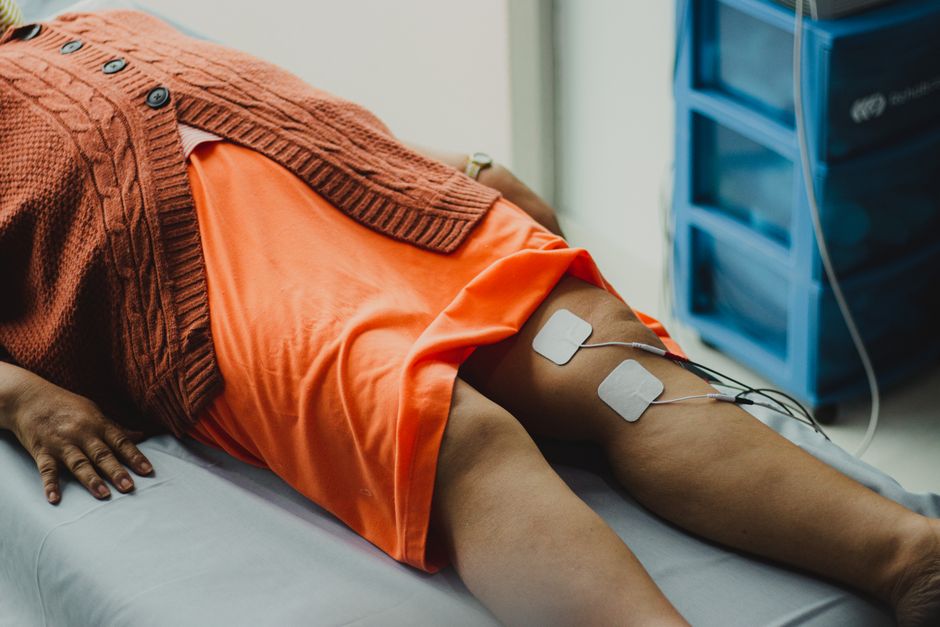
A TENS unit sends small electrical pulses through your skin to help manage pain. You place two or more electrode pads around the painful area, turn the unit on, and slowly raise the intensity until you feel a comfortable tingling without muscle twitching. A typical session lasts 15 to 30 minutes, and you can repeat it several times a day. TENS works best as one part of a broader pain plan, not as a replacement for treating the cause of your pain.
What Is A TENS Unit And How Does It Work?
TENS stands for transdermal electrical nerve stimulation. A small battery-powered device delivers low-voltage electrical current through adhesive pads placed on your skin. The current travels along nerve fibers near the surface.
The leading theory is called the gate control theory, proposed by Ronald Melzack and Patrick Wall in 1965. The idea is that stimulating large sensory nerve fibers with tingling electrical pulses can reduce the transmission of pain signals through the spinal cord. It is a real physiological mechanism, but it does not fully explain why some people get relief and others do not.
Some research also suggests TENS may help trigger the release of the body’s own pain-relieving chemicals, though this is less firmly established. What is clear is that TENS does not treat the underlying cause of pain. It changes how pain is perceived, not what is causing it.
A prescription is not required in the US. TENS units are sold over the counter, and many physical therapists use them in clinical settings.
How To Use A TENS Unit For Pain Relief: Step By Step
The basic method is straightforward, but small details affect whether it works and whether it is safe.
- Clean and dry the skin where you will place the pads. Do not use lotion or oil first.
- Place two pads on either side of the painful area, or at both ends of it. Keep them at least an inch apart and never let them touch.
- Attach the lead wires to the pads before turning the unit on. Set intensity to zero first.
- Turn the unit on and raise the intensity slowly. Stop when you feel a clear tingling. It should feel comfortable, not painful.
- Run the session for 15 to 30 minutes. This is the range most clinical protocols use.
- Turn the unit off before removing the pads. Then remove the pads gently and reapply the protective backing.
Many units offer different modes. A common approach is a continuous tingling setting for general pain and a burst or modulated setting that cycles on and off. There is no strong evidence that one mode is clearly better than another for all people. Some users find that a setting that varies the pulse helps prevent the nervous system from adapting to the signal.
If you feel nothing at first, increase intensity in small steps. If you feel muscle twitching, the intensity is too high or the pads are over a motor nerve. Turn it down.
Where Should You Place The Electrodes?
Placement matters more than most people expect. The general rule is to surround the painful area with pads.
For low back pain, pads typically go on either side of the spine at the level of pain, or at the upper and lower edges of the painful zone. For knee pain, pads go on the inner and outer sides of the knee, or above and below it. For neck pain, pads go on either side of the neck muscles. For shoulder pain, place them around the front and back of the shoulder joint.
For nerve pain that travels down a limb, some clinicians place pads along the path of the nerve rather than directly on the most painful spot. This is a clinical technique, not a universal rule, and it is worth asking a physical therapist about if you have radiating pain.
Never place pads on the front of the neck, over the eyes, across the chest in a way that crosses the heart, or on the head. These areas carry real risk and are not appropriate for home use.
How Strong Should The Current Be?
The right intensity is the one that produces a clear, comfortable tingling without muscle contraction. That is the standard guidance across clinical use.
More is not better. Turning the intensity up to the point of discomfort does not improve results and raises the risk of skin irritation. Some clinicians suggest adjusting the intensity slightly during a session as your nerves adapt, which many people notice after several minutes.
If you feel a sharp or burning sensation, turn the unit down or off. That is not a normal response.
What Does The Evidence Actually Show?
The evidence for TENS is mixed, and it depends heavily on the condition. This is where honest information matters more than marketing.
For chronic musculoskeletal pain such as low back pain, some studies suggest modest benefit, but results vary and many trials are small or poorly designed. A common problem in TENS research is that the placebo is hard to fake. People can usually tell whether a unit is delivering current, which makes blinding difficult and weakens study quality.
For osteoarthritis of the knee, evidence indicates TENS may provide some short-term pain relief, but the effect is generally small and not consistently confirmed across trials.
For nerve-related pain such as diabetic neuropathy, evidence is limited and results are inconsistent. Some people report meaningful relief; others get none.
For acute pain after surgery or injury, evidence is mixed. Some trials show reduced pain and less need for pain medication; others show no difference.
The honest summary: TENS is generally low-risk, some people get real relief, and the evidence does not support it as a strong standalone treatment for most pain conditions. It is widely used in physical therapy and pain management, but widespread use is not the same as proven effectiveness.
Who Should Not Use A TENS Unit?
TENS is not appropriate for everyone. The following situations carry real risk and are standard contraindications in clinical practice.
- Pregnancy. Do not use TENS on the abdomen or lower back during pregnancy without medical clearance. No clinical guidelines establish safety for this use.
- Pacemakers or implanted electronic devices. Electrical current can interfere with device function. Do not use TENS without explicit approval from your cardiologist or device specialist.
- Over the heart or across the chest. Current passing through the chest can affect heart rhythm.
- On the front of the neck or over the carotid arteries. This can affect blood pressure and heart rate.
- On the head, over the eyes, or in the mouth.
- Over broken, irritated, or infected skin.
- If you have epilepsy or a history of seizures, talk to your doctor before using TENS.
- In children. No clinical guidelines establish safe use in children, and it should only be done under medical supervision.
If you have a diagnosis that affects sensation, such as advanced diabetes with neuropathy, you may not feel the current properly. That raises the risk of skin burns. Ask a clinician before using TENS in that situation.
Common Mistakes And Practical Tips
Most problems with TENS come from small errors rather than the device itself.
Reusing pads until they lose stickiness is a frequent issue. Worn pads do not conduct well, which leads people to crank up the intensity and irritate their skin. Replace pads when they stop adhering firmly.
Placing pads too close together concentrates current and can cause a burning sensation. Keep at least an inch between them.
Using TENS as the only strategy for a problem that needs assessment is a bigger mistake. New, severe, or unexplained pain should be evaluated by a clinician. TENS can mask symptoms without addressing what is causing them.
Some people find TENS works better when combined with movement, stretching, or physical therapy rather than used while sitting still. That fits with what clinicians often observe, though it has not been firmly established in trials.
Keep sessions reasonable. There is no evidence that hours of continuous use helps more than shorter sessions, and prolonged use raises the risk of skin irritation under the pads.
How Long Until You Know If It Works?
Most people notice within the first session whether TENS does anything for them. If you feel no change after a few consistent trials over a week or two, it is unlikely to become effective with more time.
TENS is not a treatment that builds up over weeks the way some therapies do. Its effect, when it occurs, is usually felt during or shortly after a session. That makes it easy to test honestly: try it properly for a short period and judge by your own response rather than by claims on the box.
If it helps, it can be a useful low-risk tool in your pain management plan. If it does not, there is no reason to keep using it.
Frequently Asked Questions
How often can I use a TENS unit?
Most clinical protocols use sessions of 15 to 30 minutes, repeated several times a day as needed. Follow the instructions that come with your specific device, since settings vary between models.
Can a TENS unit burn your skin?
Yes, burns and skin irritation can occur, especially with worn pads, high intensity, or reduced skin sensation. Keep the intensity comfortable and replace pads when they stop sticking firmly.
Is TENS safe if I have a pacemaker?
No, do not use TENS if you have a pacemaker or implanted electronic device without explicit approval from your cardiologist. Electrical current can interfere with how the device works.
Does TENS actually work for back pain?
Some studies suggest modest benefit for chronic low back pain, but the evidence is mixed and many trials are small. It is reasonable to try it, but it is not a proven standalone treatment.
