
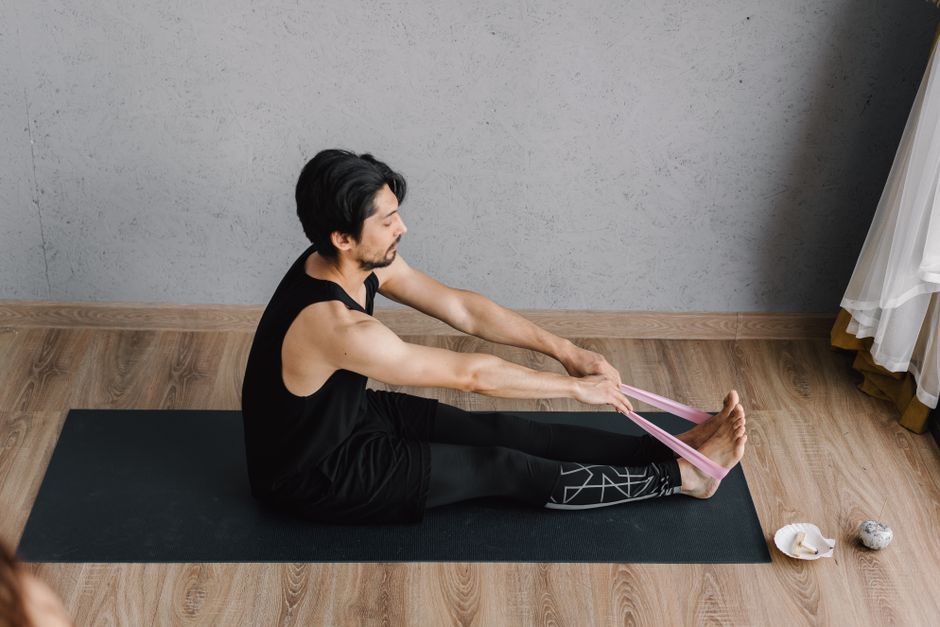
A stretch band can work every major muscle group in about 20 minutes, and you don’t need a gym or heavy weights to do it. The key is choosing the right resistance level, anchoring the band securely, and moving through controlled repetitions that keep constant tension on the muscle. You can target your legs, back, chest, arms, and core in a single session by simply changing your stance, grip, or anchor point.
How To Use A Stretch Band For A Full Body Workout?
Start with a warm-up of five minutes of light cardio, like marching in place or jumping jacks. Then move through a circuit of exercises that hit each major muscle group once. Perform 10 to 15 repetitions of each movement, rest for 30 seconds between exercises, and repeat the whole circuit two or three times.
Choose a band resistance that makes the last two repetitions of each set feel challenging but not impossible. If you can complete all repetitions without strain, the band is too light. If your form breaks down before the tenth repetition, the band is too heavy.
Stand on the middle of the band with both feet shoulder-width apart. Hold the handles at your sides for a squat, or step on one end and hold the other for a single-arm row. For pressing movements, anchor the band behind your back or around a sturdy post at chest height.
What Muscles Can You Work With A Stretch Band?
Stretch bands provide resistance in both the shortening and lengthening phases of a movement. This means your muscles work harder on the way back to the starting position compared to free weights, where gravity does much of the work during the return phase.
You can train every major muscle group with a single band:
- Legs: Squats, lunges, and leg presses with the band under your foot
- Back: Seated rows, lat pulldowns, and straight-arm pull-downs
- Chest: Chest presses, chest flys, and push-ups with the band across your back
- Shoulders: Overhead presses, lateral raises, and front raises
- Arms: Bicep curls, tricep extensions, and hammer curls
- Core: Pallof presses, woodchoppers, and standing oblique crunches
Research indicates that resistance bands can build muscle strength comparable to conventional weight training when the resistance is sufficient and the exercises are performed consistently. A study published in the Journal of Strength and Conditioning Research found that both resistance band training and traditional weight training produced similar strength gains in trained men over an eight-week period.
How Do You Anchor A Stretch Band Safely?
Anchoring is where most band injuries happen. A band that slips or snaps can hit you in the face or cause you to fall. Always inspect your band for tears, fraying, or weak spots before each use.
When anchoring around a door, close the door on the band and place the anchor at the height you need. Use the door anchor attachment that comes with most band sets rather than just closing the door on the band itself. The door must be solid, not hollow or flimsy, and you should stand on the same side of the door as the band.
For lower body exercises, stepping on the band is the most secure anchor. Make sure the band is flat on the floor and positioned in the center of your foot, not on the edge. Wear athletic shoes to protect your feet and prevent the band from slipping.
When anchoring to a pole or post, wrap the band around the anchor point and pass one end through the loop of the other end. This creates a secure knot that will not slip during exercise. Never anchor to furniture that could tip over or roll.




What Is The Correct Form For Band Exercises?
Form matters more with bands than with weights because the resistance increases as the band stretches. This means the hardest part of the movement is at the end of the range of motion, where your muscles are fully contracted and most vulnerable to injury if your form breaks down.
Keep your core braced throughout every exercise. This protects your lower back and transfers force from your lower body to your upper body. Imagine someone is about to poke you in the stomach and you are bracing for it.
Move slowly and control the band on both the push and the return. Do not let the band snap back quickly. A controlled tempo of two seconds out and three seconds back keeps tension on the muscle and reduces the risk of injury.
Breathe naturally. Exhale on the effort phase, inhale on the return. Holding your breath during resistance training can cause a dangerous spike in blood pressure.
How Many Repetitions And Sets Should You Do?
For general fitness and muscle endurance, perform two to three sets of 12 to 15 repetitions per exercise. For muscle growth, research suggests that three to five sets of 8 to 12 repetitions with a heavier band produces better results.
The band should be stretched enough that the last two to three repetitions are difficult. If you are not feeling fatigue by the final repetitions, increase the resistance by using a thicker band or shortening the starting length of the band by holding it closer to the anchor point.
Rest 60 to 90 seconds between sets. This is enough time for your muscles to recover partially without losing the training stimulus. For a full body workout, aim for a total session of 20 to 40 minutes depending on how many exercises you include.
Train two to three times per week with at least one rest day between sessions. Your muscles need time to repair and grow stronger. Training the same muscles every day with bands does not produce faster results and increases your risk of overuse injury.
How Do You Choose The Right Band Resistance?
Bands come in color-coded resistance levels, but the colors are not standardized across brands. A light band from one company may feel like a medium band from another. The only reliable way to choose is to test the band yourself.
When testing a band, perform the exercise you plan to do. The band should provide noticeable resistance throughout the entire range of motion but still allow you to complete the movement with good form. If the band is too loose at the start of the movement, it will not provide enough resistance at the end either.
Most band sets include three to five resistance levels. A common approach is to use a lighter band for upper body exercises and a heavier band for lower body exercises, since your legs are stronger than your arms. You can also combine two bands together for extra resistance on exercises like squats or chest presses.
If you are a beginner, start with a light or medium band and focus on learning the movements with correct form. You can always progress to a heavier band as you get stronger.
Can You Build Muscle With Just A Stretch Band?
Yes, but with some limitations. Research consistently shows that resistance bands can build muscle and increase strength in both beginners and trained individuals. The key factor is progressive overload, meaning you must continually increase the resistance or volume over time to keep making gains.
Bands have a maximum resistance limit. Once you can perform 15 or more repetitions of an exercise with the heaviest band in your set, you will need to find a thicker band or add a different training method to continue building muscle. This is the main limitation compared to free weights, which have no practical upper limit.
Bands also provide the most resistance at the end of the movement, where the band is most stretched. This means the beginning of the movement has less resistance, which can be a disadvantage for exercises where you are weakest at the start, like a bicep curl from a fully extended arm.
For most people, bands are an excellent tool for maintaining muscle, improving endurance, and building a foundation of strength. For advanced lifters seeking maximum muscle growth, bands work best as a supplement to free weights rather than a complete replacement.
Common Mistakes To Avoid With Stretch Bands
The most common mistake is using a band that is too light. Many people grab a light band because it feels easy and comfortable, but this provides minimal training stimulus. You should feel significant resistance on every repetition.
Another frequent error is letting the band go slack between repetitions. The band should remain under tension throughout the entire set. If the band goes slack, the muscle relaxes and you lose the training effect.
Do not wrap the band around your hands multiple times if it is too long. This creates a pinching hazard and can cut off circulation. Instead, shorten the band by holding it closer to the anchor point or choose a shorter band.
Inspect your band regularly for damage. Replace any band that shows cracks, tears, or significant stretching. A damaged band can snap during exercise and cause serious injury. Most bands last six months to a year with regular use, but this varies based on quality and frequency of use.
Frequently Asked Questions
How often should you do a stretch band full body workout?
Train two to three times per week with at least one rest day between sessions. This gives your muscles time to recover and grow stronger.
Are stretch bands as effective as weights for building muscle?
Research indicates that resistance bands can build strength comparable to free weights when the resistance is adequate and you progress over time. The main limitation is that bands have a maximum resistance, so advanced lifters may need weights for continued gains.
How long does a full body stretch band workout take?
A complete full body session takes 20 to 40 minutes depending on how many exercises you include and how many sets you perform. A circuit format with minimal rest between exercises is the most time-efficient approach.
Can you do a stretch band workout every day?
Training the same muscles every day does not produce faster results and increases your risk of overuse injury. Your muscles need at least 48 hours to recover between resistance training sessions.
